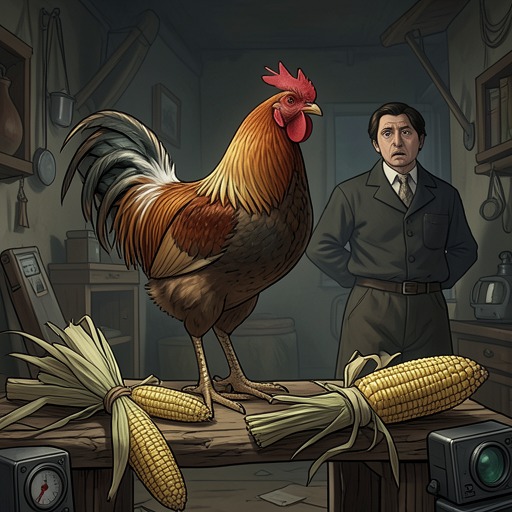
“I am not corn”
Guantanamo Diary“I am not corn” is the narrator’s compact metaphor for the struggle to make the United States government recognize him as he understands himself. Drawn from a Mauritanian folktale about a man who fears a rooster, the expression turns an absurd misunderstanding into a measure of the distance between an individual’s account and an authority’s suspicion.
The Folktale and Its Logic
The story begins with a rooster-phobic man who asks a psychiatrist for help. When the psychiatrist asks why he fears the rooster, the man explains, “The rooster thinks I’m corn.” The obstacle is not simply his fear: he knows the rooster’s belief is mistaken, but thinks it must be corrected before he can be safe. He therefore tells the psychiatrist, “Your job is to go to him and convince him that I am not corn.” The story ends with the recognition that the task cannot be completed, because talking with a rooster is impossible.
The joke depends on a mismatch between the proposed remedy and the nature of the problem. The man’s appeal is internally logical, but it assigns the work of persuasion to someone who cannot reach the supposed audience. That impossible conversation gives the tale its force: a person can understand that an accusation rests on a mistake and still be unable to make the mistaken party understand.
A Refrain Directed at Government
The narrator explicitly applies the folktale to his own circumstances: “For years I’ve been trying to convince the U.S. government that I am not corn.” The line transforms the punchline into a governing image for his account. Rather than presenting the misunderstanding as a brief confusion, it emphasizes its persistence: the effort to be recognized continues for years, while the power to accept or reject his explanation lies elsewhere.
The metaphor does not claim that the government literally mistakes him for corn. It conveys the narrator’s sense that his own insistence cannot, by itself, dislodge an institutional view of him. The folktale’s psychiatrist cannot make the rooster listen; the narrator’s repeated effort likewise exposes the limits of persuasion when the other party is represented as unwilling or unable to revise its belief.
Repetition in the Jail
The expression returns in the account of the narrator’s detention, where he says his concern remains convincing the U.S. government that he is not a corn. The recurrence places the folktale’s image beside the immediate circumstances of confinement, making it more than an opening joke: it becomes a refrain that links the narrator’s extended struggle to a specific period in custody.
That passage also contrasts his preoccupation with the concern of his fellow detainee, a young man from Ivory Coast who wanted to leave Africa for Europe or America. The two men share a jail but not an objective. The companion speaks of migration and recounts failed attempts to reach destinations abroad; the narrator returns to the effort to correct the government’s view of him. The contrast makes the refrain more precise: his immediate problem, as he describes it, is not simply movement or escape, but being understood by an authority whose judgment shapes his situation.