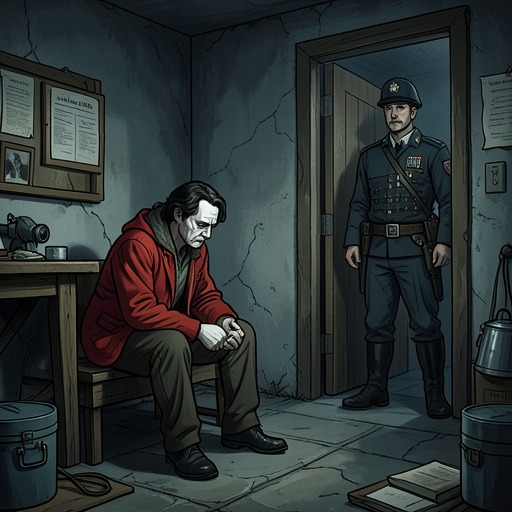
24-hour interrogation shift regime
Guantanamo DiaryThe 24-hour interrogation shift regime organized questioning of Mohamedou Ould Slahi into successive teams so that interrogations could continue throughout the day and night. It was not simply a staffing arrangement: in Slahi’s account, the schedule left little opportunity for sleep or recovery, and basic comforts were presented as conditional on cooperation. The diary’s description of the routine is supported in significant respects by government investigations and interrogation records, while redactions and the classification of underlying files limit what can be independently established about every detail.
Organization and Schedule
When a new member joined the interrogation team, the interrogators organized a 24-hour schedule. A morning shift began between 7 and 9 a.m. and ended between 3 and 4 p.m.; a dayshift ran from 4:30 p.m. until 10 or 11 p.m.; and a night shift took over after that. The handover was literal: one interrogator would pass Slahi to the next. According to the diary, this three-shift arrangement continued until August 24, 2003, with little relief from any of the shifts.
The schedule expanded rather than eased when an interrogator pointed out that additional personnel were available. The team added another person, creating four shifts across the 24-hour period. The change meant more interrogators rotated through Slahi’s questioning, not that he received a longer interval in which to rest. His account describes the period as continuing day after day, with few days off; elsewhere he says that, for the next seventy days, he rarely slept quietly and was questioned through three, and sometimes four, shifts. The shift system thus turned continuity of interrogation into an operating routine.
Conditions and Effects
The schedule functioned alongside a broader system of restriction. Slahi describes being held in a block where he was separated from other detainees and deprived of books, the Quran, soap, toothpaste, toilet paper, and most of his other comfort items. His cell was kept cold, and recreation was sometimes scheduled at night so that he would not see daylight or interact with other detainees. The account presents these conditions not as incidental surroundings but as circumstances that narrowed the opportunities for ordinary rest and contact while the questioning continued.
Sleep was made conditional on cooperation. Slahi recalls being told that cooperation would bring sleep and hot meals. The account also describes interrogation as continuing across shifts with little regard for whether he had just fallen asleep. On one occasion, after a difficult twenty-hour interrogation, an escort team arrived early in the morning as he had only just dozed off. He was ordered to leave for another reserved interrogation. This sequence makes the mechanism of the schedule concrete: a moment of sleep did not mark the end of a session or guarantee a period of rest.
The effects recorded in the diary include headaches, nausea, heartburn, and difficulty keeping his eyes steady after several days without adequate sleep. Slahi also describes waiting in an empty room, repeatedly dozing while an interrogator arrived late. He says that this interrogator sometimes confused him with other suspects because he had not read the reports, yet reserved him early, preventing him from sleeping while he waited. Repeated encounters returned to the same subjects, giving the routine the quality of an interrogation that began again without meaningful progress. The account also records restrictions on showering and changing clothes: opportunities came only after the lack of access had persisted for months. These details show how the schedule intersected with control over ordinary bodily needs, without making every deprivation identical to the act of questioning itself.
Repetition and Control
The rotation of personnel gave the regime a structure of repeated handovers rather than a single continuous conversation. Each shift could resume questioning, while the detainee’s need for rest did not determine the schedule. In Slahi’s description, the routine became predictable in its repetition but uncertain in its relief: familiar topics returned, interrogators changed, and even waiting for a late arrival could prevent sleep. The contrast between a formal shift timetable and the absence of dependable recovery is central to how the system operated in his account.
This pattern also links time management to material conditions. The deprivation of books and other comforts, limited daylight, separation from other detainees, and sporadic access to showers shaped the setting in which the shifts took place. The regime was therefore more than a clock-based roster. Its practical effect depended on the way questioning was combined with control of rest, movement, contact, and daily necessities. Slahi’s account does not describe the schedule as an isolated administrative choice, but as one element in the conditions of his confinement and interrogation.
Documentary Record and Limits
The diary’s account was later considered alongside records obtained by investigators. When Stuart Couch was assigned Slahi’s case in 2003, reports attributed to Slahi were being presented as a major interrogation success, but they did not explain how the information had been obtained. Couch had been told that Slahi was on special projects and had seen a separate prisoner shackled in an interrogation booth under intense conditions. An investigator working with Couch gained access to military interrogation files, including daily memoranda that recorded both what was said and how information was extracted.
Those files remain classified, but the U.S. Senate Armed Services Committee’s 2008 inquiry and the U.S. Department of Justice’s 2008 review summarized aspects of the interrogation and its planning. The investigations described a special interrogation conducted under a second plan approved by Donald Rumsfeld and reported that it unfolded in substantial agreement with Slahi’s account. The Senate inquiry also documented a staged transfer and an isolation hut at Camp Echo designed to reduce outside stimuli. That evidence concerns the broader special-interrogation plan and should not be confused with proof of every detail of the shift schedule; it does, however, place the diary’s description of sustained questioning within a documented system of planned isolation and interrogation.
The editorial notes accompanying the manuscript explain the method and limits of this kind of corroboration. They draw on public records, declassified government documents, investigative reporting, and government inquiries to assess what redactions may plausibly conceal, but explicitly do not claim to reconstruct the original censored text or disclose classified material. The regime’s significance therefore rests on two connected records: Slahi’s detailed account of how shifts structured his days and nights, and later investigations that corroborate important features of the special interrogation while leaving some underlying evidence inaccessible.