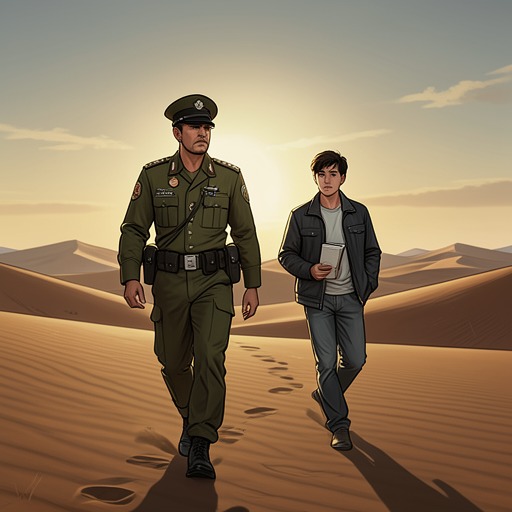
Afghan war against communism
Guantanamo DiaryThe Afghan war against communism is a crucial point of reference in Mohamedou Ould Slahi’s account of his past: he recalls traveling to Afghanistan in 1991 and 1992, and says that his involvement ended with the fall of the communist government. Years later, those journeys became a recurring subject of interrogation, as authorities treated his history in Afghanistan as relevant to allegations about terrorism despite his account that he had returned to ordinary life afterward.
Journeys and Training
Slahi describes two trips to Afghanistan, in January 1991 and February 1992, during the war against communism. He identifies his participation as jihad and says he trained at Al Farouq in 1991. He also recalls making the February 1992 journey with a Mauritanian friend to help people fighting against communism. In his account, these were journeys undertaken during the conflict, not evidence of later criminal activity.
The narrative also places the trips within a wider network of people who had been in Afghanistan. An interrogator who later questioned Slahi had himself attended training camps there as an undercover agent during the war: while Slahi was at Al Farouq in 1991, the interrogator was working undercover as a student in Khalden. That overlap makes Afghanistan more than a distant setting in the memoir; it becomes a shared history that the authorities revisit through questioning and photographs.
The End of Slahi’s Participation
In recounting his history, Slahi distinguishes the period of the war from what followed. He says that when the war was over, he resumed his regular life and had broken no Mauritanian or German laws. In later habeas proceedings, the government argued that his contacts with people who remained active in al-Qaeda showed that he too remained part of the organization. Judge James Robertson’s account of the case noted that Slahi had joined al-Qaeda in 1991 and sworn a loyalty oath, but that he maintained his participation ended with the fall of the communist government in Afghanistan.
That distinction is central to the book’s treatment of the period: a past journey and an earlier affiliation are not, by themselves, proof of continuing involvement. The court record described Slahi’s later contacts as sporadic and considered whether they showed continuing membership, while his own account placed a boundary at the end of the Afghan conflict.
A Past Recast as Suspicion
After returning to Mauritania in January 2000, Slahi was detained and questioned by FBI agents in connection with the Millennium Plot. He was released on February 19 after authorities concluded there was no basis to believe he had been involved. When he was detained again in September 2001, FBI agents again questioned him about the plot, and Mauritanian authorities publicly affirmed his innocence upon his release. In the later interrogations recounted in the book, his Afghanistan journeys remained a point of scrutiny even as he denied involvement in criminal activity.
Slahi describes the different meanings authorities attached to those journeys. He says the Mauritanian interrogator understood a trip to Afghanistan, while he believed the U.S. government could treat even a visit to Afghanistan as grounds for prolonged suspicion. He told interrogators that he had traveled legally and that, after the war, he returned to his regular life. The resulting conflict is not only over what happened during the trips, but over whether a past association could be made to stand for an ongoing threat.
From Wartime Travel to Detention
On November 28, 2001, a CIA rendition plane transported Slahi from Mauritania to a prison in Amman, Jordan, where Jordanian intelligence services interrogated him for seven and a half months. The book’s timeline records this transfer after his earlier questioning about the Millennium Plot; it does not establish that his journeys during the Afghan war alone caused the rendition. The distinction matters because the memoir traces how a history he regarded as finished was repeatedly brought forward in interrogations and detention.
The Afghan war against communism therefore functions in the narrative as both a bounded historical period and a contested explanation of Slahi’s later life. His account places his participation in the early 1990s and describes it as over with the fall of the communist government. The subsequent interrogations and legal proceedings expose the consequences of treating that past as continuing evidence, even when the question of what it proved remained disputed.