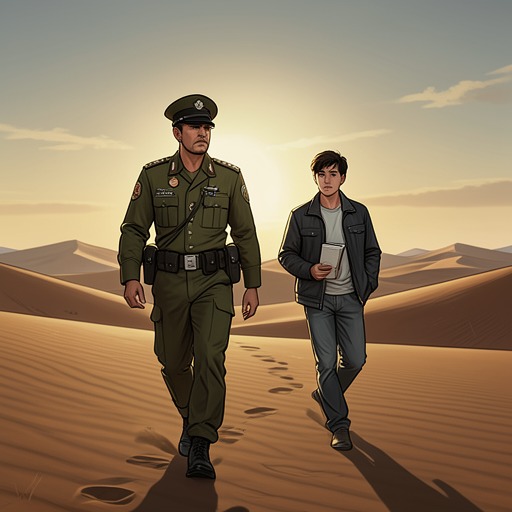
Alpha Ruk Training Camp
Guantanamo DiaryAl-Farouq training camp was a training site near Khost, Afghanistan, where Mohamedou Ould Slahi went in 1991 while studying electrical engineering in Germany. The camp stands at an early point in his account of Afghanistan: he trained there during the insurgency against the communist-led government, before returning to his studies and later going back to the country as political conditions changed.
Setting and Purpose
In the book’s account, joining the fight against the communist-led government required military training, and young men traveled openly to take part in the insurgency. The cause was actively supported by Western countries, including the United States. Al-Farouq was operated by al-Qaeda; a historical note also identifies it, alongside Khalden, as a camp training al-Qaeda fighters in the conflict against the Soviet-backed government in Kabul.
Slahi’s Training
The memoir describes Slahi interrupting his studies in Germany to attend Al-Farouq for seven weeks in early 1991. He swore a loyalty oath to al-Qaeda and received light-arms and mortar training. The account specifies that most of the guns were Soviet-made, while Slahi recalled that the mortar shells had been made in the United States. These details place the training within a conflict whose participants and equipment crossed the political lines that later shaped the accusations against him.
Conflicting Accounts of Duration
The book’s accompanying historical note reports a different duration from the narrative: court documents indicate that Slahi trained at Al-Farouq for six months in late 1990 and early 1991, rather than seven weeks in early 1991. The two accounts agree on the camp’s location and his participation but diverge on its length. Preserving that distinction is important because the training is both a documented part of his history and one element later considered in disputes over what his earlier association with al-Qaeda meant.
Place in the Larger Narrative
After training, Slahi returned to his studies. In early 1992, as Afghanistan’s communist government neared collapse, he went back and joined a unit commanded by Jalaluddin Haqqani during the siege of Gardez. He later explained that he left when the fighting shifted to conflict among Muslim factions, saying that he had not wanted to fight other Muslims. Al-Farouq therefore marks a specific beginning to his military involvement, not a complete account of its duration or its later significance: the narrative distinguishes the training and oath from his subsequent decision to leave the fighting.