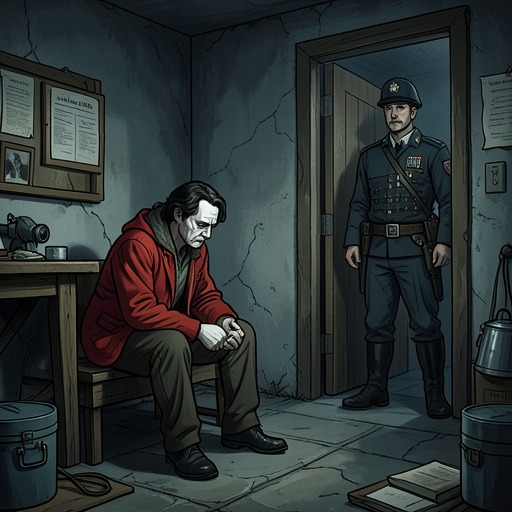
Deterioration of physical and mental health in detention
Guantanamo DiaryDeterioration of physical and mental health in detention is a persistent condition in Mohamedou Ould Slahi’s account, not a single crisis with a clear endpoint. Across secret transfers, isolation cells, round-the-clock questioning, and delayed medical attention, bodily weakness and psychological distress develop alongside the restrictions that make them difficult to see, describe, or treat. The account records both individual symptoms and the institutional conditions surrounding them, while showing how secrecy and fear obstructed outside scrutiny.
A body moved through hidden spaces
The deterioration has to be read against the geography of Mohamedou Ould Slahi’s detention. In the eighteen months beginning with his January 2000 flight from Canada, he was taken through four countries and covered what the narrative describes as twenty thousand miles. He was questioned in Senegal and Mauritania, secretly transferred to Jordan, later taken to Bagram Air Base, and then delivered to Guantánamo Bay detention camp. The journey repeatedly changed the conditions under which he could sleep, move, communicate, and obtain help; it was not a passage through ordinary medical or legal oversight.
In Jordan, the recurring movement between his cell and a cellar was organized around visits by the International Committee of the Red Cross. Every fourteen days, guards moved him to the cellar for a couple of days, then returned him to his cell. He eventually learned that the procedure was intended to hide him from the visitors, and that he had been kept in this cat-and-mouse arrangement throughout his eight-month stay. The significance for his health is also a question of access: the very institution that might have provided an external witness was prevented from seeing him during this period.
The isolation later imposed at Guantánamo made the cell itself part of the assault on physical and mental well-being. In a block reserved for him, Mohamedou Ould Slahi was left with a thin sleeping mat and a worn, inadequate blanket; his books, Quran, soap, toothpaste, and toilet paper were taken away. The cell was kept so cold that he says he shook much of the time. He was denied daylight and given recreation at night to prevent contact with other detainees. These were not incidental discomforts: they narrowed his access to ordinary bodily care, light, reading, and companionship at once.
Physical weakness and inadequate care
During the period of extreme interrogation, the conditions included questioning for twenty-four hours a day, divided among three or sometimes four shifts. Mohamedou Ould Slahi says he rarely had a day off and cannot remember sleeping peacefully through a night. He was repeatedly told that cooperation would bring sleep and hot meals, making basic bodily needs part of the pressure to comply. The routine joined exhaustion to deprivation: food and rest were presented not as ordinary necessities but as benefits conditional on interrogation cooperation.
Later, his health was better than it had been in Jordan, but he remained underweight, vulnerable, and frequently sick; as time passed, he said his condition worsened. Although the camp diet gradually improved, he could not benefit from it. Being led past a wall mirror sometimes frightened him because of how pitiful he looked. The mirror gave him an abrupt view of physical decline, while the improving menu offered no simple remedy for a body already weakened by confinement and distress.
A change came when an interrogator witnessed one of his meals and objected to the food. The interrogator arranged an adequate diet in a relatively short time, and Mohamedou Ould Slahi says the improvement decisively helped his health. This episode sits uneasily beside the larger conditions: a practical improvement was possible, but it depended on an individual noticing the problem and taking action. It did not erase his underweight condition or the worsening he had already described.
Isolation, distress, and delayed treatment
The account connects psychological distress to the deprivation of external stimulus as well as to interrogation. A government document cited in the editorial notes records an interrogator reporting that Mohamedou Ould Slahi was hearing voices and was worried because he recognized that this was not normal. A psychologist responded that sensory deprivation could cause hallucinations, noting that darkness could lead a person to create images from very little external input. The exchange gives documentary support to the relationship between reduced daylight and human interaction and the mental effects described in the record; it does not turn those effects into a diagnosis beyond what the documents establish.
The treatment of another detainee offers a nearby, though distinct, account of detention’s psychological damage. When the man was moved next to Mohamedou Ould Slahi’s hut and allowed to meet him during recreation, he appeared to suffer from paranoia, amnesia, depression, and other mental problems. Mohamedou Ould Slahi could not determine whether interrogators were right to suggest the man was pretending, but he was eager for company. The episode shows both the damage visible among detainees and the scarcity of ordinary human contact: even a compromised encounter could matter because isolation had made companionship so rare.
Medical care arrived late in Mohamedou Ould Slahi’s Guantánamo detention. Doctors were finally allowed to see him around March 2004, and he received psychological assistance for the first time in April. He was prescribed Paxil and Klonopin to help him sleep, along with a multivitamin for a condition attributed to lack of exposure to the sun. He also attended sessions with psychologists assessing him and said those sessions helped. Yet he did not tell them the real reason for his sickness because he feared retaliation. The possibility of care therefore existed alongside a barrier to disclosure: treatment could begin, but the circumstances of detention made truthful explanation feel unsafe.
The limits of rescue and testimony
The delay in outside access was not confined to Jordan. In September 2004, after a long struggle with the United States government, the International Committee of the Red Cross was finally permitted to visit Mohamedou Ould Slahi. The organization had been alarmed by his sudden disappearance from the camp and had repeatedly tried to locate him or see him. He was the last detainee the visitors had to fight to see. When they asked about the period in which they had been denied access, he hid the ill-treatment because he feared retaliation. The visit brought an observer into the cell, but it did not automatically make the account safe to tell.
The narrative also describes the wider toll among detainees. At the time Mohamedou Ould Slahi wrote, many men were on hunger strike and determined to continue; he worried that they were practically dying and could suffer lasting damage even if they began eating again. He had personally joined a hunger strike in September 2002, but says the government did not seem impressed, and that detainees continued striking for familiar and new reasons without an apparent solution. This collective suffering places individual deterioration within a continuing detention system rather than presenting it as an isolated medical misfortune.
The evidentiary form matters because much of this account was written under confinement and later subjected to extensive redaction. The published book derives from a handwritten manuscript composed in Mohamedou Ould Slahi’s cell in 2005, and the United States government added more than 2,500 black-bar redactions before publication. The editor records that Mohamedou Ould Slahi could not participate in either the government’s or the editor’s changes. In passages about health, that history sharpens the distinction between what the text can establish and what remains obscured: the record names cold, sleeplessness, weight loss, illness, hallucinations, medication, and fear of retaliation, but it does not offer a complete clinical history or a simple recovery. Its account of deterioration is therefore also an account of constrained witnessing—of bodily and psychological harm that became harder to document because the conditions producing it restricted contact, candor, and visibility.