Geoffrey Miller
Guantanamo DiaryGeoffrey Miller is presented in Guantánamo Diary less through private biography than through the authority attached to his command at Guantánamo. The documentary record links him to the institution’s increasingly coercive interrogation policies, to the planning and approval process for Mohamedou Ould Slahi’s Special Interrogation Plan, and to the exclusion of Slahi from an International Committee of the Red Cross visit. The book’s treatment is careful about what can be established: it sets Slahi’s account beside government investigations and released records, while acknowledging that redactions leave parts of the underlying story unavailable.
Command at Guantánamo
Miller became commander of the Joint Task Force Guantánamo in November 2002, when that organization encompassed all operations at the facility. His arrival followed a period in which interrogations were becoming more abusive. The Senate Armed Services Committee documented an escalation during October and November 2002, including the development of the military’s first Special Interrogation Plan. In the same period, Defense Secretary Donald Rumsfeld signed a December 2 memorandum authorizing methods beyond those in the Army Field Manual. The account distinguishes these decisions rather than assigning them all to Miller: the memorandum was Rumsfeld’s authorization, while Miller’s significance lies in the command structure and later operational planning at Guantánamo.
That distinction matters to the portrait. Miller is shown as a senior commander working within a system in which policy moved through military command, legal review, and Pentagon approval. In 2003, interrogators’ methods were supported by a sequence of official authorizations, including a memorandum signed by Rumsfeld in December 2002, a legal opinion issued by the Office of Legal Counsel in March 2003, and another Rumsfeld authorization in April. The Senate committee found that Miller sought Pentagon approval for Slahi’s plan and that Rumsfeld personally approved it. The evidence therefore locates Miller’s role in the organization and pursuit of a specific interrogation regime, without making him the sole source of its authority.
The Special Interrogation Plan
The book reconstructs the plan’s development through official reports and records. As interrogation sessions were taking place in July 2003, Miller submitted Slahi’s plan to the commander of the U.S. Southern Command for approval. It was forwarded to Rumsfeld on July 18, approved by Deputy Secretary of Defense Paul Wolfowitz on July 28, and signed by Rumsfeld on August 13. A separate account of the plan’s earlier status records that Miller had signed an original version on July 1. Taken together, these dates show a process that involved successive command and department-level decisions, rather than a single authorization made at the moment of an interrogation.
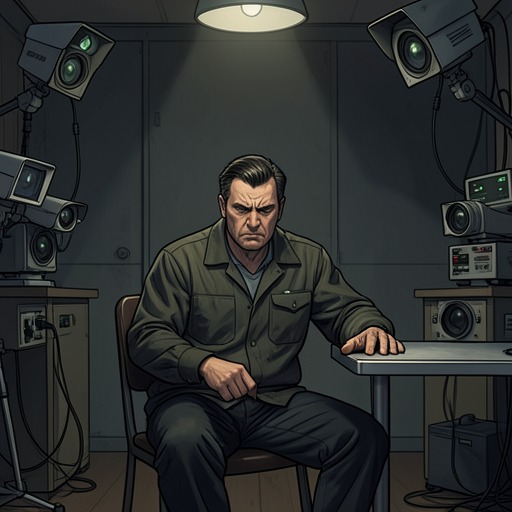
The plan’s documented methods included an elaborate staged transfer intended to make Slahi believe he had been taken away from Guantánamo. The Senate committee described military personnel in riot gear removing him from his cell, placing him on a watercraft, and taking him around the island. He was then to be moved to Camp Echo, where his cell and interrogation room were designed to limit outside stimulation. The plan described measures to block light and reduce visible objects, as well as equipment for securing and interrogating the detainee. The Justice Department inspector general reported that an earlier version proposed a helicopter flight, but that this was abandoned as too difficult to arrange; on August 25, Slahi was instead taken on a disorienting boat ride and exposed to preplanned deceptive conversations. The documentary account connects these details to a plan associated with Miller’s command, while preserving the distinction between the plan’s proposals and the method ultimately used.
Access and the Red Cross dispute
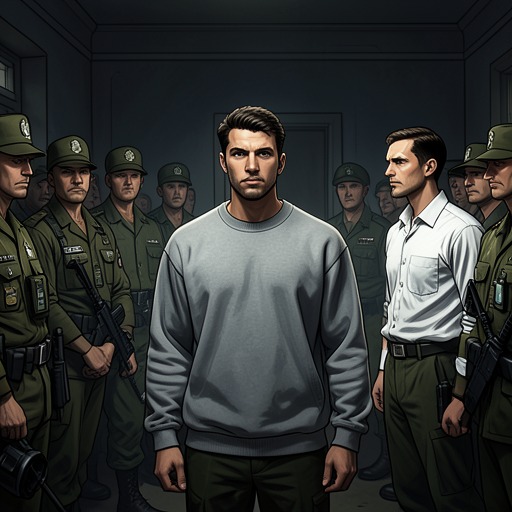
Miller also appears in the record of the dispute over Red Cross access. Minutes of an October 9, 2003 meeting between Miller and a visiting International Committee of the Red Cross delegation record that he told the delegation three detainees were off limits during that visit on grounds of military necessity. Mohamedou Ould Slahi was one of them. The restriction turned access into a direct question of command: the organization could be present at Guantánamo and still be prevented from seeing particular prisoners.
Slahi’s account describes a longer interruption in contact. He writes that the Red Cross was eventually permitted to visit in September 2004, after a prolonged struggle with the government, and that its representatives had been unable to find out where he was during his disappearance from the camp. He also says that officials had refused them access and that a visit became possible only after one of those officials had left. The narrative places this account alongside the October 2003 meeting record, which independently documents Miller’s decision to exclude Slahi from that visit. It does not, however, make every detail of the later access history equally certain; the manuscript’s redactions and the editor’s explanatory notes preserve limits on what can be identified or reconstructed.
Documentary portrait and significance
Miller’s characterization depends substantially on evidence assembled outside Slahi’s own description. A Naval Criminal Investigative Service investigator obtained interrogators’ files containing daily memoranda that recorded both what was said and how information was obtained. Those files remain classified, but their contents are summarized in the Senate Armed Services Committee’s inquiry and the Justice Department’s 2008 review of interrogations in Guantánamo, Afghanistan, and Iraq. The accounts of a second, Rumsfeld-approved plan and the related interrogation procedures broadly corroborate Slahi’s description, and records uncovered by the investigator helped convince prosecutor Stuart Couch that Slahi had been tortured.
The book’s editorial framing is explicit about the limits of this corroboration. Its notes use public records, released government documents, investigations, and close reading to offer the most plausible context for redacted passages; they do not claim to restore the missing text or disclose classified material. That method shapes the reader’s view of Miller: his role emerges through dated memoranda, approval chains, meeting records, and Slahi’s account, rather than through access to Miller’s private motives. The resulting portrait is institutional but concrete. Command authority appears in decisions about whose treatment could proceed under an approved plan and whose case could be withheld from outside observers; the documentary gaps remain visible alongside the evidence.