Roosters
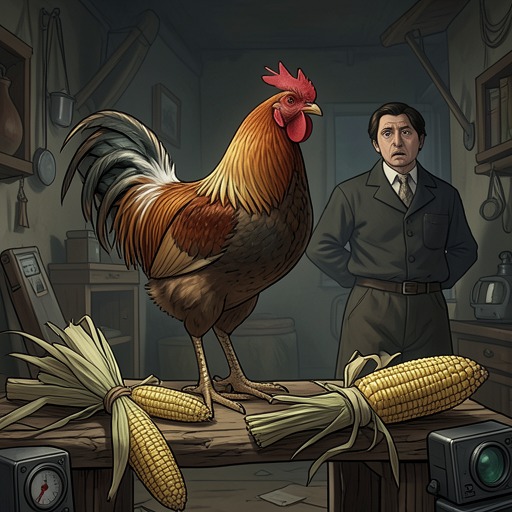
Guantanamo DiaryRoosters are the unreachable figures in a Mauritanian folktale that the narrator uses to frame his struggle to convince the U.S. government that he is not a threat. The animal’s imagined view of a frightened man turns the tale into a compact image of accusation that cannot be corrected simply by stating the truth.
The Folktale
A rooster-phobic man nearly loses his mind whenever he encounters a rooster. When a psychiatrist asks why he is so afraid, the man explains, “The rooster thinks I’m corn.” His fear rests not only on the rooster’s presence but on the belief that the animal mistakes him for something to eat.
The man understands that the rooster’s view is mistaken, but he cannot resolve the danger by understanding it himself. He asks the psychiatrist to go to the rooster and convince it otherwise. Since talking with a rooster is impossible, the folktale ends with the man never being healed: the obstacle is not a lack of explanation, but the impossibility of reaching the creature whose belief governs his fear.
The Narrator’s Comparison
Immediately after the tale, the narrator connects its predicament to his own: for years, he has been trying to convince the U.S. government that he is not corn. The parallel gives the rooster a role beyond that of a frightening animal. It figures an authority that may hold a damaging view of someone who cannot make himself understood to it.
The comparison also preserves a pointed difference between the story’s terms and the narrator’s situation. The folktale’s rooster is an animal that cannot be reasoned with; the narrator is addressing a government. By placing his own effort beside the man’s impossible appeal, he conveys the experience of trying to correct an accusation when the power to hear or accept that correction lies elsewhere.