Secret Detention and Enforced Disappearance
Guantanamo DiarySecret Detention and Enforced Disappearance describe a system in which Mohamedou Ould Slahi’s location and condition were concealed from his family and outside observers while he was moved between countries and detention sites. In his account, disappearance was not a single journey or a single locked door: it was sustained through misleading assurances, hidden transfers, isolation, and obstruction of visits. The consequences were both personal and evidentiary. His family searched for him in the wrong place, while independent observers struggled to establish where he was and what had happened.
A route shaped by concealment
The memoir’s account of detention spans an eighteen-month period in which Slahi was held and questioned in four countries, covering roughly twenty thousand miles. What began as a return toward home ended with him held thousands of miles away on a Caribbean island. The route was carried out with American participation and at the United States’ behest. The successive transfers made his whereabouts difficult for his family to establish and placed him under the authority of institutions beyond their reach.
The concealment took an especially consequential form after Slahi was again taken into custody in Mauritania. He had returned to work after an earlier questioning, but, after completing a work assignment at the Presidential Palace, he went voluntarily to police headquarters and told his mother he expected to return soon. Instead, he disappeared from his family’s view. For almost a year, relatives were led to believe he was in a Mauritanian security prison. His oldest brother, Hamoud, regularly brought clean clothes and money for his meals, unaware that Slahi had already been secretly transferred out of the country.
A week after Slahi reported to police, a CIA rendition flight had taken him to Jordan. Months later he was transferred from Amman to Bagram Air Base, and then to the Guantánamo Bay detention camp. Meanwhile, prison officials accepted the family’s money for his supposed upkeep in Nouakchott and did not disclose that he was no longer there. The separation became publicly legible to the family only when his youngest brother, Yahdih, read a report in Der Spiegel on October 28, 2002, stating that Slahi had been held for months at Guantánamo. The revelation redirected the family’s anger toward local officials who had continued to assure them that Slahi was safe in their custody.
The hidden prisoner in Jordan
In Jordan, concealment was built into the routine of detention. Slahi spent seven days in Mauritanian custody before being told, on November 28, 2001, that he would be sent to Jordan. His family had not been allowed to visit or learn where he was. He was told that the operation was secret and could not say goodbye to his mother. The date was Mauritanian Independence Day, lending the transfer particular force in his account: the state that marked its independence that day was sending one of its citizens abroad without his family’s knowledge.
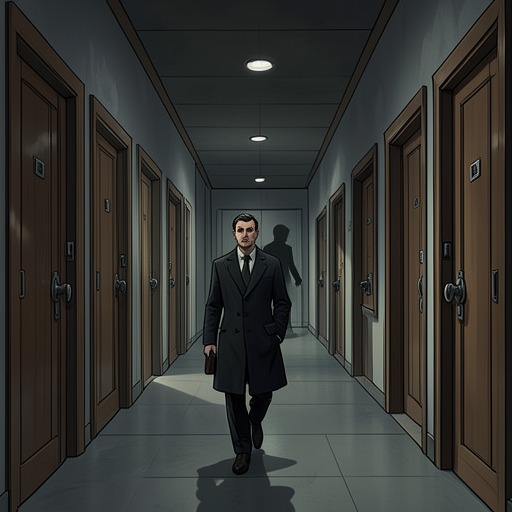
Slahi spent eight months in Jordan. An accidentally overlooked sheet of prison rules disclosed that the International Committee of the Red Cross visited every fourteen days. He then recognized why guards repeatedly moved him from his cell to a cellar for several days at a time: the movements were timed to keep him from being seen by visiting representatives. When he challenged his interrogator, the official denied that the International Committee of the Red Cross was present and said Slahi would not see it. Slahi also asked to contact the Mauritanian ambassador and his family, but neither avenue gave him a way to establish his situation publicly or reach home.
The concealment operated alongside his isolation from other detainees. Slahi inferred the presence and movement of people in nearby cells from the food cart, guards, and sounds of movement, while the occupants of neighboring cells changed. He understood that other prisoners, like him, were being hidden in the cellar operation. This limited knowledge did not end his isolation, but it showed that his concealment was part of a practice affecting more than one detainee. His family remained out of contact, and the repeated relocation deprived outside visitors of a reliable opportunity to find him.
Isolation and blocked access at Guantánamo
At Guantánamo, Slahi’s isolation became more concentrated within the camp. During a period of intensified interrogation, he was placed in a block empty of ordinary signs of life; after the other detainees there were transferred, the block was reserved for him alone. The account describes restrictions on access to daylight, books, personal items, and contact with other detainees. In August 2003, he was separated from the rest of the community before a new phase of interrogation. The precise identity of every location and participant is obscured in the published text, but the spatial pattern is clear: transfers between cells and blocks narrowed his contact with anyone outside the interrogation system.
Documents later summarized by the Senate Armed Services Committee and the Justice Department provide an external record of parts of this process. They describe the Guantánamo Special Interrogation Plan, including a staged boat journey intended to make Slahi believe he had been taken away from the island, followed by transfer to Camp Echo. The plan called for an isolation hut altered to reduce outside stimuli, including measures to prevent light from entering and to obstruct visual contact with guards. These records do not erase the limits of what remains known, but they corroborate the account of deliberate isolation and deceptive movement rather than an ordinary transfer within the camp.
Access by the International Committee of the Red Cross was also obstructed. Slahi writes that representatives were finally allowed to see him in September 2004 after a prolonged struggle with the government. The organization had noticed that he had suddenly vanished from the camp and had been unable to learn where he was. It was told that he was the last detainee it had been permitted to see. Slahi concealed his mistreatment when questioned, fearing retaliation; he also doubted that the organization’s efforts could change the government’s course. The visit therefore marked a change in access, but did not immediately make his account of the hidden period available to outside scrutiny.
What the record can and cannot disclose
The conditions of publication extend the theme of concealment from Slahi’s detention to the surviving text. He wrote a 466-page manuscript by hand in his Guantánamo cell in the summer and fall of 2005. The United States government added more than 2,500 black-bar redactions, and Slahi could not participate in or respond to either the government’s edits or the subsequent editorial process. The black bars thus mark more than missing words: they make visible the government’s continuing control over what the author and his readers could disclose about his experience.
The editor’s annotations were presented as a record of close reading, not an attempt to restore the original text or uncover classified material. They draw on context in the manuscript, public records, declassified documents, reporting, and government investigations, while acknowledging that interpretations of redacted passages remain speculative. The Senate Armed Services Committee’s inquiry, Justice Department reviews, and records uncovered by investigators provide corroboration for specific aspects of the detention, but they do not authorize an invented reconstruction of every omission. That distinction matters to the subject: concealment shaped not only where Slahi could be found, but also what could be stated with confidence about his treatment.
Across Mauritania, Jordan, and Guantánamo, separation from family and barriers to independent access made Slahi’s whereabouts uncertain to those trying to locate him. The transfers and repeated concealment had immediate human consequences, while the later documentary record exposed some of the methods and left other details obscured. The memoir’s account, its redactions, and the cautious annotations together present disappearance as both a lived condition and a continuing struggle over who can know, record, and publish what happened.