Senate Armed Services Committee inquiry into detainee treatment
Guantanamo DiaryThe Senate Armed Services Committee inquiry into detainee treatment provides an official account of interrogation practices in U.S. custody and, in the case of Mohamedou Ould Slahi, helps establish how a specially planned interrogation was carried out. Its significance lies not only in recording what interrogators intended to do, but also in placing details from Slahi’s Guantánamo Diary alongside records later examined by investigators and made public through official reviews.
Investigative Record and Scope
The inquiry’s findings are discussed alongside the U.S. Department of Justice’s own review of interrogations in Guantánamo, Afghanistan, and Iraq. The underlying military records remained classified, but the reports summarized material from the Special Projects Team, including daily memoranda that documented what was said during interrogation sessions and how information was obtained. A Naval Criminal Investigative Service investigator gained access to those files; Stuart Couch, the military prosecutor assigned to Slahi’s case, later learned of their contents. The reports’ summaries gave public readers access to evidence that was otherwise unavailable in the classified files.
The inquiry also serves as one of the public sources used in the editorial notes accompanying the censored manuscript. Those notes draw on declassified records, reporting, litigation, and government investigations to assess what may plausibly correspond to redactions. Their stated method is not to reconstruct the missing text or disclose classified material: they present information only when it is supported by the public record or careful reading and judged important to the manuscript’s readability. The editor acknowledges that such interpretations may be mistaken and that people with access to the unredacted manuscript did not confirm them. The inquiry therefore contributes to a broader corroborating record, while the limits of that record remain explicit.
The Special Interrogation and Its Documentary Corroboration
According to the published summaries, Slahi’s special interrogation followed a second plan approved by Donald Rumsfeld and unfolded in substantially the manner described in Guantánamo Diary. Couch’s investigator located records that helped persuade Couch that Slahi had been tortured. One was a fictitious State Department letter presented to Slahi in August 2003. The inquiry described it as a means of exploiting his close relationship with his mother: it falsely claimed she had been detained, would be interrogated, and might be transferred to Guantánamo if she did not cooperate. The letter also emphasized that she would be the only woman held in what had previously been an all-male prison. Its significance was not simply that it contained false information; it used the prospect of harm to a close family member as part of the interrogation.
A second record was an October 17, 2003, email exchange between an interrogator and a military psychiatrist. The interrogator reported that Slahi was hearing voices, recognized that this was abnormal, and asked whether a lack of daylight and human interaction might produce such experiences. The psychiatrist replied that sensory deprivation can cause hallucinations, usually visual, while allowing that other experiences were possible. The exchange connects Slahi’s reported symptoms to the conditions of isolation being imposed on him. In the book’s account, the inquiry’s documentation and the Justice Department review corroborate the diary’s description of the interrogation without making the classified session records themselves public.
Staged Transfer and Isolation at Camp Echo
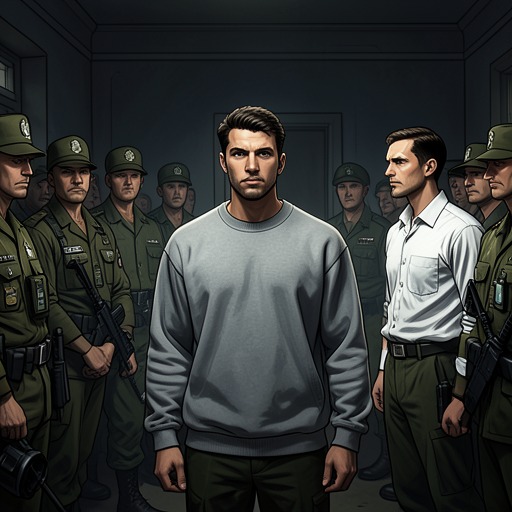
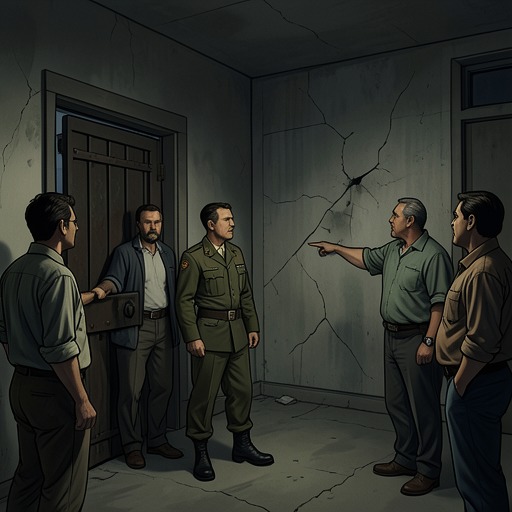
The inquiry also documented a staged scene intended to make Slahi believe he had been taken off the island. In the plan, military personnel in riot gear would remove him from his cell, put him aboard a watercraft, and take him around the bay before bringing him to Camp Echo. There, his cell and interrogation room were to be contained within an isolation hut modified to reduce outside stimuli. The plan specified sealing the doors against light, covering walls with white material to limit objects on which a detainee might focus, and placing an eye bolt in the floor and speakers in the room.
An August 21, 2003, email from a Joint Task Force Guantánamo intelligence specialist to Richard Zuley described preparations to seal Slahi’s cell against light and cover the hut’s exterior with a tarp so he could not see guards. The reported implementation differed from the original plan in one important respect. A helicopter flight had first been proposed, but investigators later reported that it was abandoned as too logistically difficult and would have required too many people on the base to know about it. On August 25, Slahi was instead taken from Camp Delta wearing blackout goggles on a disorienting boat ride, during which he was allowed to hear prearranged deceptive conversations among the passengers. The inquiry’s account thus preserves both the planned deception and the form it ultimately took.
Reading Findings Against Public Claims
The report’s importance extends beyond the details of Slahi’s treatment: it supplies documentary context for a case whose public characterization changed over time. Slahi arrived at Guantánamo on August 5, 2002, among thirty-five prisoners carried on a U.S. military C-17. Contemporary reporting described the detainee population as lacking major al-Qaeda leaders, while a camp commander’s officers were questioning whether detainees should be designated enemy combatants rather than treated as prisoners of war. The book describes this setting as one in which military interrogation practices were expanding and sharply contested.
A later allegation connecting Slahi to the September 11 attacks emerged after the capture of Ramzi bin al-Shibh. Slahi’s account of the accusation, and the public record discussed in the book, are distinct from the inquiry’s specific findings about interrogation conditions. Likewise, when Slahi’s habeas petition came before a federal court in 2009, the government did not argue that he was a major al-Qaeda figure or that he had participated in an al-Qaeda attack. The inquiry does not by itself decide those legal questions. Its contribution is more concrete: it documents methods and records that bear on the reliability and circumstances of information obtained from Slahi, material that must be considered when evaluating the larger claims made about him.
Evidentiary Value and Limits
The inquiry helps turn a first-person account into a record that can be compared against documents produced within the institutions conducting the interrogation. Its summaries support specific details in Slahi’s narrative, including the false letter, the interrogator’s report of voices, the psychiatrist’s response, and the staged boat transfer. That corroboration matters especially because the original military files remain classified and because Slahi’s account was written under a censorship regime that left substantial portions of the manuscript obscured.
At the same time, the inquiry’s public summaries are not the unredacted records themselves, and the editorial annotations do not claim to recover missing text. The distinction between documented findings, Slahi’s own account, and an editor’s contextual interpretation remains essential. Read with those limits in view, the report offers a substantial evidentiary counterweight to official secrecy: it makes parts of the interrogation’s design and consequences publicly legible without pretending that every uncertainty has been resolved.