Sensory Deprivation and Isolation
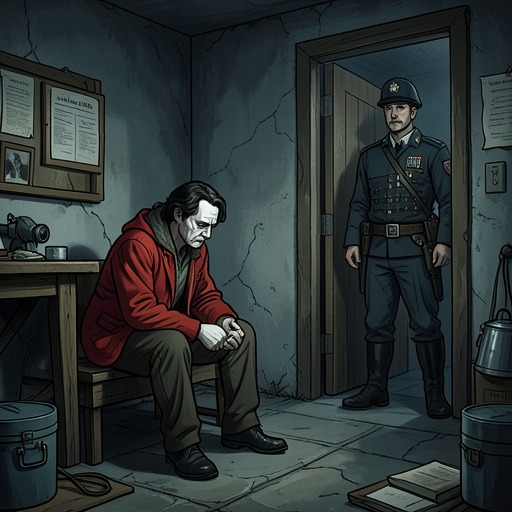
Guantanamo DiarySensory deprivation and isolation shape Mohamedou Ould Slahi’s detention across countries and years, turning restricted light, contact, and movement into instruments of concealment and interrogation. In his account, the cell is never merely a place to stay: its position, temperature, visibility, and access to visitors determine whether he can reach other detainees, his family, or an outside witness. The methods range from moving him into a cellar in Jordan to the deliberately sealed isolation hut prepared for him at Guantánamo.
Isolation Across a Transnational Detention Route
Slahi situates these conditions within an eighteen-month journey of roughly twenty thousand miles through four countries, a chain of detention and interrogation shaped at the behest of the United States. The distance was not only geographical. While his family believed he remained in a Mauritanian prison, he had been secretly transferred to Jordan, then taken by the United States through Bagram Air Base to Guantánamo. His relatives continued paying for his supposed upkeep, unaware that the prison officials were keeping the money while concealing his absence. Secrecy separated Slahi from family knowledge as effectively as a locked cell separated him from people nearby.
In Jordan, isolation also served to obstruct outside scrutiny. Slahi found an old sheet of prison rules on a cellar door and learned that the International Committee of the Red Cross visited every fourteen days. He had initially hoped the cellar was a temporary step before release; instead, he later understood that guards moved him there for several days during each visit so the organization would not find him. This pattern continued through his eight months in Jordan. Once he explicitly asked to see the International Committee of the Red Cross, his interrogator denied that it was present and described the facility as a military prison. The cellar’s function was therefore both spatial and informational: it hid a detainee from visitors while preserving the appearance of a regular prison routine.
Guantánamo’s Restricted Spaces
At Guantánamo, Slahi describes being placed in a block emptied of ordinary signs of life. Other detainees were initially housed at a distance, without interaction; after they were transferred elsewhere, the block was reserved for Slahi alone. He was deprived of books, his Quran, soap, toothpaste, toilet paper, and most bedding, leaving only a thin mat and a worn blanket. The cell was kept cold, and his limited recreation took place at night, preventing ordinary access to daylight and contact with other detainees. For seventy days, interrogations ran around the clock, in three or sometimes four shifts, with little rest. Offers of sleep and hot meals were tied to cooperation, making basic comfort part of the pressure imposed on him.
The isolation acquired a more explicit design in the special interrogation measures of 2003. In June, Slahi was moved from Mike Block to India Block for what he described to an administrative review board as total isolation. Accounts of India Block describe windowless solitary cells kept at frigid temperatures. In August, after a weekend in an emptied block, Slahi noted the contrast: that cell was warmer and allowed daylight, unlike the frozen box from which he had been moved. Even this comparatively better space was part of a system in which separation from other detainees could be arranged and adjusted by the people controlling his confinement.
The plan for a staged transfer to Camp Echo extended that control beyond the cell. The Senate Armed Services Committee reported that soldiers in riot gear would take Slahi onto a watercraft and drive him around so that he would believe he had been taken off the island. The prepared hut at Camp Echo was designed to reduce outside stimuli: doors were to be sealed against light, walls could be covered to limit visual points of focus, and the room included an eyebolt in the floor and speakers. Preparations also called for covering the exterior with a tarp to prevent visual contact with guards. The original plan proposed a helicopter journey, but investigators later reported that it was abandoned as logistically difficult; the boat ride was used instead. The deception and the stripped-down room made uncertainty about location part of the isolation itself.
Psychological Effects and Control of Contact
Slahi’s account links the removal of ordinary stimuli to physical and mental strain. During one two-month period, an interrogator kept him awake through a combination of cold, water, writing tasks, and prolonged standing. On another occasion, Slahi was made to listen repeatedly to the U.S. national anthem in a cold room containing patriotic images. The account also describes the suppression of Islamic practice, including prayer and recitation of the Quran. These were not simply restrictions on comfort: they narrowed the routines, objects, and forms of orientation available to him while interrogators sought to weaken his resistance.
The effects of sensory deprivation appear in the documentary record as well as in Slahi’s testimony. In October 2003, a military interrogator reported that Slahi said he was hearing voices and was worried that this was abnormal. A behavioral science psychologist responded that sensory deprivation could cause hallucinations. The exchange makes the conditions legible from outside the cell, but it does not mean that Slahi had reliable access to help or independent observation. Confinement could produce disturbing effects while also limiting the detainee’s ability to communicate them beyond the interrogation team.
Access, Witness, and Aftermath
The long denial of access to the International Committee of the Red Cross at Guantánamo extended the logic of concealed detention. The organization had difficulty determining where Slahi was after he disappeared from the camp’s ordinary view, and its representatives were refused permission to see him. Only in September 2004, after a prolonged dispute with the government and after a senior interrogator had left, was a visit allowed. Slahi was the last detainee the organization had fought to see. He says he hid his ill-treatment when asked about it because he feared retaliation, illustrating that physical access alone could not undo the conditions of fear and control created by isolation.
The pattern therefore runs from hidden transfer and the Jordanian cellar to Guantánamo’s solitary blocks and sealed hut: separation restricted not only human contact, but also the possibility of verification. Even after the period of acute interrogation, the confinement did not simply end. The manuscript indicates that Slahi remained in the cell where he had been placed after the staged abduction, with no indication that he had moved by the time he wrote. Isolation in this account is consequently both a set of specific conditions and a continuing structure: it governs who can see the detainee, what he can see, and how much of his experience can reach the outside.