Slahi's special interrogation and torture at Guantánamo
Guantanamo DiaryMohamedou Ould Slahi’s special interrogation and torture at Guantánamo turned a detention marked by uncertain allegations into a deliberate program of isolation, threats, and manipulation. Personally approved by Defense Secretary Donald Rumsfeld, the plan was carried out in 2003 and 2004. Its later documentation would corroborate important parts of Slahi’s account, while exposing a contradiction at the heart of the case: the interrogation was presented as productive, but the information obtained under it did not yield a prosecution.
From suspicion to a special plan
Slahi arrived at the Guantánamo Bay detention camp in August 2002 with thirty-four other prisoners. The available record gives little reason to think he initially stood out as a high-value detainee. At the time, reports described the camp’s population as lacking major al-Qaeda leaders, and even military officers were questioning whether detainees should be called enemy combatants rather than treated as prisoners of war under the Geneva Conventions. That changed as U.S. agencies intensified their intelligence operations and a connection between Slahi and Ramzi bin al-Shibh came to light.
Bin al-Shibh identified Slahi as a person he had met in Germany in 1999. Slahi had hosted him and two companions for one night, and their conversations included jihad and Afghanistan. The allegation that Slahi had advised bin al-Shibh to seek training became a consequential link in the case, though it did not by itself establish that Slahi knew of the September 11 attacks. Years later, the government abandoned an argument that Slahi was detainable because he had aided those attacks, acknowledging that he probably did not even know about them.
By the time military interrogators began their special plan, Slahi was being described within the camp as a successful intelligence source. Lieutenant Colonel Stuart Couch, assigned to the case in fall 2003, received reports of Slahi’s statements but no account of the conditions under which they had been obtained. Couch had reason to question the process: he had been told Slahi was on a special project, and had seen another detainee shackled in an interrogation booth during an earlier visit. His own military training had exposed him to some techniques used to prepare airmen for capture, giving him a basis for recognizing the significance of what he saw.
Isolation, threats, and staged transfer
The plan, approved by Rumsfeld, subjected Slahi to months of extreme isolation and a sustained course of psychological pressure. The documented methods included threats of death and threats against his family, as well as degrading treatment and a simulated kidnapping and transfer. The account of the plan later confirmed by official investigations makes clear that the apparent transfer was staged to make Slahi believe he had been taken away from the island and that the rules governing his treatment had changed.
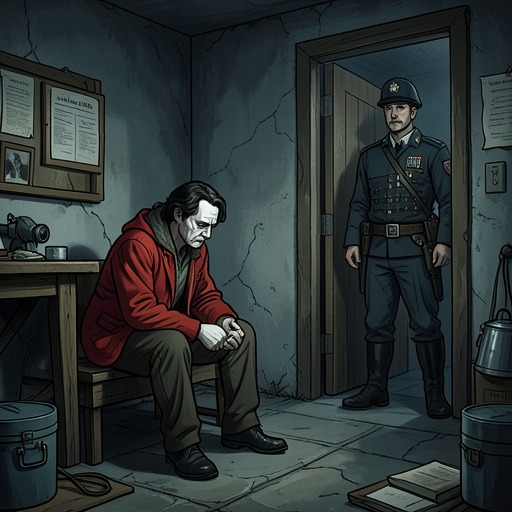
On August 25, 2003, Slahi was removed from his cell in Camp Delta wearing blackout goggles and taken on a disorienting boat ride. The original plan had contemplated a helicopter flight, but investigators later reported that the military decided it would be too difficult to arrange. Instead, the boat carried out the deception, including pre-planned conversations for Slahi to overhear. He was then taken to Camp Echo, where the isolation hut had been altered to minimize outside stimuli. Preparations included sealing out light and blocking his view of guards. The plan also called for a room with few objects to focus on, an attachment point in the floor, and speakers.
Other recorded actions targeted Slahi’s family ties and mental state. In August 2003, interrogators presented him with a fictitious State Department letter claiming that his mother had been detained, would be questioned, and might be transferred to Guantánamo if she did not cooperate. The letter exploited his close relationship with her by making her vulnerability part of the pressure exerted on him. In October, an interrogator wrote to a military psychiatrist that Slahi had begun hearing voices and was worried about the change. The psychiatrist replied that sensory deprivation can cause hallucinations. The exchange records both a reported consequence of isolation and the interrogators’ awareness that reduced external stimulation could affect Slahi’s perception.
Records, corroboration, and Couch’s withdrawal
Couch’s suspicions became more concrete when an investigator from the Naval Criminal Investigative Service gained access to the military interrogators’ files. The files included daily memoranda recording not only what Slahi said but how interrogators obtained the information. Although the records remained classified, the Senate Armed Services Committee’s 2008 inquiry and a 2008 review by the U.S. Department of Justice summarized the interrogation and its documentation. Their accounts described a second, painstaking plan approved by Rumsfeld and found that the special interrogation unfolded almost exactly as Slahi had described in his manuscript.
Two documents particularly affected Couch: the fabricated letter concerning Slahi’s mother and the exchange about his reported voices. In a later interview, Couch recalled reading the materials over a period of months and then attending a church baptism. During the service, the congregation affirmed the dignity of every human being and the pursuit of peace and justice. Couch said the words clarified his responsibility: he could not support a prosecution built on evidence obtained through the treatment he had uncovered. He withdrew from Slahi’s case and refused to proceed with an effort to try him before a military commission.
The contrast between the records and the official presentation of the interrogation is central to the event’s significance. Military interrogators had promoted Slahi’s questioning as their most successful interrogation at Guantánamo, yet the intelligence reports Couch reviewed contained no description of how the information had been extracted. The reports that circulated were scrubbed accounts, not a transparent record of the process. The investigative files, and later public inquiries, made it possible to compare Slahi’s narrative with contemporaneous documentation rather than treating either his account or the government’s characterization as self-confirming.
Legal and public consequences
No charge sheet was drawn up against Slahi in Guantánamo, no military commission defense attorney was appointed for him, and the available account indicates no further effort to prepare a prosecution. The record does not establish that the special interrogation produced reliable evidence of criminal activity. Slahi told an administrative review board in 2005 that he had manufactured confessions under torture; the intelligence reports passed on by interrogators instead consisted largely of names and associations. Couch later questioned whether Slahi knew more about those people than the intelligence services already did.
When Slahi’s habeas petition reached federal court in 2009, the government did not argue that he was a major al-Qaeda figure or that he had participated in al-Qaeda plans or attacks. The dispute instead concerned whether his past oath, associations, hospitality, and referrals meant that he had been part of the organization when detained. In 2010, Judge James Robertson ordered his release, prompting a newspaper editorial to characterize him as a leading September 11 recruiter and to urge an appeal. The later disclosure that the government had abandoned its claim that Slahi aided the attacks sharpened the gap between public accusation and the narrower case presented in court. The interrogation thus stands not only as an episode of abuse, but as a test of what official claims can prove when the methods used to obtain information are themselves concealed and contested.