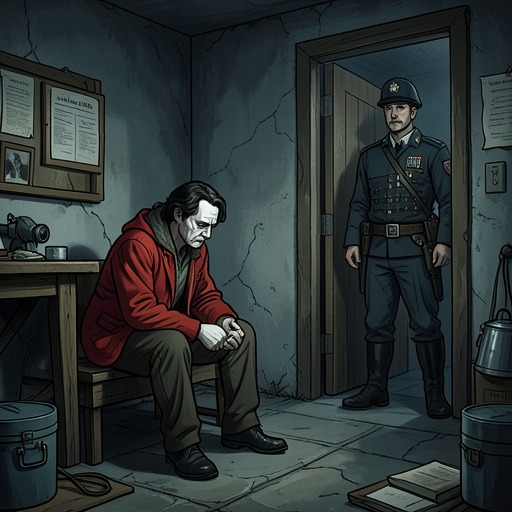
Sleep Deprivation
Guantanamo DiarySleep Deprivation is presented in Mohamedou Ould Slahi’s account as an organized feature of interrogation: his opportunities for rest were repeatedly interrupted or withheld so that questioning could continue across the day and night. The practice intensified from near-continuous questioning to a regime of enforced wakefulness, water, and sensory isolation. Its consequences included exhaustion and hallucinations, while later government investigations and historical research offered independent context for the methods he describes.
Continuous interrogation and rotating shifts
At one stage in the block, Slahi describes being questioned around the clock for seventy days, with three and sometimes four interrogation shifts in a day. He rarely received a day off and recalls no night of undisturbed sleep. The condition was not simply that questioning happened at inconvenient hours: a shift system ensured that one interrogator could hand him over to the next, extending the process across a full twenty-four-hour period.
The shift arrangement became more explicit when another team joined his case. The morning shift began between seven and nine and ended in the afternoon; a dayshift followed, and a nightshift took over after that. Slahi says this rotation continued until August 24, 2003, with little relief. When he asked whether it was excessive to be interrogated continuously, the team added personnel rather than reducing the hours. A fourth shift was introduced, leaving him to face four successive groups during the day.
The schedule made sleep precarious even outside the formal interview sessions. On the third day of the shifts, an escort team arrived just after Slahi had fallen asleep following a twenty-hour interrogation. The interruption became part of a recurring pattern: rest could begin, but the routine offered no assurance that it would last. When he was moved into a colder, isolated block, he describes the same basic regime of questioning at all hours, now accompanied by loss of daylight, books, religious materials, and other ordinary comforts.
Enforced wakefulness and its effects
In a later phase, guards used repeated bottles of water at intervals of roughly one to two hours to keep Slahi awake. He explains that the frequency made it difficult to close his eyes for even ten minutes because he was continually getting up to use the bathroom. He understood the water regimen as a means of producing wakefulness without simply ordering him to stand. A guard later explained that the method was intended to make a detainee remain awake through his own bodily needs. The account thus identifies not only the result but a mechanism for sustaining it.
Sleep deprivation was accompanied by rules and routines that made lying down or relaxing difficult. Guards announced new shifts by banging on his cell door, and he says their arrival made him fear that another restriction or demand would follow. He was sometimes given only seconds to eat, required to clean or arrange his cell repeatedly, and ordered to remain awake whenever a guard appeared. These practices extended the denial of rest beyond the interview room: the cell itself was governed by demands that prevented a stable period of sleep.
Slahi describes the mental effects as increasingly difficult to distinguish from the surrounding isolation. He began hearing what seemed to be clear voices: family members talking together, readings from the Quran, and music from his country. He knew he was separated from his family, yet the voices continued day and night. Guards then spoke in imitation voices through the plumbing and encouraged him to hurt them or plan an escape. Slahi says he recognized the voices as hallucinations and was not led astray, although he played along. The episode shows how deprivation and isolation could become material for further psychological pressure.
The special interrogation and isolation
The account also places sleep deprivation within a broader special interrogation campaign. Slahi says one interrogator deprived him of sleep for about two months while trying to break his resistance. The methods included lowering the room temperature, making him write about his life, repeatedly giving him water, and at times requiring him to stand through the night. The account distinguishes these measures by their function: each helped keep him awake, while the interrogations continued and the surrounding conditions limited rest and outside stimulation.
The planned move to Camp Echo placed isolation at the center of this phase. A Senate Armed Services Committee account of the interrogation plan describes a staged boat journey intended to make Slahi believe he had been taken away from the island, followed by confinement in a specially prepared hut. The cell was to be sealed against light, its walls covered to limit visual points of focus, and its exterior covered so that he could not see guards. These details document the design of the environment around the interrogation; they do not, by themselves, establish that every planned measure was carried out exactly as written.
Other records helped corroborate the broader account. When an investigator gained access to interrogators’ files, the records included daily memoranda describing both what was said and how information was obtained. The files remain classified, but the Senate Armed Services Committee’s inquiry and a Justice Department review summarized the special interrogation and found that its course closely resembled the account in Slahi’s manuscript. A military psychiatrist’s email exchange, also described in the committee’s report, discussed Slahi’s report of hearing voices and the possibility that little daylight and human interaction could produce hallucinations.
Public record and significance
Historical research cited alongside the account placed sleep loss among established coercive interrogation methods. A 1956 Central Intelligence Agency study described repeated interruption or denial of sleep as a way to produce fatigue and clouded consciousness, and discussed cold conditions as an additional source of strain. A study by Air Force sociologist Albert Biderman, examining false confessions by captured United States airmen during the Korean War, likewise concluded that sleep deprivation could weaken a prisoner’s ability to resist. These sources provide context for the method; they are not proof that a particular interrogator relied on those studies.
A separate legal finding illustrates the wider stakes of interrogating sleep-deprived detainees. The Supreme Court of Canada held that Canadian Security Intelligence Service and foreign-affairs agents’ questioning of the youth Omar Khadr violated his rights, noting that the youth had been subjected to sleep deprivation and that the resulting statements would be shared with prosecutors. That case concerned Khadr, not Slahi, but it records an institutional recognition that questioning a sleep-deprived detainee can raise serious fairness concerns.
In Slahi’s account, sleep deprivation is therefore both bodily condition and information-gathering strategy: hours without reliable rest narrow the space for recovery, while questioning and isolation continue. His recollection is not the sole basis for understanding the practice. Declassified summaries, official investigations, and historical studies offer points of comparison, while the source material also preserves limits: the detailed interrogator files remain classified, and some surrounding information was redacted. The result is a record in which the deprivation is described through its routines and effects, and tested against public evidence without treating inaccessible material as known.