The Cat-and-Mouse Game Over ICRC Visits in Jordanian Detention
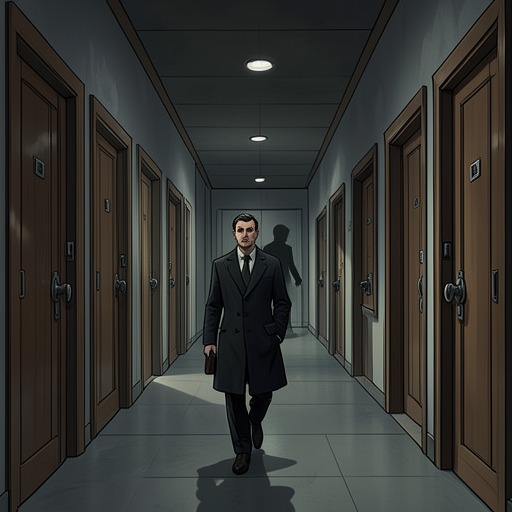
Guantanamo DiaryThe Cat-and-Mouse Game Over ICRC Visits in Jordanian Detention was an eight-month system of concealment in which Mohamedou Ould Slahi was moved into a cellar at regular intervals to prevent meetings with the International Committee of the Red Cross (ICRC). A forgotten prison-rules notice revealed the pattern and the purpose of the transfers, but knowing how the arrangement worked did not give him a way to end it. The episode makes the control of space and access central to his account: a change of cell could determine whether an outside witness was allowed to find him.
Detention and the concealed location
Slahi’s Jordanian detention is placed between November 29, 2001, and July 19, 2002. It formed part of a much longer journey through detention and interrogation that began after he returned from Canada to Senegal and Mauritania. In the account’s wider frame, that journey covered roughly twenty thousand miles over eighteen months, crossed four countries, and proceeded with American participation and at the behest of the United States. A CIA rendition flight had taken Slahi to Jordan about a week after he surrendered to Mauritanian authorities; his family, however, was led to believe for almost a year that he remained in Mauritanian custody. His brother Hamoud regularly brought money and clean clothes to the prison there, unaware that Slahi had been moved.
Jordan’s role in this route was therefore not simply a change of country. Slahi describes detention in which his location could be altered without his family knowing, and in which access by the ICRC could be managed through movement inside the prison. Later, the United States retrieved him from Amman and transferred him to Bagram Air Base in Afghanistan, then to the Guantánamo Bay detention camp. Those later transfers place the Jordanian episode within a broader sequence of hidden custody, while the cellar itself shows how concealment operated on the scale of a prison’s internal geography.
The rules reveal the schedule
The cellar first appeared to Slahi as a possible transfer point before release. After being woken and told to gather his belongings, he took a blanket, his Qur’an, and a library book. Blindfolded, he was instead placed in a cellar. He initially tried to interpret the move as evidence of good intentions, but the room was dirty and cold, and he had no reliable information about why he had been taken there.
During the evening meal, he noticed a paper notice on the door listing prison rules. It had been left in place by mistake. Among its instructions were that smoking depended on cooperation, that speaking to guards was forbidden, that the ICRC visited every fourteen days, and that prisoners were not to discuss their political cases with ICRC representatives. The notice was more than a list of restrictions: it disclosed a timetable and showed that outside visits were part of the prison’s operating routine. Slahi understood that his temporary placement in the cellar was intended to keep him out of the ICRC’s view.
Once he recognized the pattern, the repeated movement acquired a different meaning. Every fourteen days, guards took him from his cell to the cellar for a couple of days and then returned him. What had first seemed like an unexplained transfer was, in his account, a recurring method of preventing a visit throughout his time in Jordan. The prison’s own written rules supplied the information that the process was designed to withhold.
Challenging the denial
Slahi explicitly asked his interrogator to let him see the ICRC. The interrogator answered that no ICRC was present and characterized the institution as a military prison. Slahi challenged that account by referring to the notice and the regular cellar transfers. The exchange exposed an asymmetry: he could identify the schedule and state what it accomplished, but the people controlling his location also controlled whether an outside visitor could reach him.
The interrogator then presented the refusal as protection and said Slahi would not see the ICRC. Slahi concluded that the decision was beyond the interrogator’s individual authority. He understood the arrangement as part of a conspiracy involving Mauritania, the United States, and Jordan, and feared that a terrorism case, if established against him, could leave no one knowing what had happened. His request to see the Mauritanian ambassador was also refused. The account does not describe the cellar transfers as isolated mistakes: their regularity, the rules notice, and the denial of access together show an organized restriction on outside scrutiny.
Secrecy beyond Jordan
The concealment in Jordan forms one part of a longer separation between Slahi and people who might have learned where he was. During his subsequent transfers, his family continued to believe that he was in Mauritania and paid for his supposed upkeep there. Only after his youngest brother Yahdih read a report in Der Spiegel on October 28, 2002, did the family learn that Slahi was being held at Guantánamo. The deception surrounding the Jordanian detention thus sits within a wider period in which official assurances and concealed transfers left relatives with a false account of his whereabouts.
The book later describes a related but distinct denial of ICRC access at Guantánamo. After Slahi had disappeared from the camp’s ordinary view, the ICRC was finally allowed to visit him in September 2004, following a prolonged dispute with the government. Representatives told him he was the last detainee they had had to fight to see. He concealed mistreatment when they asked about it, fearing retaliation, and judged that their efforts had not changed the government’s course. That later episode does not erase the specific Jordanian routine; it gives it a wider context. In both settings, access depended on authorities controlling where Slahi was and whether a visitor could reach him. In Jordan, the fourteen-day cycle made that control repetitive and legible, but recognition of the pattern could not itself open the door.