Truth and Coerced Confessions
Guantanamo DiaryTruth and Coerced Confessions names the central reversal in Mohamedou Ould Slahi’s account of interrogation: the insistence on truth gives way, under torture, to agreement with accusations and a false written confession. The change is not presented as new evidence of guilt, but as a consequence of coercive pressure. The narrative’s distinction between what Slahi said before and after May 22, 2003, makes the confession’s conditions essential to understanding what it can—and cannot—establish.
Two phases of testimony
Slahi divides his account into two broad periods. Before May 22, 2003, he says, he told interrogators that he had done nothing against the United States and could not resist telling the truth. In the later period, after torture, he says he answered yes to every accusation put to him. The boundary matters: a statement’s apparent certainty cannot be separated from when it was made and what was happening to the person making it.
The second phase included a written confession about a plan to attack Toronto’s CN Tower. Slahi says the account was based on advice from a military interrogator identified in the manuscript by a redaction, and that he wrote it in the hope of getting relief from the pressure. He also says he did not care how long he remained imprisoned and that his belief comforted him. The passage thus distinguishes the confession’s content from its cause: the document records an accusation he accepted, while his explanation describes submission under duress, not an independent recollection offered freely.
Truth promised, agreement demanded
One interrogator framed questioning as a choice with extreme consequences: truthful answers would lead to release and safe return to family, while failure would mean indefinite imprisonment. He then asked which terrorist organizations Slahi belonged to. Slahi answered that he belonged to none. The promise made truth sound like a route out of detention; the threat made the interrogator the judge of whether an answer counted as truthful.
When Slahi again denied membership, the interrogator put a bag over his head and subjected him to prolonged humiliation, curses, lies, and threats. Slahi describes being exhausted and in pain, and says he cried silently. He recalls being sent back to his cell with a promise of further torture. The sequence exposes the contradiction in the interrogation’s stated terms: denial did not secure release, while the later yeses emerged after punishment and fear. In this setting, cooperation came to mean supplying the answers interrogators wanted, not confirming facts through reliable questioning.
The promise of truth also appears in a separate encounter in German. An interrogator used a slogan that presented truth as liberating. Slahi understood the assurance against the historical example of the Nazi slogan claiming that work brought freedom: neither slogan, in his reading, made the promise true. The juxtaposition turns a reassuring phrase into an emblem of the gulf between official language and a detainee’s actual prospects.
How coercion produced a confession
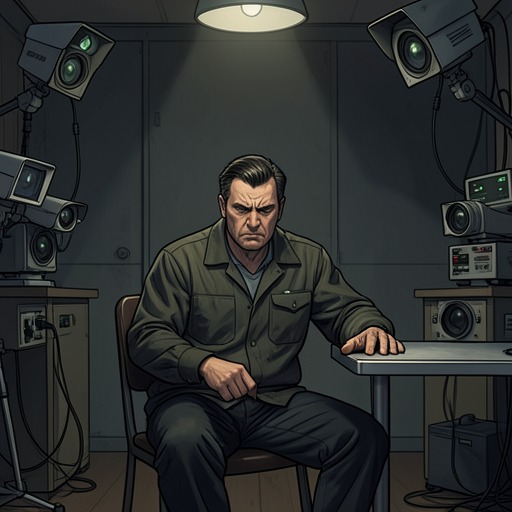
The interrogation that followed was not only a matter of words. The U.S. Senate Armed Services Committee described a Special Interrogation Plan involving a staged removal from the island and isolation at Camp Echo. On August 25, 2003, Slahi was taken from his cell in Camp Delta wearing blackout goggles, then transported on a boat ride arranged to disorient him and expose him to deceptive conversations. The plan for his Camp Echo cell called for reduced outside stimulation, including measures to block light and visual contact with guards. These details place the false confession within a deliberate environment of deception and isolation rather than an ordinary exchange of questions and answers.
The documentary record also describes an effort to exploit Slahi’s attachment to his mother. In August 2003, interrogators presented him with a fictitious State Department letter claiming that she had been detained, would be questioned, and might be transferred to Guantánamo if she did not cooperate. A later email exchange recorded Slahi reporting that he was hearing voices and worrying that this was abnormal; a military psychiatrist replied that sensory deprivation could cause hallucinations. These records do not independently establish the truth of every statement Slahi made, but they document the pressure and deprivation surrounding the interrogation.
Records, redactions, and the limits of reconstruction
When Stuart Couch was assigned Slahi’s case in 2003, he received intelligence reports and came to suspect that the interrogation had involved abuse. An investigator later gained access to the military interrogators’ files, including daily memoranda describing both what was said and how information was extracted. Those records remained classified, but the U.S. Senate Armed Services Committee’s 2008 inquiry and the U.S. Department of Justice’s 2008 review summarized them. The inquiries described a second, Donald Rumsfeld-approved plan and reported that the special interrogation unfolded almost exactly as Slahi recounts it.
The manuscript itself, however, is censored. Larry Siems explains that his annotations concerning redactions draw on surrounding context, other passages in the manuscript, and public sources, including declassified records and official investigations. He explicitly does not claim to reconstruct the hidden text or reveal classified information. The notes are reasoned possibilities where public information or close reading can support them, not verified restorations of blacked-out passages. That distinction is especially important when interpreting a confession: evidence about how it was obtained may be public even when parts of the underlying record remain inaccessible.
Testimony and credibility
Slahi presents the book as an account of what he experienced, saw, and learned firsthand, and says he tried neither to exaggerate nor to understate. Larry Siems writes that the narrative is corroborated by the declassified record, while noting that the documented torments include material not in the book and that Slahi recounts some events with restraint. Together, the memoir and the investigations make it possible to compare personal testimony with records of interrogation practice without treating either redactions or editorial speculation as proof of the concealed text.
The unresolved questions surrounding Slahi’s detention give that distinction continuing weight. The book’s account of confession is also an account of the conditions under which testimony can be shaped: a promise of freedom, a threat of indefinite imprisonment, repeated punishment for denial, and a system in which cooperation was measured by agreement. Its central contrast is not simply between truth and falsehood, but between truth as a stated institutional demand and coercion as the force that made a false confession possible.