Boat of Blefuscu
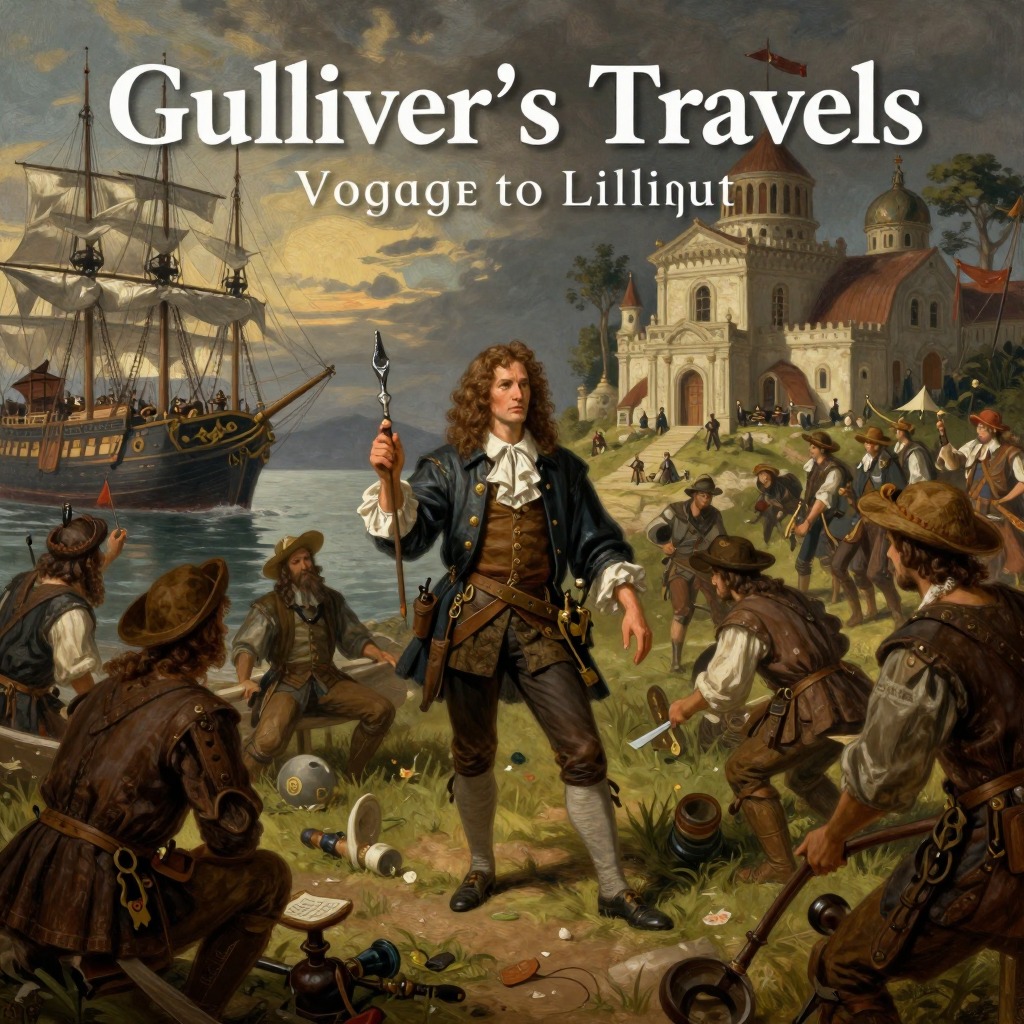
Gulliver's TravelsThe Boat of Blefuscu is the vessel that provides Lemuel Gulliver with the means to leave the miniature empires of Lilliput and Blefuscu and return to his native England, concluding his first voyage and setting the stage for his subsequent travels. Discovered by chance on the shore, this ordinary boat becomes an extraordinary object of salvation, its size and construction perfectly suited to Gulliver's own scale after his adventures among the six-inch-tall Lilliputians. The boat's appearance, refitting, and departure form the final act of Gulliver's first journey, a sequence that combines practical ingenuity with political maneuvering and personal resolution.
Discovery and Initial Assessment
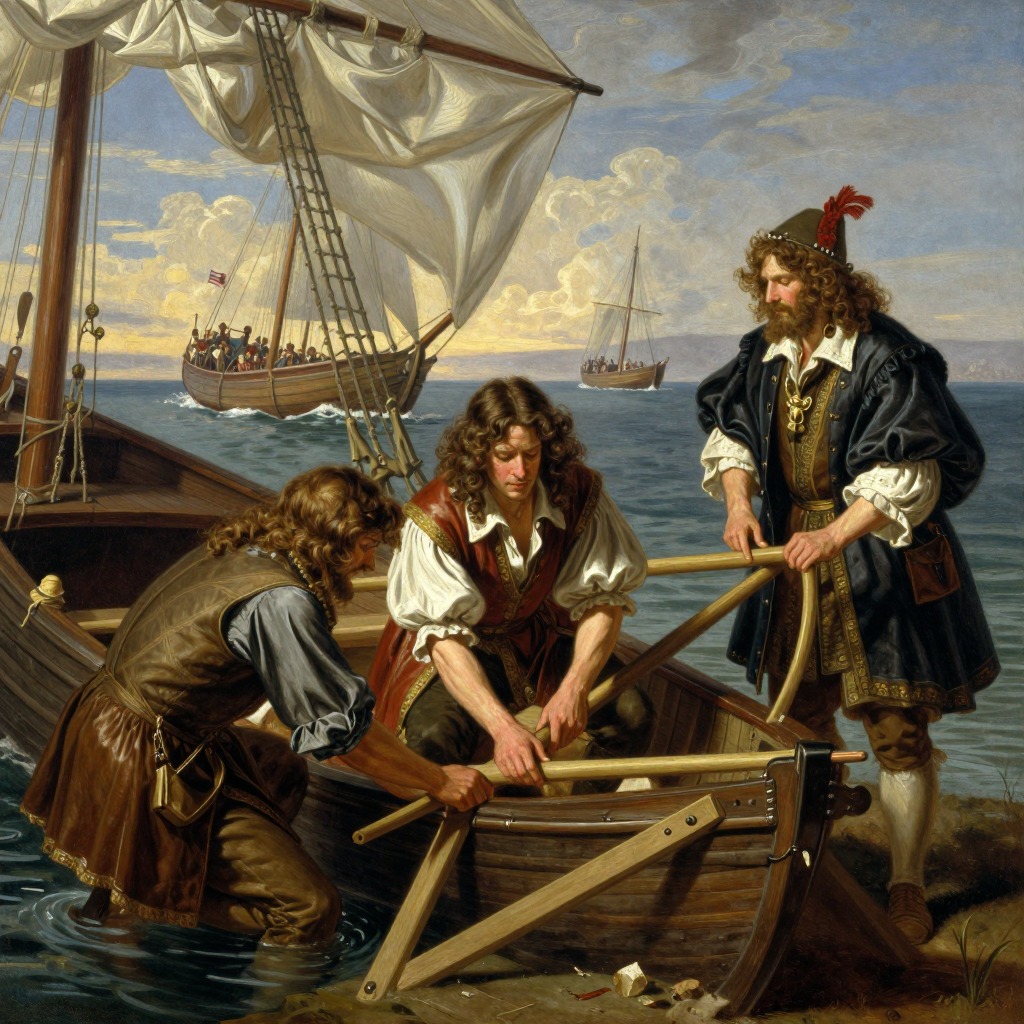
Three days after his arrival in Blefuscu, Gulliver, walking out of curiosity to the northeast coast of the island, observed about half a league off in the sea something that looked like a boat overturned. He pulled off his shoes and stockings, waded two or three hundred yards, and found the object approaching nearer by force of the tide; he then plainly saw it to be a real boat, which he supposed might by some tempest have been driven from a ship. Returning immediately towards the city, he desired the Emperor of Blefuscu to lend him twenty of the tallest vessels he had left after the loss of his fleet, and three thousand seamen under the command of his vice-admiral. This fleet sailed round, while Gulliver went back the shortest way to the coast where he first discovered the boat. He found the tide had driven it still nearer. The seamen were all provided with cordage, which Gulliver had beforehand twisted to a sufficient strength. When the ships came up, he stripped himself and waded till he came within a hundred yards of the boat, after which he was forced to swim till he got up to it. The seamen threw him the end of the cord, which he fastened to a hole in the forepart of the boat, and the other end to a man-of-war. But he found all his labor to little purpose; for, being out of his depth, he was not able to work. In this necessity, he was forced to swim behind, and push the boat forwards as often as he could with one of his hands, and, the tide favoring him, he advanced so far that he could just hold up his chin and feel the ground. He rested two or three minutes, and then gave the boat another shove, and so on till the sea was no higher than his arm-pits; and now, the most laborious part being over, he took out his other cables, which were stowed in one of the ships, and fastened them first to the boat, and then to nine of the vessels which attended him; the wind being favorable, the seamen towed, and he shoved, till they arrived within forty yards of the shore, and waiting till the tide was out, he got dry to the boat, and, by the assistance of two thousand men, with ropes and engines, he made a shift to turn it on its bottom, and found it was but little damaged.
Refitting and Preparation
Gulliver told the Emperor of Blefuscu that his good fortune had thrown this boat in his way, to carry him to some place from whence he might return into his native country, and begged his majesty's orders for getting materials to fit it up, together with his license to depart, which, after some kind expostulation, the emperor was pleased to grant. Five hundred workmen were employed to make two sails to his boat, according to his directions, by quilting thirteen folds of their strongest linen together. Gulliver was at the pains of making ropes and cables, by twisting ten, twenty, or thirty of the thickest and strongest of theirs. A great stone, that he happened to find after a long search by the sea-shore, served him for an anchor. He had the tallow of three hundred cows for greasing his boat, and other uses. He was at incredible pains in cutting down some of the largest timber-trees for oars and masts, wherein he was, however, much assisted by his majesty's ship-carpenters, who helped him in smoothing them after he had done the rough work. In about a month, when all was prepared, he sent to receive his majesty's commands, and to take his leave. The emperor and royal family came out of the palace. Gulliver lay down on his face to kiss his hand, which he very graciously gave him; so did the empress and young princes of the blood. His majesty presented him with fifty purses of two hundred sprugs a-piece, together with his picture at full length, which Gulliver put immediately into one of his gloves, to keep it from being hurt.
Departure and Return to England
Gulliver stored the boat with the carcases of a hundred oxen, and three hundred sheep, with bread and drink proportionable, and as much meat ready dressed as four hundred cooks could provide. He took with him six cows and two bulls alive, with as many ewes and lambs, intending to carry them into his own country, and propagate the breed. To feed them on board, he had a good bundle of hay and a bag of corn. He would gladly have taken a dozen of the natives, but this was a thing the emperor would by no means permit; and, besides a diligent search into his pockets, his majesty engaged his honor not to carry away any of his subjects, although with their own consent and desire. Having thus prepared all things as well as he was able, he set sail on the twenty-fourth day of September, 1701, at six in the morning. After a voyage of several days, during which he encountered a ship, he was taken aboard an English merchantman returning from Japan, commanded by Captain John Biddle of Deptford. The captain was initially skeptical of Gulliver's story, but Gulliver convinced him by producing the miniature cattle and sheep from his pockets, along with the gold given him by the Emperor of Blefuscu and the emperor's picture at full length. They arrived in the Downs on the thirteenth of April, 1702. Gulliver made a considerable profit by showing his cattle to many persons of quality and others, and before he began his second voyage he sold them for six hundred pounds. He stayed but two months with his wife and family, for his insatiable desire of seeing foreign countries would suffer him to continue no longer, and he went on board the "Adventure," a merchant ship of three hundred tons, bound for Surat, Captain John Nicholas, of Liverpool, commander.
Narrative and Thematic Significance
The Boat of Blefuscu functions as a crucial narrative device that enables Gulliver's return to England, but it also carries thematic weight. Its discovery and refitting demonstrate Gulliver's practical ingenuity and his ability to adapt the resources of a miniature world to his own scale. The boat's journey home, with its cargo of miniature livestock and treasure, provides a tangible link between the fantastical realm of Lilliput and Blefuscu and the familiar world of England, grounding the extraordinary adventure in a concrete, verifiable outcome. The boat also serves as a symbol of Gulliver's restless nature; his return home is brief, and he soon sets out again, driven by his "insatiable desire of seeing foreign countries." The boat, therefore, is not merely a means of escape but a threshold between worlds, marking the end of one voyage and the beginning of another, and underscoring the cyclical pattern of Gulliver's travels.