Brobdingnag army
Gulliver's TravelsThe Brobdingnag army is the military force of the kingdom of Brobdingnag, a militia system composed of citizen-soldiers rather than a professional standing army. Its structure, discipline, and the king's explicit rejection of gunpowder weapons together define a military philosophy that stands in pointed contrast to the European military practices Gulliver describes. The army is both a practical defense force and a symbol of the kingdom's political and moral order, one that the King of Brobdingnag himself defends as superior to the mercenary and technologically aggressive armies of Europe.
Composition and Command
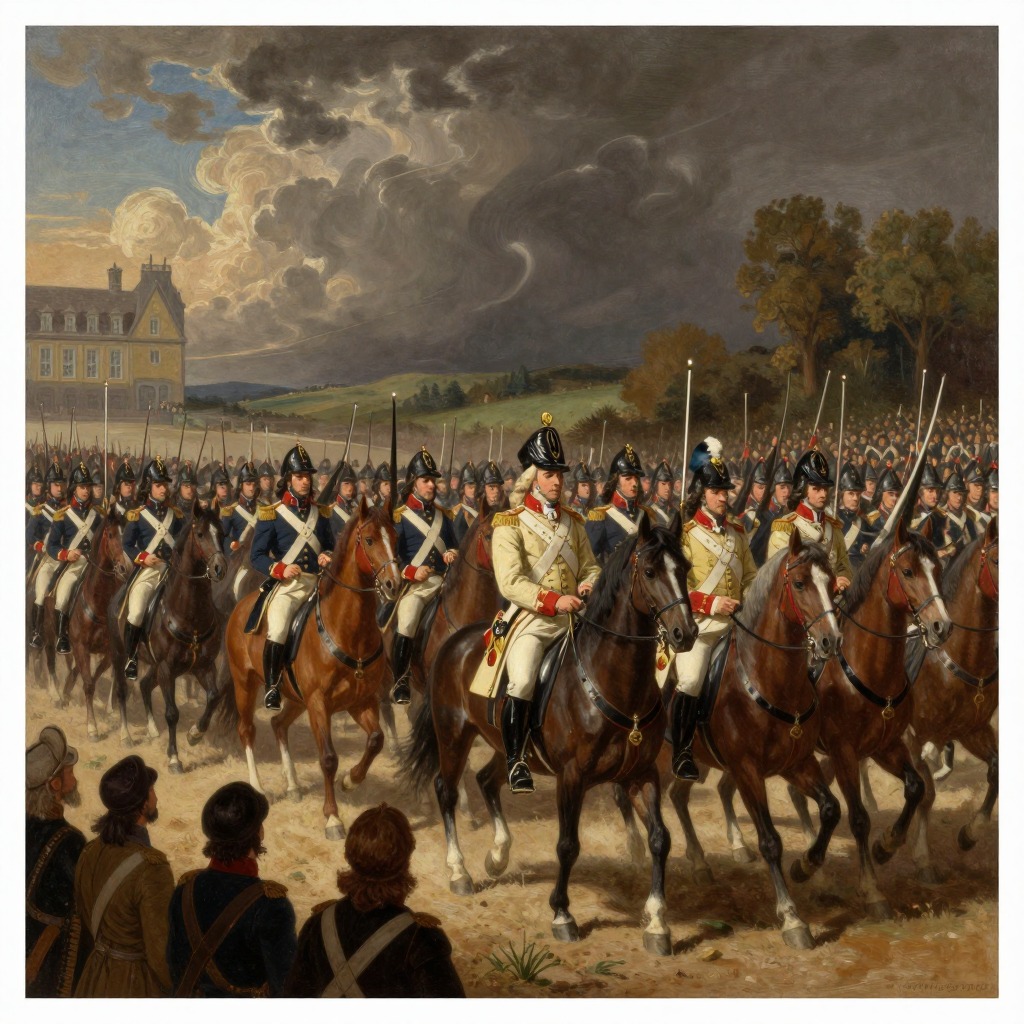
The Brobdingnag army is not a standing army but a militia. It consists of 176,000 foot soldiers and 32,000 horse soldiers, drawn from the tradesmen of the cities and the farmers of the countryside. The commanders are exclusively the nobility and gentry, who serve without pay or reward. This structure means that every farmer is under the command of his own landlord, and every citizen under that of the principal men in his own city, chosen by ballot in a manner resembling the Venetian system. The army is thus an extension of the social hierarchy rather than a separate professional class. Gulliver notes that the troops are perfect enough in their exercises and under very good discipline, but he sees no great merit in this, arguing that it could hardly be otherwise given the direct authority landlords and city leaders hold over their men.
Grandeur and Display
Gulliver witnesses the militia of Lorbrulgrud, the metropolis, drawn out to exercise in a great field near the city, twenty miles square. The force on display numbers no more than 25,000 foot and 6,000 horse, but the sheer scale of the Brobdingnagian soldiers makes the spectacle overwhelming. A single cavalryman mounted on a large steed stands about ninety feet high. When the entire body of horse draws their swords at once and brandishes them in the air on a word of command, Gulliver describes the sight as something imagination cannot equal: it looked as if ten thousand flashes of lightning were darting at the same time from every quarter of the sky. The visual grandeur of the Brobdingnag army is inseparable from the gigantic scale of its soldiers and horses, which transforms a routine military exercise into a sublime and terrifying display of power.
Origins and Purpose
The Brobdingnag army exists not for foreign conquest but for internal stability. The kingdom is a peninsula, bounded on three sides by the ocean and cut off from the northeast by impassable mountains thirty miles high topped with volcanoes; there is not a single sea-port in the whole kingdom, and the rocky coasts make even small boats impossible to launch. With no access from any other country, the army has no external enemy to fight. Gulliver learns from conversation and from reading their histories that the military was established because the kingdom has been troubled, over many ages, by the same disease that afflicts all mankind: the nobility contending for power, the people for liberty, and the king for absolute dominion. These conflicts have sometimes violated the laws, which happily temper the three parties, and have more than once occasioned civil wars. The last such war was ended by the current king's grandfather through a general composition, and the militia was then settled with common consent and has ever since been kept in the strictest duty. The army thus functions as a constitutional safeguard, a force designed to preserve internal peace rather than wage foreign war.
The King's Rejection of Gunpowder
The most decisive statement about the Brobdingnag army's character comes not from its drills but from the king's response to Gulliver's offer of gunpowder technology. Gulliver, hoping to ingratiate himself, describes an invention from three to four hundred years earlier: a powder that, when a spark falls on a heap of it, kindles the whole in a moment and makes it fly into the air with a noise and agitation greater than thunder. He explains that a proper quantity rammed into a hollow tube of brass or iron would drive a ball of iron or lead with such violence that nothing could sustain its force, destroying whole ranks of an army at once, battering the strongest walls to the ground, sinking ships with a thousand men each, and, when linked by a chain, cutting through masts and rigging and dividing hundreds of bodies. He offers to direct the king's workmen in making tubes of a size proportionable to the kingdom, the largest not needing to be above a hundred feet long, claiming that twenty or thirty such tubes would batter down the walls of the strongest town in a few hours or destroy the whole metropolis. The king is struck with horror. He is amazed that so impotent and grovelling an insect as Gulliver could entertain such inhuman ideas and appear wholly unmoved at the scenes of blood and desolation Gulliver has painted as the common effects of those destructive machines. He protests that although few things delight him so much as new discoveries in art or nature, he would rather lose half his kingdom than be privy to such a secret, and commands Gulliver, as he values his life, never to mention it again. This rejection defines the Brobdingnag army not by its technological capacity but by its moral restraint: the king refuses to acquire a weapon that would make him absolute master of the lives, liberties, and fortunes of his people, a scruple Gulliver dismisses as a strange effect of narrow principles but which the narrative presents as the kingdom's highest military virtue.
Thematic Significance
The Brobdingnag army embodies the kingdom's broader political philosophy, which the king articulates in his conversations with Gulliver. He confines the knowledge of governing within very narrow bounds: common sense and reason, justice and lenity, the speedy determination of civil and criminal causes. He declares that whoever could make two ears of corn or two blades of grass grow upon a spot of ground where only one grew before would deserve better of mankind and do more essential service to his country than the whole race of politicians put together. The army, as a militia without pay, without foreign wars, and without gunpowder, is the military expression of this agrarian, anti-expansionist, anti-professional ideal. It is a force designed to preserve a balanced constitution, not to project power. Gulliver, who has seen the armies of Europe and who offers gunpowder as a gift, finds this philosophy incomprehensible and contemptible, but the narrative consistently validates the king's position. The Brobdingnag army is thus not merely a military organization but a central element in Swift's satire of European militarism, standing as a counterexample of a society that has chosen to limit its own capacity for violence.