Chain and padlocks
Gulliver's TravelsThe chain and padlocks are the central physical apparatus through which the Lilliputian state asserts control over Lemuel Gulliver, the Man-Mountain, after his shipwreck. Forged by the king's smith and locked onto his left leg, these objects transform Gulliver from a free agent into a confined prisoner, establishing the power dynamic that governs his entire stay in Lilliput. They are not merely restraints but a calibrated technology of power, designed to manage a being of vastly superior size while simultaneously displaying the ingenuity and political calculation of his captors.
Construction and Installation
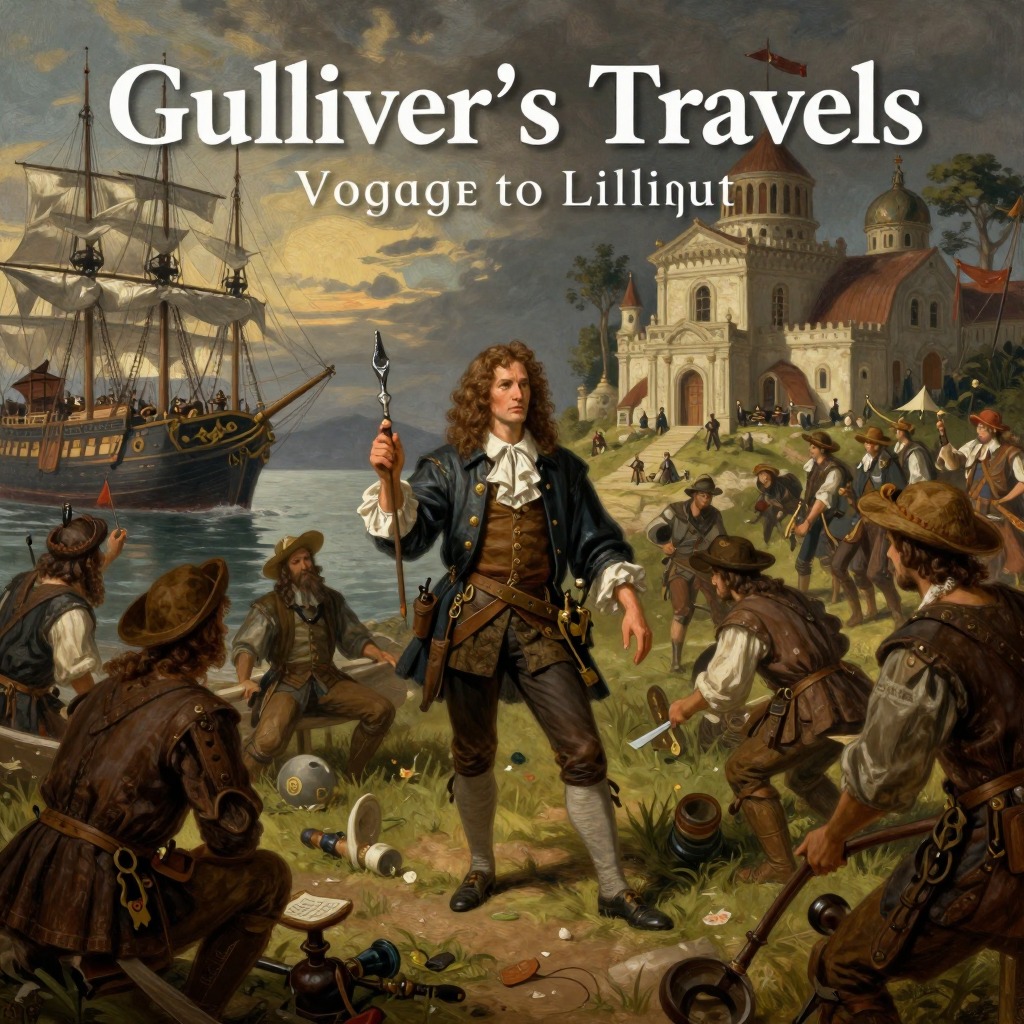
The chain and padlocks were produced by the king's smith and installed at the ancient temple where Gulliver was to be lodged. The temple, the largest in the kingdom, had been polluted by an unnatural murder and was considered profane, so it was repurposed as a prison. The great gate, fronting north, was about four feet high and almost two feet wide, allowing Gulliver to creep inside. On each side of the gate was a small window, not above six inches from the ground. Into the window on the left side, the smith conveyed four score and eleven chains—eighty-one in total—which were described as resembling those that hang to a lady's watch in Europe, though almost as large. These chains were locked to Gulliver's left leg with six-and-thirty padlocks, a number that underscores the Lilliputians' meticulous, almost obsessive, approach to security.
Physical Constraints and Daily Life
The chains that held Gulliver's left leg were about two yards long, granting him a limited but meaningful range of motion. He could walk backwards and forwards in a semi-circle, and because the chains were fixed within four inches of the gate, he was able to creep into the temple and lie at his full length inside. This arrangement allowed him to move about his immediate surroundings but kept him tethered to the temple, his designated prison. The chain and padlocks thus defined the geography of his confinement: he could receive visitors, perform for the court, and observe the city, but he could not approach the emperor's person without permission, nor could he wander freely through the countryside. The physical reality of the chain—its length, its weight, its attachment to his leg—was a constant, tangible reminder of his subjugation.
Symbol of Power and Negotiation
The chain and padlocks function as a symbol of the Lilliputian state's power over Gulliver, but they also become a site of negotiation. When the emperor first approached Gulliver on horseback, he kept without the length of the chain, a prudent distance that acknowledged the potential danger of the Man-Mountain. The chain was the boundary between the sovereign and the subject, the limit of Gulliver's reach and the measure of his captivity. When the emperor's horse reared at the sight of Gulliver, the chain's presence underscored the precariousness of the encounter. Later, when Gulliver's gentle behavior and the services he performed (such as capturing the Blefuscu fleet) earned him the emperor's favor, the chain and padlocks were removed as part of the ceremony granting him his liberty. The unlocking of the padlocks was the physical act that marked his transition from prisoner to a free, though still subordinate, member of the Lilliputian polity.
Narrative and Thematic Significance
The chain and padlocks are a crucial narrative device that establishes the central irony of Gulliver's first voyage: a man who could easily destroy his captors is rendered helpless by threads and tiny locks. The meticulous description of the chains—their number, their size, their attachment—grounds the fantastic premise in a concrete, almost bureaucratic reality. The objects also serve as a lens through which the Lilliputians' character is revealed: their mathematical precision, their engineering skill, and their political caution. The chain is not a crude restraint but a carefully calculated instrument of control, reflecting the emperor's decision to keep Gulliver alive and use him as a tool rather than kill him outright. When Gulliver finally gains his freedom, the removal of the chain and padlocks is the culminating act of a political process that involved petitions, debates, and the drafting of articles of release. The objects thus embody the tension between physical power and political authority that runs throughout the Lilliputian episode.