Escape from Lilliput
Gulliver's TravelsGulliver's escape from Lilliput to Blefuscu is the climax of the first voyage, a desperate flight that saves his eyes and his life from a court conspiracy that had secretly prepared articles of impeachment for high treason. The escape transforms him from a favored servant of the emperor into a fugitive, and it reveals the depth of the political intrigue that had been building against him for two months. By crossing the channel to the rival empire, Gulliver not only preserves his physical safety but also exposes the treacherous ingratitude of the Lilliputian court, a lesson that will color his view of princes and ministers for the rest of his travels.
The Conspiracy and the Articles of Impeachment
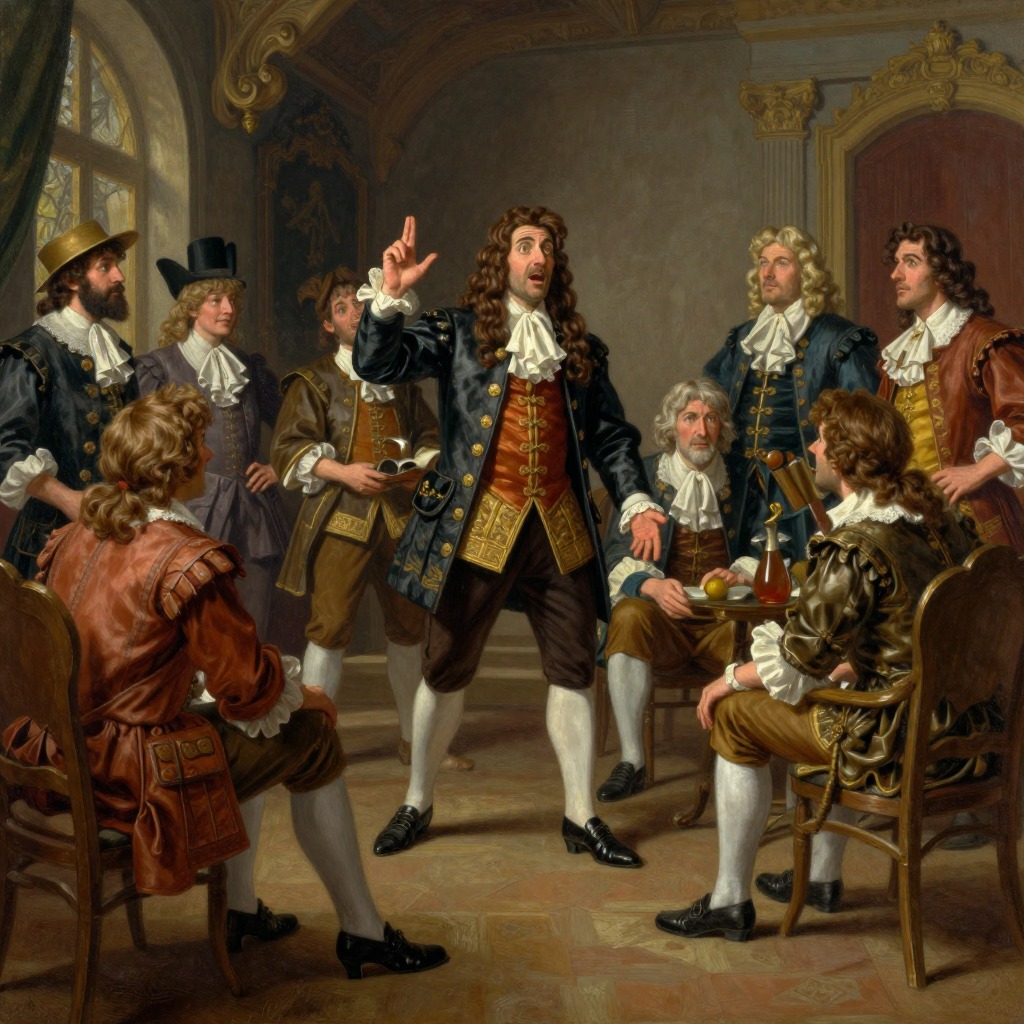
For two months before the escape, a private intrigue had been forming against Gulliver at the Lilliputian court. A considerable person at court, to whom Gulliver had been very serviceable when he lay under the highest displeasure of the emperor, came to Gulliver's house very privately at night in a close chair, without sending his name. The chairmen were dismissed; Gulliver put the chair, with his lordship in it, into his coat-pocket, and, giving orders to a trusty servant to say he was indisposed and gone to sleep, he fastened the door of his house, placed the chair on the table, and sat down by it. After common salutations, observing his lordship's countenance full of concern, Gulliver inquired into the reason, and the visitor desired he would hear him with patience in a matter that highly concerned his honor and his life. The visitor revealed that several committees of council had been lately called in the most private manner on Gulliver's account, and that it was but two days since his majesty came to a full resolution. Skyrris Bolgolam, the high-admiral, had been Gulliver's mortal enemy almost ever since his arrival, and his hatred had increased since Gulliver's great success against Blefuscu, by which his glory as admiral was much obscured. This lord, in conjunction with Flimnap the high treasurer, whose enmity against Gulliver was notorious, Limtoc the general, Lalcon the chamberlain, and Balmuff the grand justiciary, had prepared articles of impeachment against Gulliver for treason and other capital crimes. The articles included four main charges: first, that Gulliver, under color of extinguishing the fire kindled in the apartment of the empress, did maliciously and traitorously pull her by the arms and lift her high in the air in both his hands, against the statute that made it high treason to lay hands upon the empress or any of the royal children; second, that having brought the imperial fleet of Blefuscu into the royal port, and being afterwards commanded by his imperial majesty to seize all the other ships of that empire and reduce it to a province, he, like a false traitor, did petition to be excused from the said service upon pretence of unwillingness to force the consciences or destroy the liberties and lives of an innocent people; third, that when certain ambassadors arrived from the court of Blefuscu to sue for peace, he did, like a false traitor, aid, abet, comfort, and divert the said ambassadors, although he knew them to be servants to a prince who was lately an open enemy; and fourth, that he was now preparing to make a voyage to the court and empire of Blefuscu, for which he had received only verbal license, and under color of that license did falsely and traitorously intend to aid, comfort, and abet the emperor of Blefuscu, so late an enemy.
The Debate Over Punishment and the Secretary's Expedient
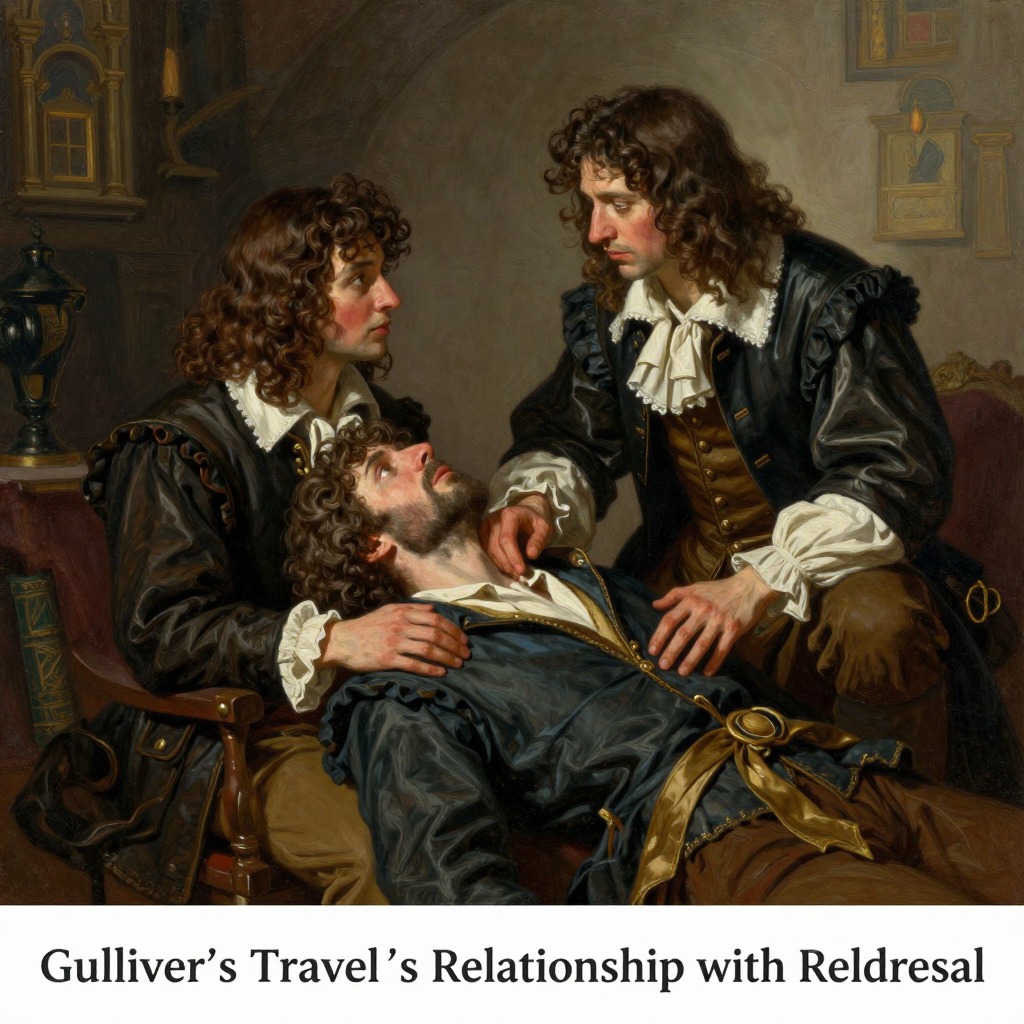
In the several debates upon this impeachment, the emperor gave many marks of his great lenity, often urging the services Gulliver had done him and endeavoring to extenuate his crimes. The treasurer and admiral insisted that Gulliver should be put to the most painful and ignominious death, by setting fire on his house at night, and the general was to attend with twenty thousand men armed with poisoned arrows to shoot him on the face and hands. Some of his servants were to have private orders to strew a poisonous juice on his shirts and sheets, which would soon make him tear his own flesh and die in the utmost torture. For a long time there was a majority against him, but his majesty, resolving if possible to spare his life, at last brought off the chamberlain. Reldresal, principal secretary for private affairs, who always approved himself Gulliver's true friend, was commanded by the emperor to deliver his opinion. He allowed Gulliver's crimes to be great, but said that still there was room for mercy, the most commendable virtue in a prince. He proposed that if his majesty, in consideration of Gulliver's services and pursuant to his own merciful disposition, would please to spare his life and only give orders to put out both his eyes, justice might in some measure be satisfied, and all the world would applaud the lenity of the emperor. He argued that the loss of his eyes would be no impediment to his bodily strength, by which he might still be useful to his majesty; that blindness is an addition to courage, by concealing dangers from us; that the fear he had for his eyes was the greatest difficulty in bringing over the enemy's fleet; and it would be sufficient for him to see by the eyes of the ministers, since the greatest princes do no more. This proposal was received with the utmost disapprobation by the whole board. Bolgolam, the admiral, could not preserve his temper, but rising up in fury, said he wondered how the secretary durst presume to give his opinion for preserving the life of a traitor; that the services Gulliver had performed were, by all true reasons of state, the great aggravation of his crimes; that he who extinguished the fire in that unprincipled manner might at another time inundate and drown the whole palace; and the same strength which enabled him to bring over the enemy's fleet might serve, upon the first discontent, to carry it back. He accused Gulliver as a traitor on that account and insisted he should be put to death. The treasurer was of the same opinion, showing to what straits his majesty's revenue was reduced by the charge of maintaining Gulliver, which would soon grow insupportable. He argued that the secretary's expedient of putting out his eyes was so far from being a remedy against this evil that it would probably increase it, as is manifest from the common practice of blinding some sort of fowls, after which they fed the faster and grew sooner fat. But his imperial majesty, fully determined against capital punishment, was graciously pleased to say that since the council thought the loss of his eyes too easy a censure, some other might be inflicted hereafter. The secretary, humbly desiring to be heard again, said that his excellency, who had the sole disposal of the emperor's revenue, might easily provide against that evil by gradually lessening Gulliver's establishment; by which, for want of sufficient food, he would grow weak and faint, and lose his appetite, and consume in a few months; neither would the stench of his carcase be then so dangerous when it should become more than half diminished; and immediately upon his death, five or six thousand of his majesty's subjects might in two or three days cut his flesh from his bones, take it away by cart-loads, and bury it in distant parts to prevent infection, leaving the skeleton as a monument of admiration to posterity. Thus, by the great friendship of the secretary, the whole affair was compromised. It was strictly enjoined that the project of starving him by degrees should be kept a secret, but the sentence of putting out his eyes was entered on the books, none dissenting except Bolgolam, the admiral, who, being a creature of the empress, was perpetually instigated by her majesty to insist upon his death, she having borne perpetual malice against him on account of that illegal method he took to remove her and her children the night of the fire. In three days, the secretary was to come to Gulliver's house and read before him the articles of impeachment, and then to signify the great lenity and favor of his majesty and council, whereby he was only condemned to the loss of his eyes, which his majesty did not question he would gratefully and humbly submit to; and twenty of his majesty's surgeons would attend in order to see the operation well performed by discharging very sharp-pointed arrows into the balls of his eyes as he lay on the ground.
The Decision to Flee and the Journey to Blefuscu
Gulliver remained alone under many doubts and perplexities of mind. He sometimes thought of standing his trial, for although he could not deny the facts alleged in the several articles, yet he hoped they would admit of some extenuation. But having in his life perused many state-trials, which he ever observed to terminate as the judges thought fit to direct, he durst not rely on so dangerous a decision in so critical a juncture and against such powerful enemies. Once he was strongly bent upon resistance, for while he had liberty, the whole strength of that empire could hardly subdue him, and he might easily with stones pelt the metropolis to pieces; but he soon rejected that project with horror, by remembering the oath he had made to the emperor, the favors he received from him, and the high title of nardac he conferred upon him. At last he fixed upon a resolution, for which it is probable he may incur some censure, and not unjustly; for he confesses he owes the preserving his eyes, and consequently his liberty, to his own great rashness and want of experience; because if he had then known the nature of princes and ministers, which he has since observed in many other courts, and their methods of treating criminals less obnoxious than himself, he should with great alacrity and readiness have submitted to so easy a punishment. But, hurried on by the precipitancy of youth, and having his imperial majesty's license to pay his attendance upon the emperor of Blefuscu, he took this opportunity, before the three days were elapsed, to send a letter to his friend the secretary, signifying his resolution of setting out that morning for Blefuscu pursuant to the leave he had got; and, without waiting for an answer, he went to that side of the island where the fleet lay. He seized a large man-of-war, tied a cable to the prow, and lifting up the anchors, he stripped himself, put his clothes (together with his coverlet, which he carried under his arm) into the vessel, and drawing it after him, between wading and swimming arrived at the royal port of Blefuscu, where the people had long expected him. They lent him two guides to direct him to the capital city, which is of the same name. He held them in his hands until he came within two hundred yards of the gate, and desired them to signify his arrival to one of the secretaries, and let him know he there waited his majesty's command. He had an answer in about an hour, that his majesty, attended by the royal family and great officers of the court, was coming out to receive him. He advanced a hundred yards. The emperor and his train alighted from their horses, the empress and ladies from their coaches, and he did not perceive they were in any fright or concern. He lay on the ground to kiss his majesty's and the empress's hand. He told his majesty that he was come, according to his promise, and with the license of the emperor, his master, to have the honor of seeing so mighty a monarch, and to offer him any service in his power consistent with his duty to his own prince, not mentioning a word of his disgrace, because he had hitherto no regular information of it, and might suppose himself wholly ignorant of any such design; neither could he reasonably conceive that the emperor would discover the secret while he was out of his power, wherein however it soon appeared he was deceived.
Aftermath and the Lilliputian Envoy
Gulliver did very much wonder, in all this time, not to have heard of any express relating to him from the Lilliputian emperor to the court of Blefuscu. But he was afterwards given privately to understand that his imperial majesty, never imagining he had the least notice of his designs, believed he was only gone to Blefuscu in performance of his promise according to the license he had given him, which was well known at the Lilliputian court, and would return in a few days when the ceremony was ended. But he was at last in pain at Gulliver's long absence; and, after consulting with the treasurer and the rest of that cabal, a person of quality was despatched with the copy of the articles against him. This envoy had instructions to represent to the monarch of Blefuscu the great lenity of his master, who was content to punish him no farther than the loss of his eyes; that he had fled from justice, and if he did not return in two hours, he should be deprived of his title of nardac and declared a traitor. The envoy further added that, in order to maintain the peace and amity between both empires, his master expected that his brother of Blefuscu would give orders to have him sent back to Lilliput, bound hand and foot, to be punished as a traitor. The emperor of Blefuscu, having taken three days to consult, returned an answer consisting of many civilities and excuses. He said that, as for sending him bound, his brother knew it was impossible. That, although he had deprived him of his fleet, yet he owed great obligations to him for many good offices he had done him in making the peace. That, however, both their majesties would soon be made easy; for he had found a prodigious vessel on the shore, able to carry him on the sea, which he had given orders to fit up with his own assistance and direction; and he hoped in a few weeks both empires would be freed from so insupportable an incumbrance. With this answer the envoy returned to Lilliput, and the monarch of Blefuscu related to Gulliver all that had passed; offering him at the same time (but under the strictest confidence) his gracious protection if he would continue in his service; wherein, although Gulliver believed him sincere, yet he resolved never more to put any confidence in princes or ministers where he could possibly avoid it; and, therefore, with all due acknowledgments for his favorable intentions, he humbly begged to be excused. He told him that, since fortune, whether good or evil, had thrown a vessel in his way, he was resolved to venture himself in the ocean, rather than be an occasion of difference between two such mighty monarchs. Neither did he find the emperor at all displeased; and he discovered, by a certain accident, that he was very glad of his resolution, and so were most of his ministers.
Thematic Significance: The Education of a Courtier
The escape from Lilliput marks Gulliver's first painful education in the nature of courts and ministers. He had been hitherto all his life a stranger to courts, for which he was unqualified by the meanness of his condition. He had indeed heard and read enough of the dispositions of great princes and ministers, but never expected to have found such terrible effects of them in so remote a country, governed, as he thought, by very different maxims from those in Europe. The conspiracy, the secret articles, the debate over whether to blind him or starve him, and the final hypocrisy of the emperor's public lenity—all teach him that the greatest services to princes are of little weight when put into the balance with a refusal to gratify their passions. The escape itself, which he later calls a product of his own great rashness and want of experience, becomes a lesson he will carry into all his subsequent voyages: that a man who has once been the instrument of a prince's ambition can never safely refuse the next demand. The flight to Blefuscu also initiates the pattern of Gulliver's mobility between rival empires, a structural device that Swift uses to expose the arbitrariness of political enmity and the self-interest that underlies international relations. The Blefuscudian emperor's willingness to let Gulliver go, and his relief at being freed from so insupportable an incumbrance, mirrors the Lilliputian court's own desire to be rid of him, and together they confirm Gulliver's growing suspicion that no prince or minister can be trusted.