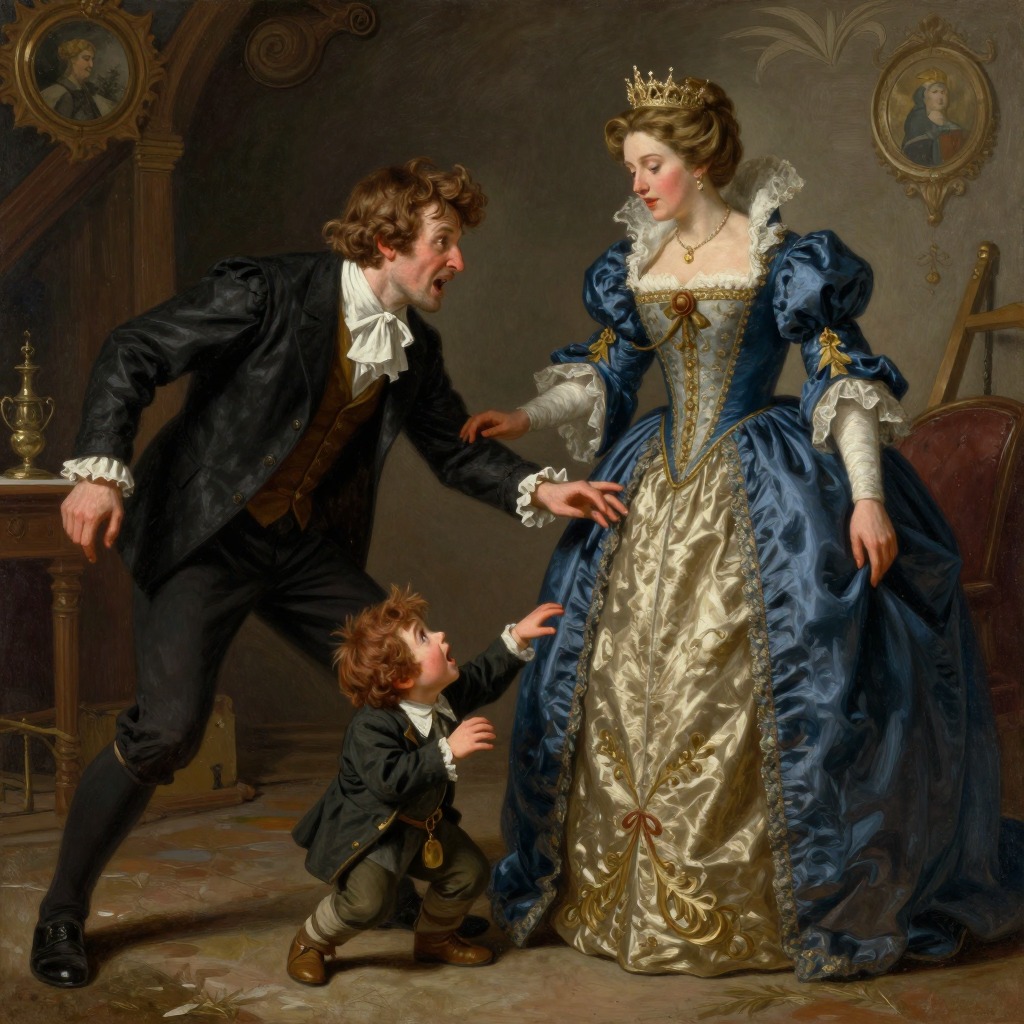
Gulliver and the dwarf of Brobdingnag
Gulliver's TravelsThe relationship between Lemuel Gulliver and the queen's dwarf in Brobdingnag is one of the most sharply drawn antagonisms in Gulliver's second voyage, a sustained conflict that exposes the raw nerves of status, size, and humiliation in a land where Gulliver is the smallest creature at court. The dwarf, who is himself the smallest human ever known in that kingdom at nearly thirty feet high, becomes instantly insolent at the sight of a creature so much beneath him, and his campaign of petty cruelties against Gulliver forms a recurring thread of danger and comedy throughout Gulliver's stay at the Brobdingnag court.
Origins and Character of the Antagonism
The dwarf's enmity is rooted in a displaced sense of superiority. Having been the queen's smallest curiosity, he finds his position usurped by Gulliver, a being far more diminutive than himself. The text notes that the dwarf, who was "not full thirty feet high," became so insolent at seeing a creature so much beneath him that he would always affect to swagger and look big as he passed Gulliver in the queen's ante-chamber. He seldom failed to deliver a smart word or two upon Gulliver's littleness, to which Gulliver could only reply by calling him "brother," challenging him to wrestle, and using other repartees common among court pages. This verbal sparring masks a deeper malice that repeatedly erupts into physical attacks.
The Cream Bowl Incident
The most dramatic and dangerous of the dwarf's attacks occurs during a dinner at court. Nettled by something Gulliver had said, the malicious little cub raised himself upon the frame of the queen's chair, took Gulliver up as he was sitting down, and dropped him head over ears into a large silver bowl of cream. Gulliver, a good swimmer, managed to stay afloat, but he swallowed above a quart of cream before Glumdalclitch, who happened to be at the other end of the room, could run to his relief. The queen was in such a fright that she lacked presence of mind to assist him. Though Gulliver received no permanent damage beyond the loss of a suit of clothes, the dwarf was soundly whipped and, as a further punishment, forced to drink up the entire bowl of cream into which he had thrown his victim. He was never restored to favor; soon after, the queen bestowed him on a lady of high quality, and Gulliver saw him no more.
The Marrow-Bone Trick
Before the cream bowl incident, the dwarf had already served Gulliver a scurvy trick that set the queen laughing even as she was heartily vexed. The queen had taken a marrow-bone upon her plate and, after knocking out the marrow, placed the bone erect on the dish. Watching his opportunity while Glumdalclitch was gone to the sideboard, the dwarf mounted upon the stool she stood on, took Gulliver up in both hands, squeezed his legs together, and wedged them into the marrow-bone above his waist. Gulliver stuck there for nearly a minute, making a very ridiculous figure, though he thought it below him to cry out. His legs were not scalded, only his stockings and breeches in a sad condition. At Gulliver's own entreaty, the dwarf received no other punishment than a sound whipping.
The Apple Incident in the Garden
The dwarf's malice extended beyond the palace dining room into the court gardens. One day, when Glumdalclitch had set Gulliver down near some dwarf apple-trees, Gulliver could not resist showing his wit by a silly allusion between the dwarf and the trees, which happens to hold in their language as it does in English. The malicious rogue, watching his opportunity while Gulliver was walking under one of the trees, shook it directly over his head. A dozen apples, each near as large as a Bristol barrel, came tumbling about his ears; one hit him on the back as he chanced to stoop and knocked him down flat on his face. Gulliver received no other hurt, and the dwarf was pardoned at Gulliver's own desire because he had given the provocation.
The Fly-Tormenting Campaign
The dwarf also exploited Gulliver's fear of the enormous Brobdingnagian flies, which were each as big as a Dunstable lark and would sting him to the quick when they alighted on his nose or forehead. It became the common practice of the dwarf to catch a number of these insects in his hand, as school-boys do, and let them out suddenly under Gulliver's nose on purpose to frighten him and divert the queen. Gulliver's remedy was to cut them in pieces with his knife as they flew in the air, a dexterity that was much admired, but the dwarf's campaign of terror was relentless.
Thematic Significance
The relationship between Gulliver and the dwarf is a microcosm of the larger themes of the Brobdingnag voyage: the cruelty of hierarchy, the relativity of size and status, and the humiliation of being the smallest and weakest. The dwarf, who should be Gulliver's natural ally as a fellow outsider at court, instead becomes his most persistent tormentor, driven by the very insecurity that his own smallness creates. Gulliver's responses—sometimes witty, sometimes fearful, sometimes generous in pleading for the dwarf's pardon—reveal his own complex navigation of pride and vulnerability. The dwarf's eventual banishment from court, while satisfying to Gulliver, also underscores the precariousness of anyone who depends on royal favor in a world where size determines power.