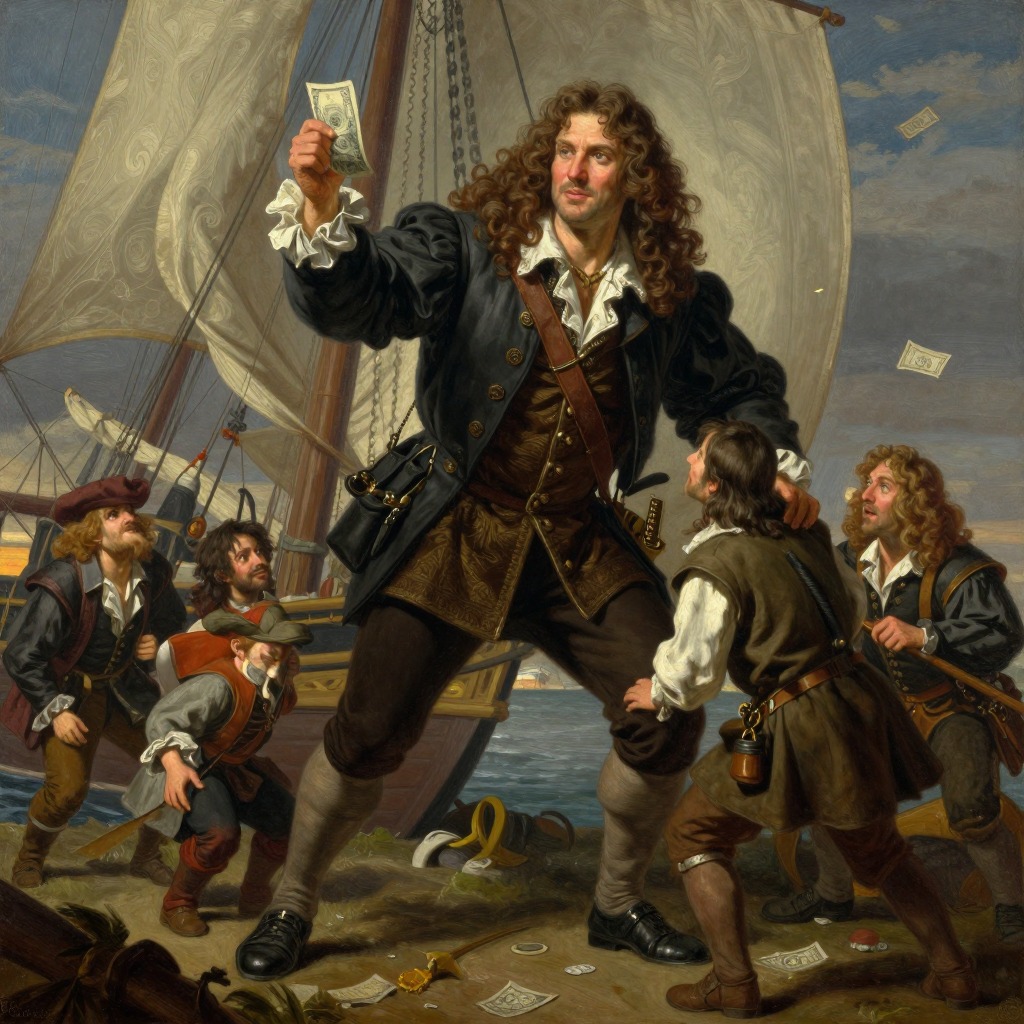
Gulliver's exhibition at the market-town
Gulliver's TravelsGulliver's exhibition at the market-town is the degrading public display of Lemuel Gulliver as a performing curiosity by the Brobdingnagian farmer who captured him, marking the first systematic commodification of his body and the beginning of his prolonged humiliation in Brobdingnag. The event transforms Gulliver from a captive into a commercial spectacle, strips him of dignity, and establishes the pattern of exhausting, repetitive performances that will define his life in the kingdom until his sale to the Queen of Brobdingnag.
Causes and Background
The exhibition was set in motion by the advice of a miserly neighbor who visited the farmer's house to verify the story of the strange animal found in the field. This old, dim-sighted man, after putting on his spectacles to examine Gulliver—an act that made Gulliver laugh heartily—suggested that the farmer show Gulliver as a sight on the next market-day in the nearest town, about twenty-two miles away. The farmer and his friend whispered together for a long time, sometimes pointing at Gulliver, who overheard and understood enough to suspect mischief. The next morning, Glumdalclitch, the farmer's nine-year-old daughter who had become Gulliver's devoted nurse and teacher, confirmed the plan, having cunningly picked it out from her mother. She wept with shame and grief, laying Gulliver on her bosom, and expressed her fear that rude, vulgar people might squeeze him to death or break his limbs. She also noted how modest Gulliver was and how deeply he would feel the indignity of being exposed for money as a public spectacle to the meanest of the people. She bitterly compared her parents' promise that Grildrig—the name she had given him—would be hers to their previous year's pretense of giving her a lamb, which they sold to a butcher as soon as it was fat.
What Happens
On the market-day, the farmer carried Gulliver in a close box to the neighboring town, with Glumdalclitch riding behind him on a pillion. The box was closed on every side, with a little door for Gulliver to enter and exit and a few gimlet holes for air. The girl had carefully put the quilt of her baby's bed into it for him to lie on. The journey was terribly shaking and discomposing, for the horse took about forty feet at every step and trotted so high that the agitation equaled the rising and falling of a ship in a great storm, but much more frequent. The farmer alighted at an inn he used to frequent, consulted with the innkeeper, and hired the crier to give notice through the town of a strange creature to be seen at the sign of the Green Eagle—not so big as a splacnuck (an animal about six feet long), in every part resembling a human creature, able to speak several words and perform a hundred diverting tricks.
Gulliver was placed upon a table in the largest room of the inn, which was near three hundred feet square. Glumdalclitch stood on a low stool close to the table to take care of him and direct his actions. The farmer, to avoid a crowd, allowed only thirty people at a time to see him. Gulliver walked about on the table as the girl commanded; she asked him questions as far as his understanding of the language reached, and he answered as loud as he could. He turned about several times to the company, paid his humble respects, said they were welcome, and used other speeches he had been taught. He took a thimble filled with liquor that Glumdalclitch had given him for a cup and drank their health. He drew out his hanger and flourished it after the manner of fencers in England. His nurse gave him part of a straw, which he exercised as a pike, having learned the art in his youth. He was shown that day to twelve sets of company and forced to act over again the same fopperies until he was half dead with weariness and vexation. Those who had seen him made such wonderful reports that people were ready to break down the doors to come in. An unlucky schoolboy aimed a hazel-nut directly at Gulliver's head, which very narrowly missed him; it came with so much violence that it would have infallibly knocked out his brains, for it was almost as large as a small pumpkin. Gulliver had the satisfaction of seeing the young rogue well beaten and turned out of the room.
Consequences and Aftermath
The exhibition was so profitable that the farmer gave public notice he would show Gulliver again the next market-day. In the meantime, he prepared a more convenient vehicle for him, for Gulliver was so tired from his first journey and from entertaining company for eight hours together that he could hardly stand on his legs or speak a word. It was at least three days before he recovered his strength. Even at home, he had no rest, as all the neighboring gentlemen from a hundred miles round, hearing of his fame, came to see him at the farmer's house. There could not be fewer than thirty persons with their wives and children, and the farmer demanded the rate of a full room whenever he showed Gulliver at home, even if only to a single family. For some time, Gulliver had little ease every day of the week except Wednesday, which was their Sabbath, although he was not carried to the town. The farmer, finding how profitable Gulliver was likely to be, resolved to carry him to the most considerable cities of the kingdom. He provided himself with all things necessary for a long journey, settled his affairs at home, and on August 17, 1703, about two months after Gulliver's arrival, they set out for the metropolis, Lorbrulgrud, about three thousand miles away. Glumdalclitch rode behind her father, carrying Gulliver on her lap in a box tied about her waist. The girl had lined it with the softest cloth, well quilted underneath, furnished it with her baby's bed, and provided him with linen and other necessaries. They made easy journeys of not above seven or eight score miles a day, for Glumdalclitch, on purpose to spare Gulliver, complained she was tired with the trotting of the horse. She often took him out of his box at his own desire to give him air and show him the country, but always held him fast by a leading-string. They passed over five or six rivers many degrees broader and deeper than the Nile or the Ganges, and there was hardly a rivulet so small as the Thames at London Bridge. They were ten weeks on the journey, and Gulliver was shown in eighteen large towns, besides many villages and private families. On October 26, 1703, they arrived at Lorbrulgrud, where the farmer took a lodging in the principal street, not far from the royal palace, and put out bills containing an exact description of Gulliver's person and parts. He hired a large room between three and four hundred feet wide, provided a table sixty feet in diameter upon which Gulliver was to act his part, and palisaded it round three feet from the edge and as many high to prevent his falling over. Gulliver was shown ten times a day to the wonder and satisfaction of all people. By this time he could speak the language tolerably well and perfectly understood every word spoken to him; he had also learned their alphabet and could make a shift to explain a sentence here and there, for Glumdalclitch had been his instructor while they were at home and at leisure hours during the journey. The frequent labors he underwent every day made a very considerable change in his health in a few weeks; the more the farmer got by him, the more insatiable he grew. Gulliver quite lost his stomach and was almost reduced to a skeleton. The farmer observed this and, concluding Gulliver must soon die, resolved to make as good a hand of him as he could. This pattern of exhausting exhibition was broken only when a gentleman-usher came from court commanding the farmer to carry Gulliver immediately to the palace for the diversion of the Queen of Brobdingnag and her ladies, an event that led to Gulliver's sale to the queen and his eventual rescue from the farmer's exploitative shows.