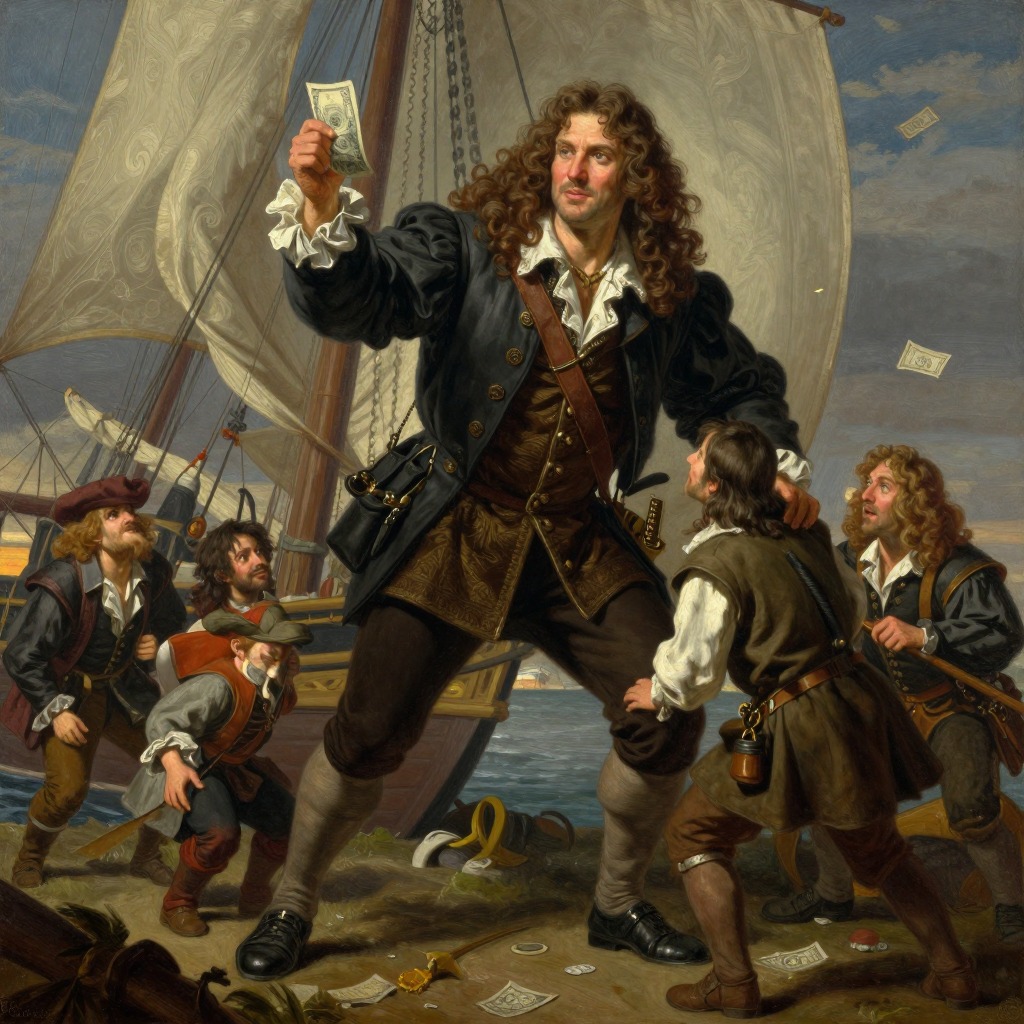
Gulliver's rescue by the English ship
Gulliver's TravelsAfter two years in Brobdingnag, Gulliver's deliverance came in a manner he described as "not very common." While accompanying the king and queen on a progress to the south coast, he obtained permission from his nurse Glumdalclitch to take the fresh sea air with a page. He had himself set down in his travelling box near the rocks on the shore, and, feeling unwell, climbed into his hammock for a nap. The page, thinking no danger could occur, wandered off among the rocks to look for birds' eggs. While Gulliver slept, an eagle seized the ring at the top of the box in its beak and carried it high into the air. The first jolt nearly shook him out of his hammock; looking through his windows he could see nothing but clouds and sky. He heard the clapping of wings and understood his peril: the bird intended to drop the box on a rock like a tortoise in a shell and then devour him.
The Fall into the Sea
The noise and flutter of wings increased rapidly, and the box was tossed up and down. Gulliver heard several bangs or buffets given to the eagle, and then suddenly felt himself falling perpendicularly for over a minute with such swiftness that he almost lost his breath. The fall was stopped by a terrible squash, louder to his ears than the cataract of Niagara. He was in darkness for another minute, then the box began to rise so high that he could see light from the tops of the windows. He perceived he had fallen into the sea. The box, by the weight of his body, the goods inside, and the broad iron plates fixed at the four corners of the top and bottom, floated about five feet deep in the water. He supposed the eagle had been pursued by two or three others and forced to let him drop while defending itself. The iron plates preserved the balance during the fall and prevented the box from breaking on the surface. Every joint was well grooved, and the door moved up and down like a sash, keeping the closet so tight that very little water entered. He got out of his hammock with difficulty and drew back the slip-board on the roof, contrived to let in air, for he was almost stifled.
Desperate Hours in the Floating Box
Gulliver found himself in a state of extreme distress. He expected every moment to see his box dashed to pieces or overset by the first violent blast or rising wave. A breach in a single pane of glass would have meant immediate death; only the strong lattice-wires placed on the outside against accidents in travelling preserved the windows. He saw water oozing in at several crannies and endeavored to stop them as well as he could. He was unable to lift up the roof of his closet, which otherwise he would have done to sit on top and preserve himself some hours longer. He reflected that if he escaped these dangers for a day or two, he could expect nothing but a miserable death of cold and hunger. He was four hours under these circumstances, expecting and indeed wishing every moment to be his last.
Discovery and Rescue
While in this disconsolate state, Gulliver heard a grating noise on the side of the box where the two strong staples were fixed, and soon after felt the box being pulled or towed along in the sea. He ventured to unscrew one of his chairs, which were always fastened to the floor, and having screwed it down again directly under the slipping board, mounted on it and called for help in a loud voice in all the languages he understood. He then fastened his handkerchief to a stick he usually carried and waved it several times in the air through the hole. After about an hour, the side of the box with the staples struck against something hard, and he found himself hoisted up at least three feet higher than before. He again thrust up his stick and handkerchief, calling for help till he was almost hoarse. In return he heard a great shout repeated three times, giving him transports of joy. He then heard a trampling over his head and somebody calling through the hole in the English tongue: "If there be anybody below, let them speak." Gulliver answered that he was an Englishman, drawn by ill fortune into the greatest calamity that ever any creature underwent, and begged to be delivered. The voice replied that he was safe, for his box was fastened to their ship, and the carpenter would immediately come and saw a hole in the cover large enough to pull him out. Gulliver answered that was needless, for there was no more to be done but let one of the crew put his finger into the ring and take the box out of the sea into the ship. Some of them upon hearing him talk so wildly thought he was mad; others laughed. The carpenter came and in a few minutes sawed a passage about four feet square, then let down a small ladder upon which Gulliver mounted, and from thence was taken into the ship in a very weak condition.
Aboard the Ship
The sailors were all in amazement and asked him a thousand questions, which he had no inclination to answer. He was equally confounded at the sight of so many pygmies, for such he took them to be after having so long accustomed his eyes to the monstrous objects he had left. The captain, Thomas Wilcocks, an honest, worthy Shropshire man, observing that Gulliver was ready to faint, took him into his cabin, gave him a cordial to comfort him, and made him turn in upon his own bed, advising him to take a little rest. Before going to sleep, Gulliver gave him to understand that he had valuable furniture in his box—a fine hammock, two chairs, a table, and a cabinet—and that his closet was hung on all sides, or rather quilted, with silk and cotton. The captain, hearing these absurdities, concluded he was raving, but promised to give orders as he desired. The seamen drew up all his goods and stripped off the quilting; the chairs, cabinet, and bedstead, being screwed to the floor, were much damaged by the ignorance of the seamen, who tore them up by force. They then knocked off some of the boards for the use of the ship and let the hull drop into the sea, which sank to rights. Gulliver was glad not to have been a spectator of the havoc they made.
Aftermath and Return to England
Gulliver slept some hours, perpetually disturbed with dreams of the place he had left and the dangers he had escaped. Upon waking, he found himself much recovered. The captain ordered supper immediately, and when they were left alone, desired Gulliver to give him a relation of his travels. The captain told Gulliver that about noon he had spied the box at a distance through his glass, thought it was a sail, and sent out his long-boat to discover what it was; his men came back in a fright, swearing they had seen a swimming-house. He laughed at their folly and went himself in the boat, rowed round the box several times, observed the windows and wire-lattices, discovered the two staples, and fastened a cable to one of them, towing the chest towards the ship. When it was there, he gave directions to fasten another cable to the ring fixed in the cover and to raise the chest with pulleys, which all the sailors were not able to do above two or three feet. He said they saw Gulliver's stick and handkerchief thrust out of the hole and concluded that some unhappy man must be shut up in the cavity. Gulliver asked whether he or the crew had seen any prodigious birds in the air about the time he first discovered him; the captain answered that one of the sailors had observed three eagles flying towards the north, but remarked nothing of their being larger than the usual size. Gulliver then asked how far they might be from land; the captain said at least a hundred leagues. Gulliver assured him he must be mistaken by almost half, for he had not left the country from whence he came above two hours before he dropped into the sea. The captain began again to think that his brain was disturbed. Gulliver begged his patience to hear his story, which he faithfully did from the last time he left England to the moment the captain first discovered him. The honest worthy gentleman, who had some tincture of learning and very good sense, was immediately convinced of his candor and veracity. To confirm all he had said, Gulliver opened his cabinet in the captain's presence and showed him the small collection of rarities he had made in Brobdingnag: the comb he had contrived out of the stumps of the king's beard, a collection of needles and pins from a foot to half a yard long, four wasps' stings like joiners' tacks, some combings of the queen's hair, and a gold ring which the queen had made him a present of, taking it from her little finger and throwing it over his head like a collar. The captain accepted a footman's tooth, about a foot long and four inches in diameter, which Gulliver had cleaned and put in his cabinet. The captain was very well satisfied with this plain relation and said he hoped when they returned to England Gulliver would oblige the world by putting it on paper and making it public. The voyage was very prosperous; they arrived in the Downs on the third day of June, 1706, about nine months after Gulliver's escape. The captain refused to receive any payment for freight. Gulliver hired a horse and guide for five shillings, which he borrowed of the captain, and set out for his house in Redriff. When he came to his own house, he behaved so unaccountably—bending down to go in for fear of striking his head, stooping lower than his wife's knees, and looking down upon the servants as if they had been pygmies—that they all concluded he had lost his wits. In a little time, he and his family and friends came to a right understanding, but his wife protested he should never go to sea any more.