Lalcon
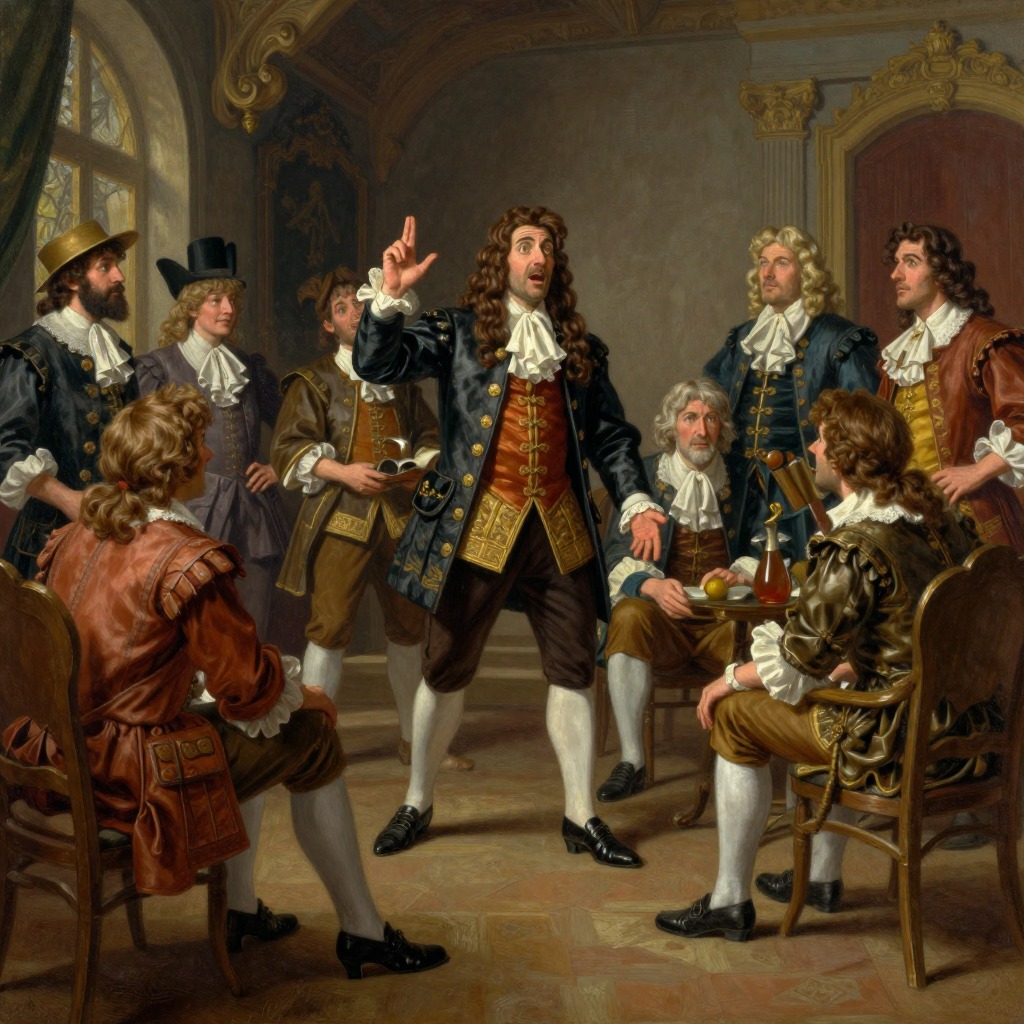
Gulliver's TravelsLalcon is the chamberlain of the Lilliputian court, a high-ranking official who participates in the most secret and consequential political machinations against Lemuel Gulliver. He is named among the junto of ministers — together with Skyrris Bolgolam the high admiral, Flimnap the lord high treasurer, Limtoc the general, and Balmuff the grand justiciary — who prepare articles of impeachment against Gulliver for treason and other capital crimes. This conspiracy, which had been forming for two months, represents the institutional turning of the Lilliputian court against the man-mountain after his greatest services to the empire.
Role in the Conspiracy Against Gulliver
Lalcon's inclusion in the cabal places him at the center of the plot to destroy Gulliver. The conspirators, meeting in the most private manner, drew up formal articles of impeachment that accused Gulliver of four principal crimes: having traitorously pulled the empress by the arms while extinguishing the fire in her apartment; having refused, like a false traitor, to seize all remaining Blefuscudian ships and reduce that empire to a province; having aided, abetted, and comforted the Blefuscudian ambassadors who came to sue for peace; and having prepared, under color of a verbal license, to make a voyage to the court of Blefuscu, thereby aiding an open enemy. The chamberlain's participation in drafting these articles made him an instrument of the court's determination to punish Gulliver for actions that had, in fact, saved the palace and prevented an invasion.
The Debate Over Punishment
During the several debates upon the impeachment, the emperor himself gave many marks of his great lenity, often urging the services Gulliver had done him and endeavoring to extenuate his crimes. The treasurer and admiral insisted that Gulliver should be put to the most painful and ignominious death, by setting fire to his house at night, with the general attending with twenty thousand men armed with poisoned arrows to shoot him in the face and hands. Some of his servants were to have private orders to strew a poisonous juice on his shirts and sheets, which would soon make him tear his own flesh and die in the utmost torture. For a long time there was a majority against sparing his life, but the emperor, resolving if possible to spare him, at last brought off the chamberlain — meaning that Lalcon, whose vote had been among the hostile majority, was persuaded to change his position, allowing the king to shift the balance away from immediate execution.
The Compromise and Its Outcome
With Lalcon's defection from the death-penalty faction, the way was opened for Reldresal, the principal secretary for private affairs and Gulliver's true friend, to propose a compromise: that Gulliver should be spared but have both his eyes put out. This proposal was received with the utmost disapprobation by the whole board, Bolgolam rising up in fury, but the emperor, fully determined against capital punishment, accepted the expedient. The sentence of putting out Gulliver's eyes was entered on the books, with none dissenting except Bolgolam, who was perpetually instigated by the empress to insist upon death. Lalcon's shift, therefore, was the critical move that prevented Gulliver's immediate murder and gave him the narrow window of three days in which to escape to Blefuscu.
Narrative Significance
Lalcon appears only as a name in the list of conspirators and as the chamberlain whom the emperor "brought off" from the death-penalty faction, yet his single recorded action — changing his vote — is the hinge on which Gulliver's survival turns. He embodies the faceless courtier who, without personal animosity toward Gulliver, participates in a political machinery that treats the man-mountain's services as irrelevant once they conflict with the emperor's ambitions. His willingness to be persuaded by the emperor's mercy, however, also shows that the Lilliputian court was not monolithic in its cruelty, and that the personal intervention of the monarch could still override the murderous designs of the admiral and the treasurer. Lalcon thus represents the ambiguous middle ground of the court — neither friend nor mortal enemy to Gulliver, but a functionary whose single decision, made at the emperor's behest, had life-or-death consequences.