Lemuel Gulliver
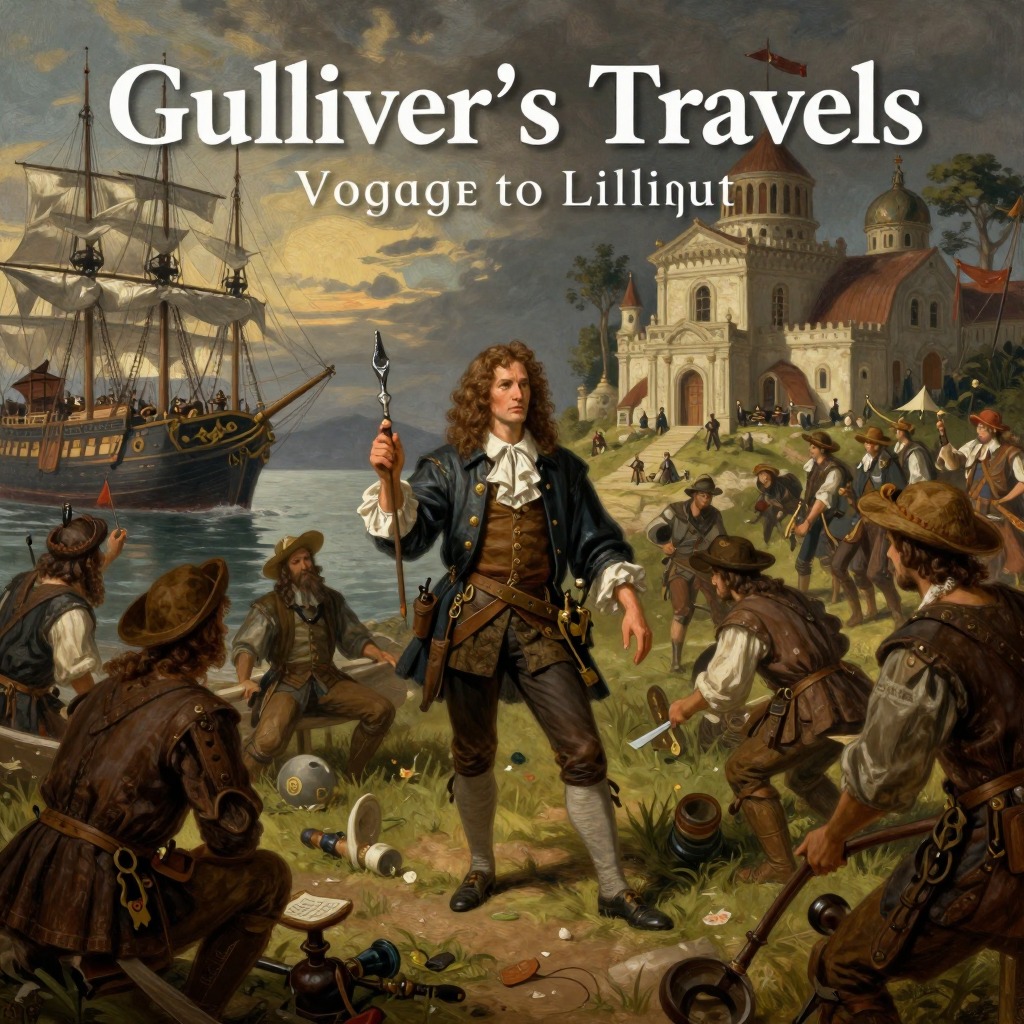
Gulliver's TravelsLemuel Gulliver is the central figure and narrator of Jonathan Swift's Gulliver's Travels, a work that uses his extraordinary voyages to mount a devastating satire on human nature and European society. A practical, middle-class Englishman—a surgeon and later a captain—Gulliver is driven by an insatiable desire to see foreign countries. His adventures among the six-inch-tall Lilliputians and the sixty-foot-tall Brobdingnagians expose him to radically different perspectives, and his own perceptions are repeatedly and comically upended. Through his eyes, Swift explores the relativity of size, power, and morality, ultimately revealing Gulliver not as a reliable hero but as a deeply flawed and increasingly unreliable narrator whose judgments are shaped by his own prejudices and limited understanding.
Identity and Background
Gulliver was born in Nottinghamshire, the third of five sons, to a father with a small estate. He was sent to Emmanuel College, Cambridge, at fourteen, where he studied for three years before being apprenticed to the eminent London surgeon James Bates. Always believing he would one day travel, he used small sums of money from his father to learn navigation and mathematics. After his apprenticeship, he studied physic at Leyden for two years and seven months, knowing it would be useful on long voyages. He then served as a surgeon aboard the "Swallow" under Captain Abraham Pannell, making voyages into the Levant. Returning to London, he married Mary Burton, receiving a four-hundred-pound portion, and set up practice. When his master Bates died and his business failed, he returned to sea, serving as a surgeon on two ships for six years, traveling to the East and West Indies. He spent his leisure hours reading the best authors and observing the manners and languages of the people he visited. After an unsuccessful final voyage, he grew weary of the sea and tried to settle in London, but after three years of poor prospects, he accepted an offer from Captain William Prichard to serve as surgeon on the "Antelope," bound for the South Sea. They set sail from Bristol on May 4, 1699.
Life and Plot Trajectory
Gulliver's first extraordinary adventure begins with a shipwreck. Driven by a violent storm northwest of Van Diemen's Land, the "Antelope" is dashed against a rock on November 5, 1699. Six crew members escape in a boat, but it is soon overset. Gulliver swims for his life, pushed by wind and tide, and eventually finds himself within his depth. He reaches shore, exhausted, and falls into a deep sleep on the grass. Upon waking, he finds himself bound by hundreds of tiny ligatures—he is a prisoner of the Lilliputians, a race of people not six inches high. After a period of captivity, during which he is fed, housed in a disused temple, and searched for weapons, he gradually gains the favor of the Emperor of Lilliput and his court. He learns their language, performs feats of strength, and eventually secures his liberty by swearing to a set of articles. He then performs a great service for the empire by single-handedly capturing the entire fleet of the rival island of Blefuscu, preventing an invasion. He also extinguishes a fire in the empress's apartment by an expedient that, while effective, deeply offends her. Despite these services, a conspiracy led by the admiral Skyrris Bolgolam and the treasurer Flimnap accuses him of high treason. Warned by his friend Reldresal, Gulliver escapes to Blefuscu, and from there, after finding a boat, he sets sail and is rescued by an English merchantman, returning home on April 13, 1702.
His second voyage is even more disorienting. After only two months at home, his "insatiable desire of seeing foreign countries" drives him to sea again, aboard the "Adventure" under Captain John Nicholas. A fierce storm drives the ship far off course, and on June 16, 1703, land is sighted. Gulliver goes ashore with a party to find water, but is left behind when a huge creature chases the boat back to the ship. He finds himself in Brobdingnag, a land where everything is gigantic. He is discovered by a farmer, who takes him home and treats him as a curiosity. The farmer's nine-year-old daughter, whom Gulliver calls Glumdalclitch ("little nurse"), becomes his caretaker and teacher. The farmer, seeing a profit, exhibits Gulliver in market towns and eventually in the metropolis of Lorbrulgrud. The Queen of Brobdingnag buys Gulliver from the farmer and presents him to the King. Gulliver becomes a favorite at court, but his life is filled with humiliating and dangerous accidents: he is dropped into a bowl of cream by the queen's dwarf, attacked by giant wasps, and carried off by a monkey. After two years, during a royal progress to the south coast, an eagle seizes his travelling box and drops it into the sea. He is rescued by an English ship under Captain Thomas Wilcocks and returns to England on June 3, 1706.
Key Actions and Objectives
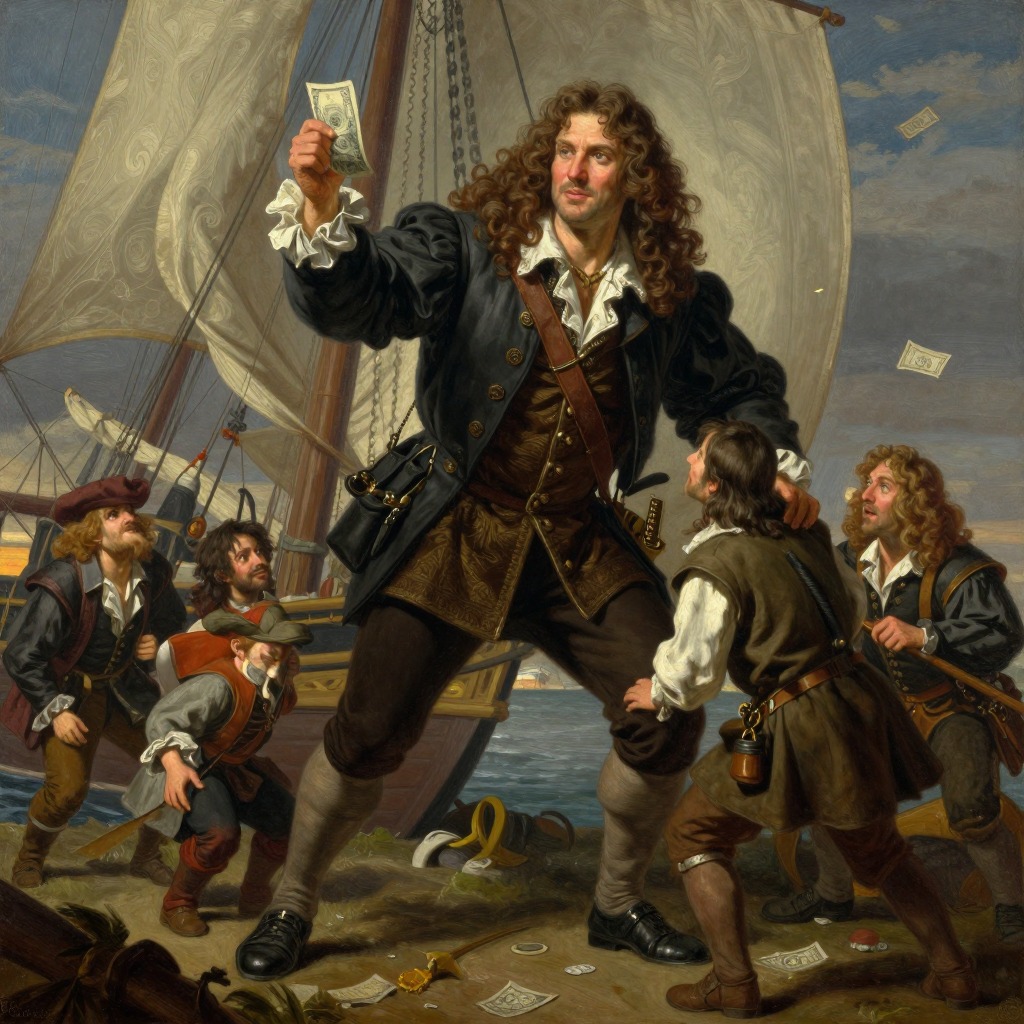
Gulliver's primary objective is survival and, ultimately, a return to his native country. In Lilliput, his actions are largely reactive: he submits to captivity, learns the language, and performs services to gain favor. His most significant action is the capture of the Blefuscu fleet, a feat of engineering and daring that he accomplishes by wading into the channel, using hooks and cables he has made, and towing fifty men-of-war back to the Lilliputian port. He also extinguishes the palace fire by urinating on it, a practical but undignified solution. In Brobdingnag, his actions are even more constrained by his helplessness. He is exhibited for money, a role he finds deeply humiliating. He attempts to ingratiate himself with the king by offering the secret of gunpowder, a proposal that is met with horror and rejection. Throughout both voyages, he is a keen observer, meticulously recording the customs, laws, and politics of the lands he visits, and he frequently attempts to defend the honor of his own country, England, against the criticisms of his hosts.
Relationships and Conflict
Gulliver's relationships are defined by his relative size and power. In Lilliput, he is a benevolent giant, forming a genuine friendship with the secretary Reldresal, who warns him of the conspiracy. He also earns the enmity of the admiral Skyrris Bolgolam and the treasurer Flimnap, who see him as a threat. His relationship with the Emperor of Lilliput is one of uneasy dependence, souring after Gulliver refuses to help enslave the Blefuscudians. In Brobdingnag, he is a helpless miniature, forming a tender bond with Glumdalclitch, who protects and teaches him. He is treated with kindness by the Queen of Brobdingnag, but the King of Brobdingnag, after listening to Gulliver's account of Europe, delivers a devastating verdict: the English are "the most pernicious race of little odious vermin that nature ever suffered to crawl upon the surface of the earth." Gulliver's conflict with the queen's dwarf is a series of petty humiliations, culminating in the dwarf dropping him into a bowl of cream. The central conflict of the narrative is not between Gulliver and any single antagonist, but between his own ingrained European prejudices and the radically different perspectives he encounters.
Change and Ending
Gulliver undergoes a profound psychological transformation, but it is not a positive one. After two years in Brobdingnag, he becomes so accustomed to the gigantic scale that upon his return to England, he perceives his own countrymen as pygmies. He is afraid of trampling on people in the street, he stoops to enter his own house, and he cannot see his daughter until she stands up. He tells his wife she has "starved herself and her daughter to nothing." His behavior is so unaccountable that his family and friends conclude he has lost his wits. Gulliver himself recognizes this as "an instance of the great power of habit and prejudice." The ending is not a triumphant return but a comic and unsettling demonstration of his inability to readjust. He has internalized the Brobdingnagian perspective so thoroughly that he can no longer function in his own world, leaving him isolated and alienated, a fitting conclusion to a narrative that systematically dismantles the certainties of its narrator.
Narrative Role and Evaluation
Gulliver is an unreliable narrator, a fact that is central to the book's satirical power. He presents himself as a plain, truthful man—his friend Richard Sympson notes that "it became a sort of proverb among his neighbors at Redriff, when any one affirmed a thing, to say it was as true as if Mr. Gulliver had spoken it"—yet his accounts are filtered through his own biases, vanity, and limited understanding. He earnestly praises the institutions of England, only to have the King of Brobdingnag expose their corruption. He claims to love truth, but admits to "artfully elud[ing] many of his questions" to give a more favorable picture of his country. His physical perspective—first towering over, then being dwarfed by, those around him—becomes a metaphor for his intellectual and moral limitations. Swift uses Gulliver's voice not to convey a reliable truth, but to dramatize the very human tendency to mistake one's own provincial viewpoint for universal reality. Gulliver is less a hero than a vehicle for satire, and his ultimate failure to learn from his experiences is the book's most damning comment on human nature.
The composition of Gulliver's Travels, and thus the character of Lemuel Gulliver, was shaped by Swift's involvement with the Scriblerus Club, a group formed around 1713 with the aim of satirizing popular literary genres. Swift was initially tasked with writing the memoirs of the club's imaginary author, Martinus Scriblerus, and with satirizing the 'travellers' tales' subgenre. Correspondence reveals that Swift began the proper composition in 1720, writing the mirror-themed Parts I and II first, followed by Part IV in 1723 and Part III in 1724, with amendments made even while he was writing the Drapier's Letters. The book was completed by August 1725. Swift, aware that the work was a transparently anti-Whig satire, had the manuscript copied to prevent its use as evidence in a prosecution, a precaution born from his experience with Irish pamphlets. The manuscript was secretly delivered to publisher Benjamin Motte in March 1726, who, fearing prosecution, cut or altered the most offending passages before publishing the first edition anonymously on 28 October 1726.