Lilliputian ox
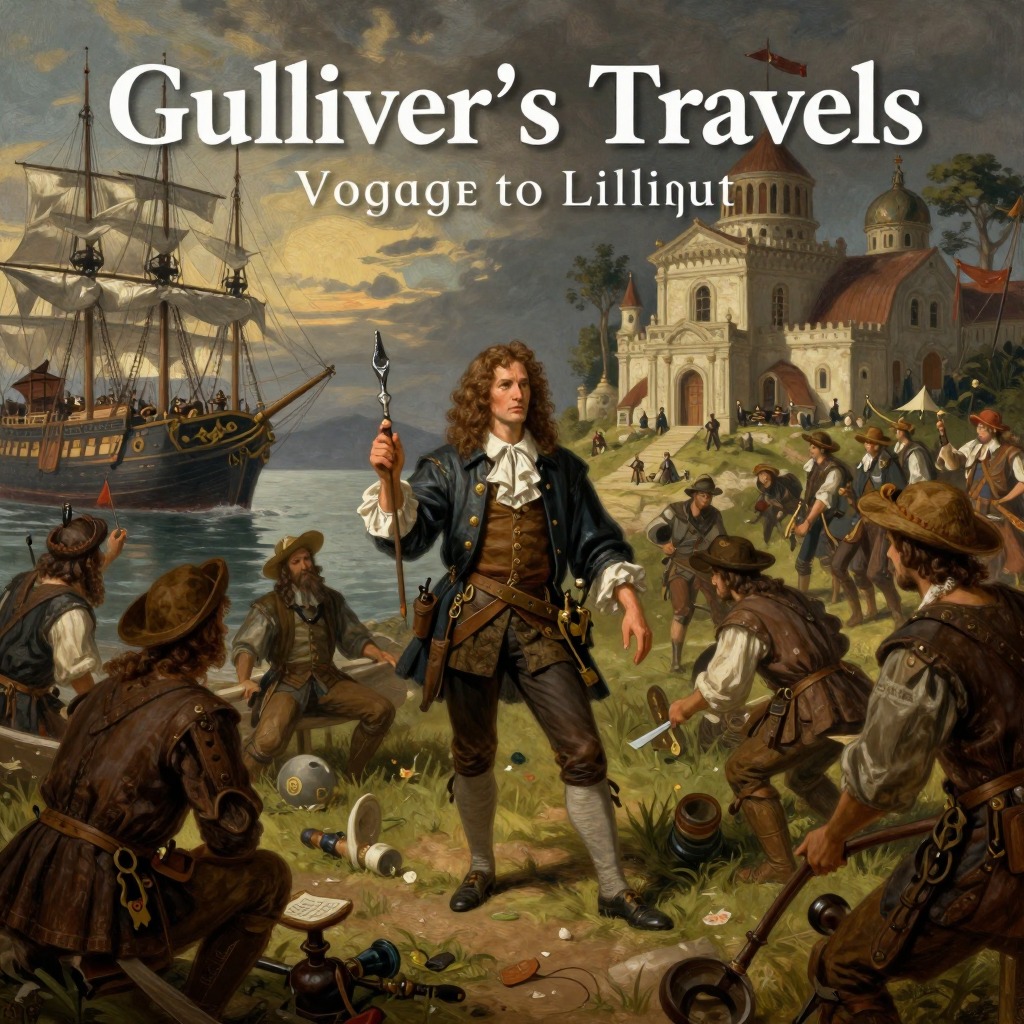
Gulliver's TravelsThe Lilliputian ox is one of the most striking examples of the exact proportional diminution that governs all life in the empire of Lilliput. As Gulliver reports, the common size of the natives is somewhat under six inches high, and all other animals, plants, and trees follow the same scale. The tallest horses and oxen are between four and five inches in height, while sheep are an inch and a half, more or less, and geese about the bigness of a sparrow. This consistent miniaturization makes the Lilliputian ox a creature that, to Gulliver's eyes, is barely larger than a common insect, yet it is a fully functional and vital part of the Lilliputian economy and diet.
Role in Gulliver's Sustenance
The Lilliputian ox was central to the enormous logistical effort required to feed Gulliver after his capture. The imperial commission that provided for his maintenance obliged all villages within nine hundred yards of the city to deliver, every morning, six beeves, forty sheep, and other victuals for his sustenance, together with a proportionable quantity of bread and wine. The emperor's mathematicians, having calculated that Gulliver's body was twelve times the height of a Lilliputian, concluded that his food requirements would equal those of 1,724 of his subjects, a figure that determined his daily allowance. The oxen were thus a key part of the state's rationing system, and their small size made them manageable for Gulliver, who could eat them in a few mouthfuls. He noted that their mutton yielded to that of England, but their beef was excellent, and he once had a sirloin so large that he was forced to make three bites of it, though this was rare.
Comparison with Other Creatures
The Lilliputian ox's size is a constant reference point for the relative scale of other animals in the book. In Brobdingnag, the giant cat that appeared in the farmer's house was three times larger than an ox, as Gulliver computed by the view of her head and one of her paws. The giant rats that attacked Gulliver in the farmer's bed were of the size of a large mastiff, but infinitely more nimble and fierce, and their size was measured against the familiar bovine. The monkey that seized Gulliver was as large as an elephant, a comparison that further underscores the ox's modest dimensions. These contrasts highlight the radical shifts in perspective that define Gulliver's travels, where the same creature can be a manageable food source in one world and a tiny, almost invisible animal in another.
Narrative and Thematic Significance
The Lilliputian ox is not merely a biological curiosity but a narrative device that reinforces the theme of relativity. Its small size makes Gulliver's own giant stature seem even more prodigious, and the elaborate state machinery required to feed him—the daily deliveries, the mathematical calculations, the assignments upon the treasury—becomes a satirical commentary on the absurdities of bureaucracy and the cost of maintaining a foreign body. The ox also appears in the context of Gulliver's proposal to the King of Brobdingnag to introduce gunpowder, where he describes the destructive power of cannonballs that would batter down the strongest walls. The king's horrified rejection of this technology is a moral counterpoint to the Lilliputians' pragmatic, if comical, management of their giant guest. The ox, as a humble and necessary part of that management, stands in quiet contrast to the violent ambitions that Gulliver represents.