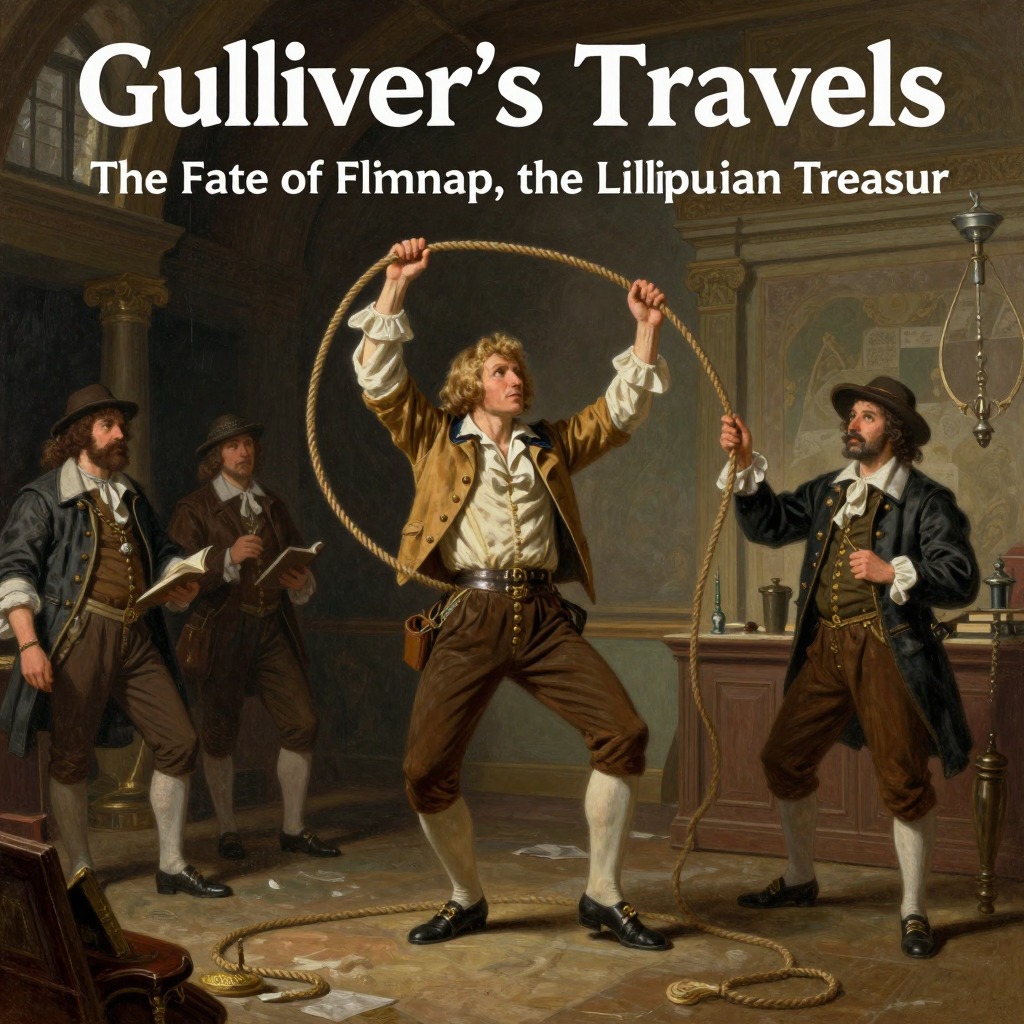
Lilliputian rope-dancing
Gulliver's TravelsLilliputian rope-dancing is a central institution of the Lilliputian court, a seemingly frivolous entertainment that in reality governs the distribution of the highest offices in the empire. Performed on a slender white thread extended about two feet from the ground, this diversion is practiced only by those who are candidates for great employments and high favor at court. The rules are brutally simple: whoever jumps the highest without falling succeeds in the vacant office. The practice is not confined to obscure aspirants; the chief ministers themselves are frequently commanded to show their skill, to convince the emperor that they have not lost their faculty. The lord high treasurer, Flimnap, is allowed to cut a caper on the straight rope at least an inch higher than any other lord in the whole empire, and has been seen doing the summersault several times together upon a trencher fixed on a rope no thicker than common packthread. Reldresal, the principal secretary for private affairs, is judged by Gulliver to be the second most skilled after the treasurer, with the rest of the great officers much upon a par.
Fatal Accidents and the Danger of Ambition
These diversions are often attended with fatal accidents, of which great numbers are on record. Gulliver himself has seen two or three candidates break a limb. The danger is much greater when the ministers themselves are commanded to show their dexterity, for by contending to excel themselves and their fellows, they strain so far that there is hardly one of them who has not received a fall, and some of them two or three. The risk is so well understood that it is a matter of court record that a year or two before Gulliver's arrival, Flimnap would have infallibly broken his neck if one of the king's cushions, that accidentally lay on the ground, had not weakened the force of his fall. The practice thus literalizes the precariousness of political life, where a single misstep can mean ruin or death.
The Stick-Leaping Ceremony and Silken Threads
A related but distinct diversion is the ceremony of the silken threads, shown only before the emperor, empress, and first minister upon particular occasions. The emperor lays on the table three fine silken threads of six inches long—one purple, the other yellow, and the third white—proposed as prizes for those he wishes to distinguish by a peculiar mark of his favor. The candidates, advancing one by one, must leap over or creep under a stick held by the emperor, sometimes with the first minister holding the other end, sometimes with the minister holding it entirely alone. Whoever performs with most agility and holds out the longest in leaping and creeping is rewarded with the blue-colored silk; the yellow is given to the next, and the green to the third. These girdles are worn twice about the middle, and few great persons around the court are not adorned with one of them. The ceremony is a transparent allegory for the arbitrary and physical nature of royal favor, where advancement depends on acrobatic submission rather than merit.
Corruption and the Degeneration of Institutions
Gulliver is careful to note that these practices were not part of the original institutions of Lilliput. He explains that the infamous practice of acquiring great employments by dancing on the ropes, or badges of favor and distinction by leaping over sticks and creeping under them, was first introduced by the grandfather of the emperor now reigning, and grew to its present height by the gradual increase of party and faction. This historical framing underscores the satirical point: the rope-dancing and stick-leaping are not timeless customs but recent corruptions, symptoms of a political system that has degenerated from its original principles. The contrast between the original laws—which punish fraud with death, reward long-term good conduct with the title of snillpall, and emphasize moral virtue over great abilities in choosing persons for employments—and the current practice of dancing for office highlights the depth of the court's decay. The rope-dancing is thus not merely a strange custom but a damning indictment of how political ambition and factionalism have perverted the mechanisms of governance, turning the selection of ministers into a lethal circus.