Lilliputian sheep
Gulliver's TravelsThe Lilliputian sheep are the native ovine species of the island empire of Lilliput, where all creatures exist in exact proportion to the six-inch-tall human inhabitants. These sheep are among the smallest of the country's domesticated animals, standing roughly an inch and a half in height, a scale that makes them appear almost insect-like to a visitor of normal human stature. They are a staple of the Lilliputian diet and economy, and their size and utility become a matter of direct consequence for Lemuel Gulliver during his captivity and eventual departure from the kingdom.
Size and Proportion
The Lilliputian sheep are a precise miniature of their European counterparts, their dimensions dictated by the same mathematical proportion that governs all life in Lilliput. While the tallest horses and oxen in the country reach between four and five inches in height, the sheep are notably smaller, standing at about an inch and a half. This extreme diminutiveness makes them a regular part of the Lilliputian diet, and Gulliver, who requires the sustenance of 1,724 Lilliputians, is provisioned daily with forty sheep as part of his official allowance from the emperor. The sheep are so small that Gulliver can consume them with ease, often eating them whole, bones and all, in a single mouthful, much as a European would eat the leg of a lark.
Role in the Lilliputian Economy
The sheep are a significant part of the Lilliputian agricultural economy, which is managed with the same meticulous efficiency as the rest of the empire. When the imperial council debates the enormous cost of feeding Gulliver, they calculate his daily ration based on the precise ratio of his body to theirs, concluding that he requires the equivalent of 1,724 Lilliputian portions. To meet this demand, an imperial commission obliges all villages within nine hundred yards of the capital to deliver, every morning, six beeves and forty sheep, along with other victuals, for his sustenance. The emperor assigns payments for these provisions from his own treasury, demonstrating the sheep's role as a standard unit of food supply and economic obligation within the kingdom.
Transport to England and Economic Aftermath
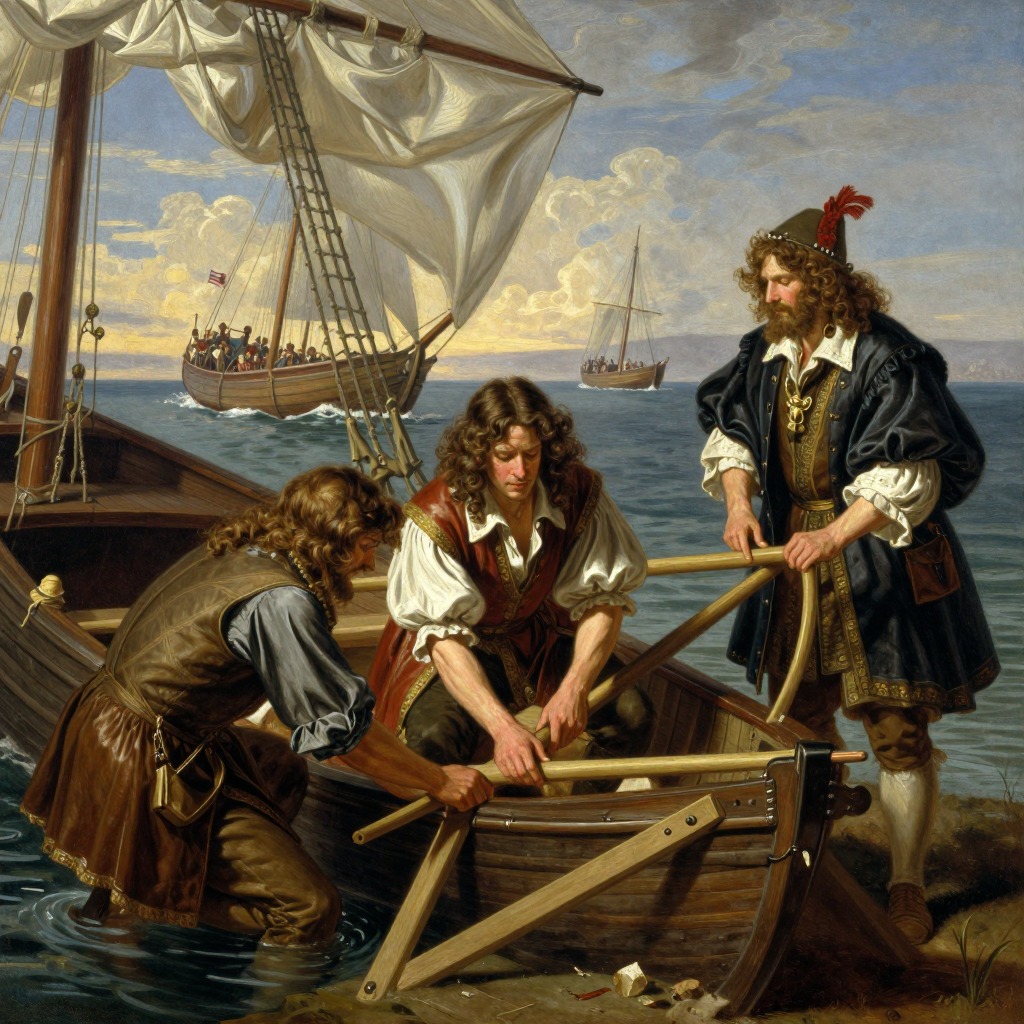
Upon preparing to leave Blefuscu and return to his native country, Gulliver stores the carcasses of three hundred sheep in his boat as provisions for the voyage. More significantly, he takes with him six ewes and two rams alive, with the explicit intention of carrying them into his own country and propagating the breed. This act of biological importation proves highly profitable. After his rescue by the English ship and his return to England, Gulliver sets the surviving livestock to graze on a bowling-green at Greenwich, where the fineness of the grass makes them feed heartily. He makes a considerable profit by showing the miniature cattle to many persons of quality and others, and before he begins his second voyage, he sells them for six hundred pounds. He later notes with satisfaction that the breed has considerably increased, especially the sheep, and expresses hope that the fineness of their fleeces will prove much to the advantage of the woollen manufacture.
Narrative and Thematic Significance
The Lilliputian sheep serve as a concrete emblem of the relative scale that defines Gulliver's first adventure. Their tiny size, which makes them a curiosity and a source of profit in England, is a direct consequence of the proportional world Gulliver has left behind. The sheep also function as a tangible link between the two worlds, a living souvenir that Gulliver can use to prove the truth of his extraordinary tale and to enrich himself. Their successful breeding in England underscores the practical, economic dimension of Gulliver's travels, contrasting with the political and philosophical lessons he learns. The sheep are not merely a curiosity; they are a commodity, a piece of evidence, and a symbol of the way that one world's ordinary livestock can become another world's marvel.