Mildendo
Gulliver's TravelsMildendo, the metropolis of Lilliput, is a city of exact geometric design and miniature scale, serving as the political and social heart of the empire. Its layout, architecture, and the events that unfold within its walls reveal the nature of Lilliputian civilization and the precarious position of Gulliver within it.
Layout and Architecture
The city is an exact square, each side of its encompassing wall measuring five hundred feet long. Two great streets, each five feet wide, run across the city and divide it into four quarters. The lanes and alleys, which Gulliver could only view as he passed, are from twelve to eighteen inches wide. The town is capable of holding five hundred thousand souls, and the houses range from three to five stories. The shops and markets are well provided. The wall that encompasses the city is two feet and a half high and at least eleven inches broad, flanked with strong towers at ten feet distance. The emperor's palace is situated in the very center of the city, where the two great streets meet. It is enclosed by a wall two feet high and twenty feet distant from the buildings. The outward court is a square of forty feet and includes two other courts; in the inmost are the royal apartments. The great gates from one square into another are but eighteen inches high and seven inches wide, and the buildings of the outer court are at least five feet high, built of hewn stone four inches thick.
Gulliver's Visits and Observations
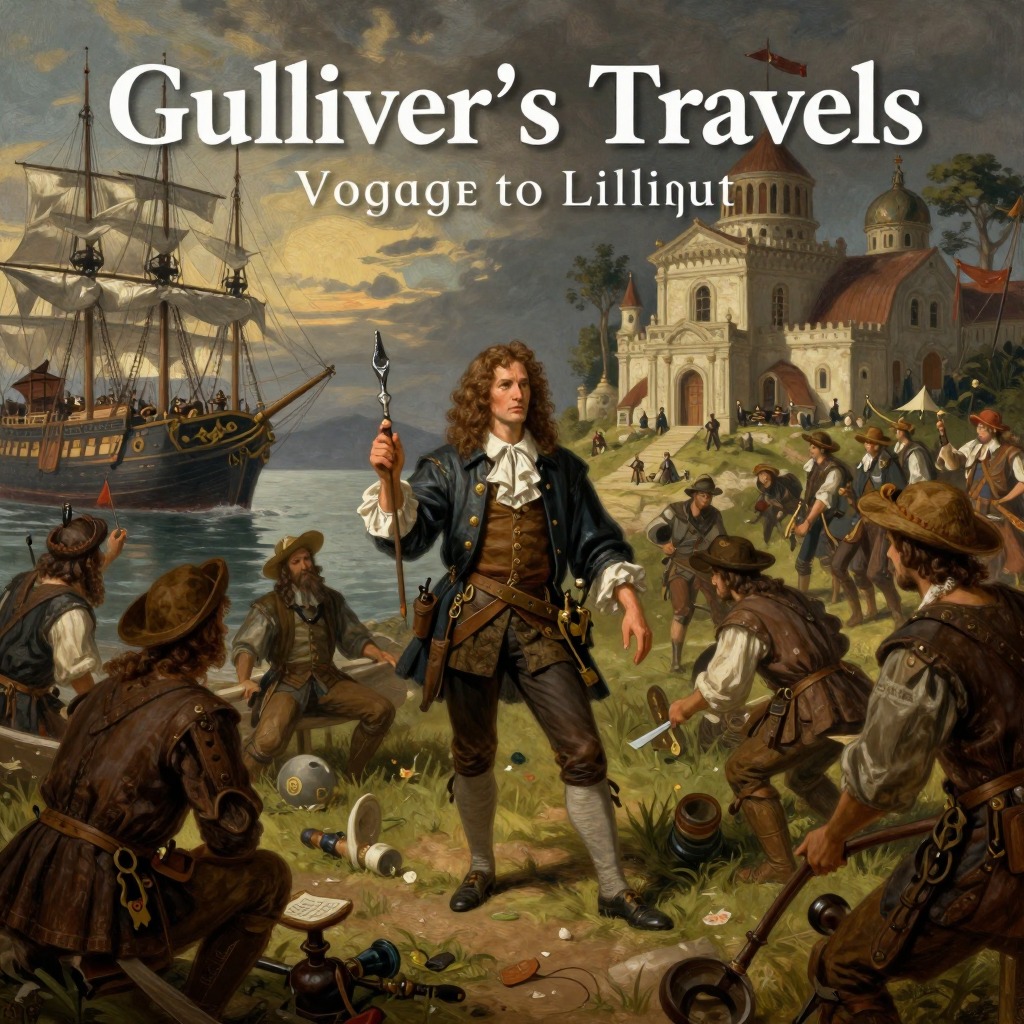
Gulliver's first request after obtaining his liberty was to see Mildendo, a wish the emperor easily granted with a special charge to do no hurt to the inhabitants or their houses. The people had notice by proclamation of his design to visit the town. Gulliver stepped over the great western gate and passed very gently and sideling through the two principal streets, wearing only his short waistcoat for fear of damaging the roofs and eaves with the skirts of his coat. He walked with utmost circumspection to avoid treading on any stragglers, though the orders were very strict that all people should keep within their houses at their own peril. The garret-windows and tops of houses were so crowded with spectators that Gulliver thought in all his travels he had not seen a more populous place. To see the innermost royal apartments, Gulliver cut down some of the largest trees in the royal park to make two stools, each about three feet high. He then went again through the city to the palace, using the stools to step over the buildings and gain access to the inmost court, where he lay down upon his side and applied his face to the windows of the middle stories, discovering the most splendid apartments that can be imagined. There he saw the empress and the young princes in their several lodgings, and her imperial majesty was pleased to smile very graciously upon him and give him out of the window her hand to kiss.
Political and Social Center
Mildendo is not merely a physical location but the epicenter of Lilliputian political life. It is from the palace that the emperor, whose heels are lower by at least a drurr than any of his court, administers the government. The city is the stage for the violent faction between the Tramecksan and Slamecksan, the high heels and low heels, who will neither eat nor drink nor talk with each other. The heir to the crown is observed to have one heel higher than the other, giving him a hobble in his gait. The metropolis is also the destination for the ambassadors from Blefuscu, who come to sue for peace after Gulliver's capture of their fleet. The emperor's palace is the site of the fire in the empress's apartment, caused by the carelessness of a maid of honor who fell asleep while reading a romance. Gulliver, alerted at midnight by the cries of many hundred people at his door, made his way to the palace and extinguished the fire in three minutes by an expedient that, while saving the palace, incurred the empress's perpetual malice, as she conceived the greatest abhorrence of him and vowed revenge. The city's central location and the emperor's palace are thus the nexus of both the empire's greatest crises and the personal dangers that ultimately force Gulliver to flee to Blefuscu.