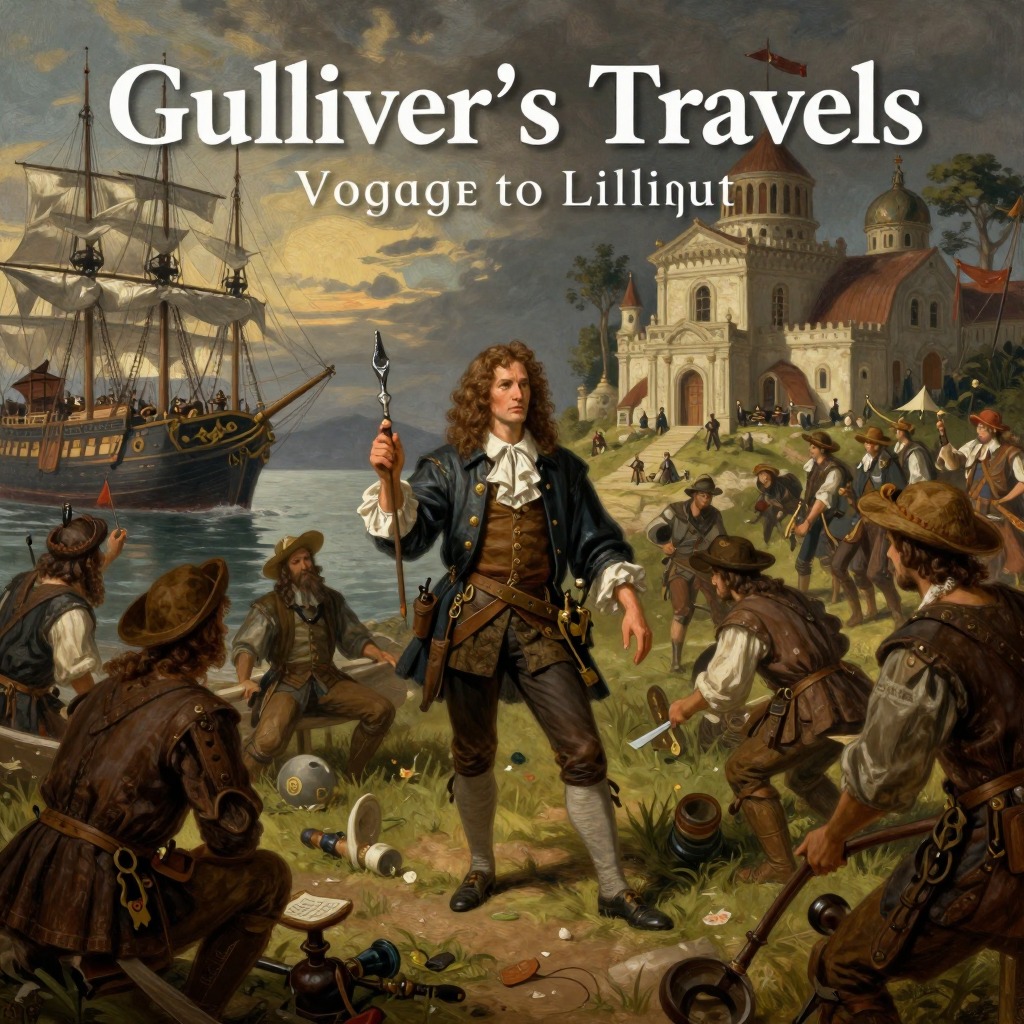
The emperor's search of Gulliver's pockets
Gulliver's TravelsThe emperor's search of Gulliver's pockets stands as one of the most richly comic and politically charged episodes in the Lilliputian voyage, a scene in which the mundane apparatus of an eighteenth-century European traveler is systematically catalogued by a civilization one-twelfth his size. The inventory, conducted by two officers named Clefrin Freloc and Marsi Freloc, becomes a mirror held up to both cultures: the Lilliputians' bureaucratic precision and their terrified wonder at Gulliver's technology, and Gulliver's own unexamined assumptions about the universality of his possessions. The event is not merely a security measure but a ritual of state power, a formalized act of inspection that transforms the Man-mountain from a guest into a documented subject of the empire.
Background and Authorization
The search arose directly from the emperor's political calculus. After Gulliver had been secured in the ancient temple and his daily maintenance established, the emperor held frequent councils debating the Man-mountain's fate—some ministers proposed starving him, others shooting him with poisoned arrows. In the midst of these deliberations, the emperor desired that Gulliver would not take it ill if he gave orders to certain proper officers to search him, for probably he might carry about him several weapons which must needs be dangerous things if they answered the bulk of so prodigious a person. Gulliver, having by then learned enough of the language to communicate, replied that his majesty should be satisfied, for he was ready to strip himself and turn up his pockets before him. The emperor responded that by the laws of the kingdom, Gulliver must be searched by two of his officers, but that he knew this could not be done without Gulliver's consent and assistance; he had so good an opinion of Gulliver's generosity and justice as to trust their persons in his hands, and whatever they took from him should be returned when he left the country, or paid for at the rate which he should set upon them. This legalistic framing—a promise of return and compensation—gave the search the veneer of a contractual arrangement rather than outright confiscation, though the power imbalance was absolute.
The Inventory and Its Discoveries
The two officers, armed with pen, ink, and paper, made an exact inventory of everything they saw, and Gulliver later translated this document into English. The inventory, presented as a formal report to the emperor, reads as a catalogue of incomprehensible marvels. In the right coat-pocket they found only one great piece of coarse cloth, large enough to be a foot-cloth for the emperor's chief room of state. In the left pocket they discovered a huge silver chest with a cover of the same metal, which they could not lift; when opened, one of the searchers stepped into it and found himself up to the mid-leg in a sort of dust that set them both sneezing—this was Gulliver's snuff-box. In his right waistcoat pocket they found a prodigious number of white thin substances folded one over another, about the bigness of three men, tied with a strong cable and marked with black figures, which they humbly conceived to be writings, every letter almost half as large as the palm of their hands. In the left waistcoat pocket was a sort of engine with twenty long poles resembling the palisadoes before the emperor's court, which they conjectured the Man-mountain used to comb his head—this was his comb. In the large pocket on the right side of his breeches they saw a hollow pillar of iron about the length of a man, fastened to a strong piece of timber, with huge pieces of iron sticking out cut into strange figures—this was one of his pocket-pistols. In the left pocket they found another engine of the same kind. In the smaller pocket on the right side were several round flat pieces of white and red metal of different bulk, some so heavy that the two officers could hardly lift them—these were his coins. In the left pocket were two black pillars irregularly shaped, one covered and seemingly all of a piece, the other with a white and round substance at the upper end about twice the bigness of their heads; within each was enclosed a prodigious plate of steel, which Gulliver showed them, explaining that in his own country his practice was to shave his beard with one and to cut his meat with the other—these were his knife and razor.
The Watch and the Fobs
The most extraordinary discoveries came from the two fobs, which the searchers could not enter. Out of the right fob hung a great silver chain with a wonderful kind of engine at the bottom. Gulliver drew it out: a globe, half silver and half of some transparent metal, with strange figures circularly drawn on the transparent side. When he put this engine to their ears, it made an incessant noise like that of a water-mill. The officers conjectured it was either some unknown animal or the god that Gulliver worshipped, for he assured them that he seldom did anything without consulting it, calling it his oracle, and saying it pointed out the time for every action of his life—this was his watch. From the left fob he took out a net almost large enough for a fisherman, but contrived to open and shut like a purse, containing several massy pieces of yellow metal which, if real gold, must be of immense value—this was his purse with gold coins. The officers also observed a girdle about his waist made of the hide of some prodigious animal, from which on the left side hung a sword of the length of five men, and on the right a bag or pouch divided into two cells, each capable of holding three of the emperor's subjects. In one cell were several globes or balls of a most ponderous metal about the bigness of their heads; the other contained a heap of certain black grains—these were his bullets and gunpowder.
The Emperor's Examination of the Weapons
When the inventory was read over to the emperor, he directed Gulliver, although in very gentle terms, to deliver up the several particulars. The emperor first called for Gulliver's scimitar, which Gulliver took out, scabbard and all. The emperor ordered three thousand of his choicest troops to surround Gulliver at a distance with their bows and arrows just ready to discharge, though Gulliver did not observe this, his eyes being wholly fixed upon his majesty. The emperor then desired Gulliver to draw his scimitar, which, though it had got some rust by the sea-water, was in most parts exceedingly bright. When Gulliver did so, the troops gave a shout between terror and surprise, for the sun shone clear and the reflection dazzled their eyes as he waved the scimitar to and fro. The emperor, a most magnanimous prince, was less daunted than Gulliver could expect; he ordered Gulliver to return it into the scabbard and cast it on the ground as gently as he could, about six feet from the end of his chain. Next, the emperor demanded one of the hollow iron pillars—the pocket-pistols. Gulliver drew it out, and at the emperor's desire expressed the use of it as well as he could. Charging it only with powder, which by the closeness of his pouch had escaped wetting in the sea, he first cautioned the emperor not to be afraid, and then let it off in the air. The astonishment was much greater than at the sight of the scimitar: hundreds fell down as if they had been struck dead, and even the emperor, though he stood his ground, could not recover himself for some time. Gulliver delivered up both his pistols in the same manner, and then his pouch of powder and bullets, begging the emperor that the former might be kept from fire, for it would kindle with the smallest spark and blow up his imperial palace into the air.
The Watch as Oracle and the Secret Pocket
Gulliver likewise delivered up his watch, which the emperor was very curious to see. The emperor commanded two of his tallest yeomen of the guards to bear it on a pole upon their shoulders, as draymen in England do a barrel of ale. He was amazed at the continual noise it made and the motion of the minute-hand, which he could easily discern, for their sight is much more acute than that of Europeans. He asked the opinions of his learned men about it, which were various and remote, as the reader may well imagine. Gulliver then gave up his silver and copper money, his purse with nine large pieces of gold and some smaller ones, his knife and razor, his comb and silver snuff-box, his handkerchief and journal-book. His scimitar, pistols, and pouch were conveyed in carriages to his majesty's stores, but the rest of his goods were returned to him. Crucially, Gulliver had one private pocket which escaped their search, wherein there was a pair of spectacles (which he sometimes used for the weakness of his eyes), a pocket perspective, and some other little conveniences. Being of no consequence to the emperor, Gulliver did not think himself bound in honor to discover them, and he apprehended they might be lost or spoiled if he ventured them out of his possession. This secret pocket would later prove decisive when Gulliver used his spectacles to protect his eyes during the capture of the Blefuscu fleet.
Consequences and Significance
The search established the terms of Gulliver's captivity and the Lilliputian state's relationship to his alien technology. The inventory, signed and sealed on the fourth day of the eighty-ninth moon of the emperor's auspicious reign, became an official state document, a bureaucratic monument to the encounter between two radically different scales of civilization. The emperor's decision to confiscate the weapons while returning the personal items reflected a calculated prudence: the scimitar, pistols, and powder were too dangerous to leave in the Man-mountain's hands, but the watch, coins, and other curiosities could be studied and marveled at. The episode also deepened the reader's understanding of the Lilliputians' character—their mathematical precision, their capacity for wonder, their legalistic formality, and their underlying fear of the giant in their midst. For Gulliver, the search was a lesson in the relativity of power: the objects that defined his identity as a European gentleman—his watch, his sword, his pistols—were here transformed into incomprehensible engines of potential destruction, and he himself became a walking museum of curiosities. The event foreshadowed the political intrigues to come, as the emperor's ministers would later use the very fact of Gulliver's dangerous capabilities to argue for his execution or mutilation.