“Decisive moment”
H is for Hawk“Decisive moment” links photography’s art of recognition to the fragile, changing relationship between Helen and Mabel the goshawk. Its significance shifts from the photographer’s ability to seize a fleeting scene to the hawk’s brief absorption in the room around her: the moment Helen hoped for does not arrive, but a different one reveals that Mabel is beginning to accept her.
The photographic idea
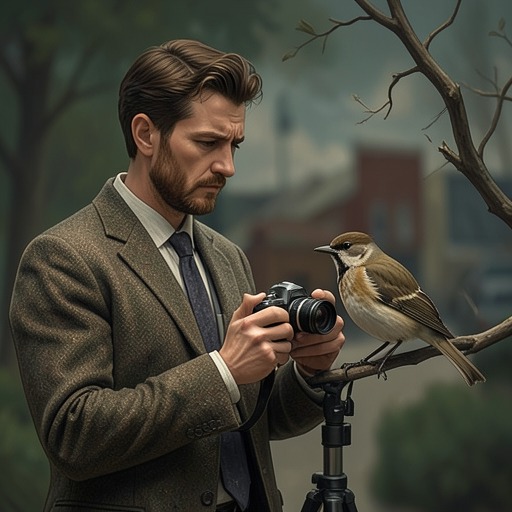
Henri Cartier-Bresson describes a good photograph as a moment when life offers a composition or expression and the photographer knows intuitively when to press the shutter. He calls it “The Moment! Once you miss it, it is gone for ever.” The phrase makes the instant valuable not simply because it passes, but because a particular arrangement of bodies, gestures and feeling may never recur in quite the same way. Seeing it in time is part of the achievement.
Helen’s father and the sparrow
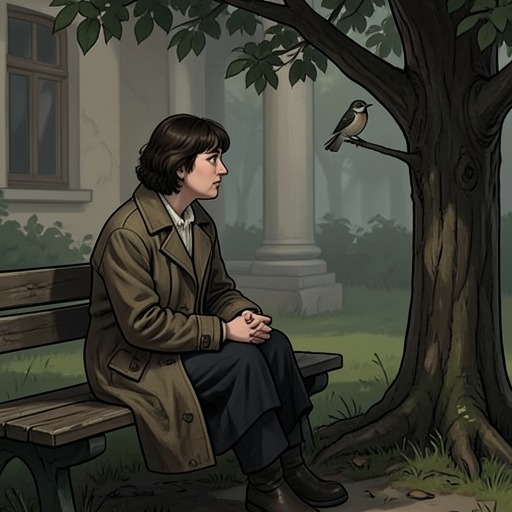
While waiting for Mabel to eat from her hand, Helen recalls a black-and-white photograph taken by her father years earlier. Its details reconstruct the instant: an elderly street-cleaner, with a white goatee, wrinkled socks and worn shoes, bends down beside his birch-twig broom. His camera is low, as if her father crouched in the road. The man has removed one glove and offers a crumb between the fingers of his bare right hand; the sparrow is caught mid-hop as it takes the food. The street-cleaner’s face, which Helen sees as angelic, gives the image its emotional force. A small act of feeding has become a visible expression of joy, preserved at the precise instant of contact.
The moment with Mabel
The scene with Mabel does not fulfil Helen’s expectation that the hawk will eat. Mabel is frightened and not hungry, so Helen covers her with the hood; after both have rested, she returns Mabel to the glove. The hawk still bates once, but this time towards the floor rather than away from Helen in blind terror. Instead of fixing her gaze on Helen, she begins to inspect the room: shelves, walls, floor, ceiling and the rug’s tassels, judging distances with small turns of her head. Then she turns and sees Helen, jumping in surprise. Helen feels the scratch of the talons and the shock of the encounter, but the crucial change has already happened: for a fraction of a second, Mabel had forgotten her.
Expectation and recognition
The parallel between the photograph and the hawk scene rests on attention, but the scenes reverse who is looking and who is absorbed. In the photograph, the street-cleaner’s attention is joined to the sparrow’s movement in a moment Helen’s father captures. With Mabel, Helen is watching and waiting, yet the unexpected revelation comes when the hawk’s attention moves elsewhere. The hoped-for sign of trust—eating from the hand—does not occur; Mabel’s curiosity about her surroundings, followed by her startled recognition of Helen, becomes the more telling sign. Helen finds the hawk’s momentary forgetting delightful because it suggests acceptance, and thrilling for the darker reason that she herself has disappeared from Mabel’s attention. The expression therefore names both the instant’s precision and its surprise: what matters is not always the moment one set out to capture.