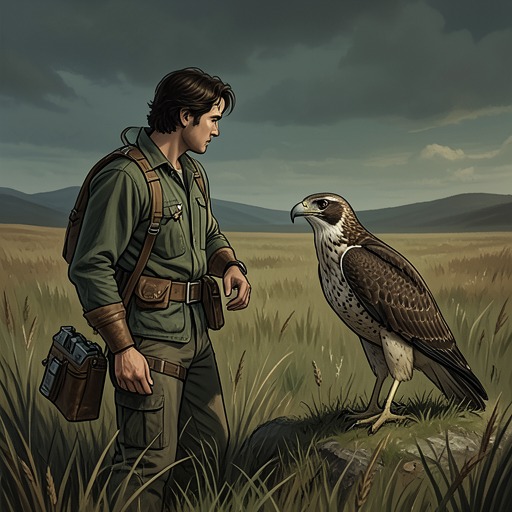
“I was turning into a hawk”
H is for HawkThe expression “I was turning into a hawk” marks the point at which Helen recognizes that training Mabel has become more than a familiar exercise in falconry. Grieving and feeling unable to inhabit her former self, she watches the young hawk so closely that the act of understanding another animal begins to feel like becoming one. The phrase gives form to that altered identity: not a bodily metamorphosis, but a troubling, partly chosen withdrawal from human life into the hawk’s apparent self-possession.
The phrase and its immediate context
Helen’s recognition follows an early scene in which Mabel, unexpectedly calm, falls asleep on the glove. Helen had anticipated a difficult struggle and had read T. H. White’s account of hawk-training as a harsh ordeal. Instead, she finds herself watching a baby hawk do what babies do: sleep. Mabel is not ill, as Helen fears. Helen’s own disorientation is not an illness either, but she understands that she is bereaved, “orphaned,” and desperately suggestible, without yet knowing what grief is doing to her.
That distinction matters to the expression. The hawk does not undergo a change to match Helen’s state, and the bird is not the source of the grief. Rather, Mabel’s ordinary vulnerability becomes something Helen can attend to when her own experience feels difficult to comprehend. The sight of the sleeping hawk briefly anchors her in the present after a dream of a collapsing, burned-out house. Her need to hold on to Mabel’s visible reality makes the bird both a companion in the scene and a focus for Helen’s attempt to recover orientation.
Watching as a route out of the self
The training process requires Helen to read Mabel’s posture and feathers: tight feathers signal fear, looser ones ease, and small changes in expression can suggest other states. The work depends on anticipating what the hawk may do by attending to what she is noticing. As that attention intensifies, Helen describes a shift from observing Mabel’s body language to seeming to feel what the bird feels. The boundary between inference and identification grows thin: apprehension that begins in the hawk is experienced by the watcher as her own.
The phrase condenses this method of attention into a startling result. In Helen’s account, watching can involve temporarily forgetting the watcher’s identity and imaginatively entering the life of what is watched. She recalls that this capacity to disappear into birds had belonged to her since childhood. Now the same habit has a new and more consequential setting: she is using it to train a wild hawk while grief has left her unusually vulnerable to losing her bearings. The transformation is therefore both an extension of a longstanding way of looking and a change intensified by bereavement.
Literary transformation, not literal metamorphosis
Helen immediately distinguishes her experience from the magical change in The Sword in the Stone, where the Wart is transformed into a merlin by Merlyn. She remembers the story’s physical signs of transformation, but insists that her own change happens differently. There are no talons or feathers; instead, grief, watching, and the feeling of not being herself produce an inward resemblance to the hawk. The comparison lets the memoir evoke metamorphosis while keeping the event grounded in perception and emotional life.
The transformation also carries an appeal. Helen imagines the hawk as solitary, self-possessed, free from grief, and numb to human hurts: qualities she longs to possess at a time when she feels in ruins. That longing explains the force of the identification without making it a simple claim that Mabel is only a symbol of Helen. Mabel has her own moods and needs, and Helen must learn them through attentive observation. The relationship depends on responding to an animal who does not become human merely because a grieving person finds meaning in her.
Human ideas and the hawk’s independence
Elsewhere, Helen examines the histories through which falconers have ranked birds and assigned them characters. Falcons were praised as noble and prestigious partly because flying them properly required access to large expanses of land. Goshawks, associated with solitary austringers, received a harsher reputation. Older writing portrayed them as disagreeable or irrational, while seventeenth-century accounts could describe them as shy, sociable, and responsive to kind treatment. Helen’s reading of these contrasts shows how ideas about a bird may reflect human status, conduct, and expectations as well as observation.
That history gives the expression a productive tension. Helen’s identification with Mabel risks making the hawk an imagined refuge from human grief; at the same time, training demands that Helen notice Mabel’s distinct moods rather than simply impose a ready-made account of them. The phrase names the danger and the possibility in that closeness. It records a temporary surrender of self through attention, but it does not settle the difference between human and hawk or erase the bird’s independent presence. Its decisive meaning lies in that unresolved boundary: Helen feels herself becoming like Mabel precisely because she is learning to watch a life that is not her own.