1937 Berlin International Hunting Exhibition bronze falcon trophy
H is for HawkThe 1937 Berlin International Hunting Exhibition bronze falcon trophy is both an award for British falconry and a surviving emblem of the sport’s entanglement with political power. Made for an exhibition steeped in Nazi symbolism, it eventually came to rest out of sight in a cupboard, where its value and craftsmanship could not separate it from the history it represented.
Discovery and appearance
Years after the exhibition, Helen Macdonald visited a friend who was then president of the British Falconers’ Club. Over tea and biscuits, their conversation turned to the history of falconry and the Club. He opened a cupboard and indicated an object at the back, partly obscured by ordinary household belongings. Macdonald recognized it as the award associated with the Club’s appearance in Berlin. Her friend, Gordon, said he hated having it in the house and could not bear it there.
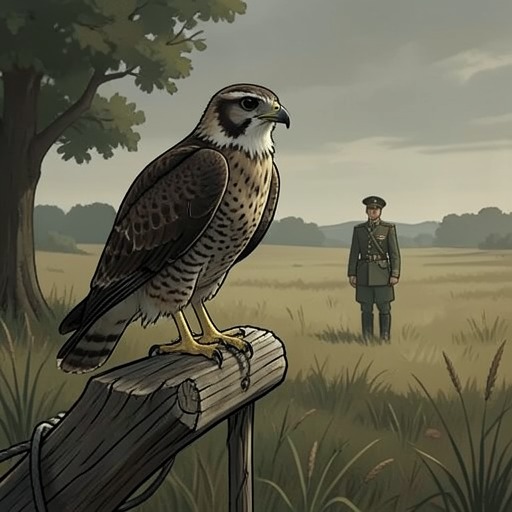
The object was a bronze falcon standing on a vertical plinth. It was heavy and stylized, with slight wear around the wings. Macdonald describes it as both valuable and beautifully made, yet an object she and Gordon wished had never been made. The contrast is central to its significance: the trophy’s artistic quality and material worth remain evident, but neither can make its origin feel innocuous. Its place at the back of a cupboard gives physical form to a history the Club’s president would rather not keep in view.
The 1937 exhibition
In 1937, Gilbert Blaine and Jack Mavrogordato travelled to Berlin with a British falconry display. It included stuffed falcons on perches, equipment, photographs, books, and paintings. Lord Halifax, Britain’s pro-appeasement Foreign Secretary, was also travelling to the event for secret talks with Hitler. Macdonald suspects that the falconers’ attendance, arranged at short notice, may have served partly as diplomatic cover; she presents this as an interpretation, not a confirmed explanation.
Falconry had a prominent symbolic place in Germany despite the small number of German falconers: there were no more than fifty. The Deutscher Falkenorden had state patronage, and the Reichsfalkenhof, a large State Falconry Centre, had recently been built in the forest at Riddagshausen. The exhibition’s catalogue cover showed a stylized, naked Übermensch holding a golden hawk. Inside the exhibition halls, red banners bearing swastikas hung among thousands of antlers. The British visitors admired the German hawks, falcons, and eagles displayed on perches, but were less impressed by the demonstrations: they saw a saker falcon catch a tethered pigeon and an eagle released at a rabbit that remained tame and continued nibbling grass until the eagle landed.
Award and political symbolism
Only two countries had falconry exhibits at the exhibition. Germany won first prize; the British Falconers’ Club came second. The bronze falcon was the Club’s award, sent after the exhibition by Hermann Göring, Hitler’s right-hand man and commander-in-chief of the Luftwaffe. Thus the trophy did not simply commemorate British participation or recognize an exhibit. Its journey from the exhibition to the Club carried the authority and political associations of the regime that presented it.
Macdonald connects Göring’s enthusiasm for falconry to the way hawks could be made to signify hierarchy and force. For him, the sport belonged to the Romantic image of ancient Teutonic kings, while predatory birds could be presented as a natural elite: powerful creatures that killed weaker ones without guilt. This interpretation places the trophy within a wider ideological use of nature, in which the hawk’s predation could be recruited to make domination appear innate and legitimate. The object’s form—a falcon raised on a plinth—therefore recalls more than the technical skill of falconry. In the setting of the exhibition, it belonged to a public display where the sport and its birds could be made to serve nationalist imagery.
Falcons, goshawks, and remembered histories
The trophy’s context also complicates the distinction falconers made between kinds of birds. Falconry writing had often elevated the peregrine as noble and graceful while describing goshawks as difficult, unruly, or threatening. Access to flying falcons depended on having the open land needed to hunt them, places more readily available to wealthy or well-connected people. By contrast, goshawk training could take place in a wider range of settings. These inherited preferences joined ideas of bird temperament to class and status, shaping which birds and falconers received admiration.
The political symbolism around the trophy is set against the book’s attention to actual hawks as animals with their own ways of perceiving and acting. Mabel, for example, responds selectively to drawings of gamebirds, and later to a live pheasant and her chicks; in the winter landscape, she pursues a rabbit and returns to Macdonald’s fist. Such episodes do not erase the histories attached to falconry, but they resist reducing a hawk to a ready-made emblem. The bronze bird is fixed in a deliberately composed pose; the living birds in Macdonald’s account perceive, choose, and move beyond the meanings people assign them.
Connections and significance
The award also sits within a personal history that reaches beyond the Berlin exhibition. Göring kept a trained goshawk, later seen by Macdonald stuffed and mounted in an American archive, still wearing its jesses and bells. She wondered whether it might have been related to Gos, the goshawk trained by T. H. White. The possible connection leads through Renz Waller, who painted Göring’s gyrfalcon portrait, headed the Deutscher Falkenorden, helped arrange falconry’s state patronage, designed the Reichsfalkenhof, and sent Gos to White. The trophy is therefore one point in a network linking the Club’s British display, German state falconry, and the history of White’s hawk.
Its afterlife is not a simple story of honor preserved. The Club received the award, but decades later its president kept it tucked away and expressed an aversion to having it in his home. Macdonald and Gordon’s shared discomfort does not undo the award’s place in the exhibition’s history; it makes that history present in the act of finding it. The trophy’s beauty remains, but the cupboard reveals the limits of beauty as a defense against political meaning.