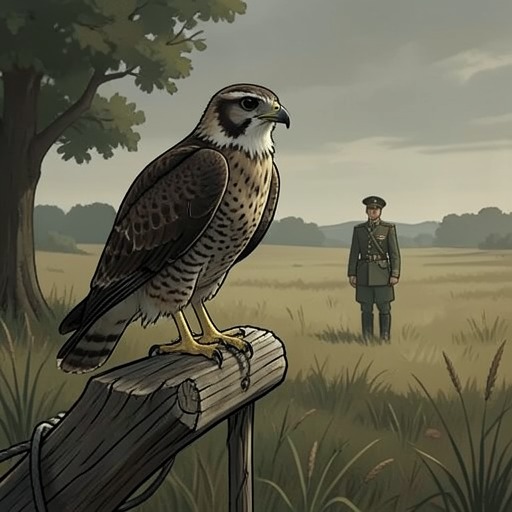
1937 International Hunting Exhibition
H is for HawkThe 1937 International Hunting Exhibition in Berlin was both a showcase for falconry and a political spectacle in which Nazi Germany recast the sport as an emblem of power, hierarchy, and national identity. The British display earned second prize, but the exhibition’s lasting significance in Helen Macdonald’s account lies in the way its bronze award links Hermann Göring, German falconry, and the history of T. H. White’s goshawk, Gos.
British participation and the exhibition
In 1937, Gilbert Blaine and Jack Mavrogordato travelled to Berlin after being invited to the exhibition. Their display presented British falconry through stuffed falcons on perches, equipment, photographs, books, and paintings. Lord Halifax, Britain’s pro-appeasement Foreign Secretary, travelled with them after being invited for secret talks with Hitler. Macdonald suspects that the falconers’ last-minute attendance may have provided diplomatic cover, but presents this as a possibility rather than an established purpose.
Falconry occupied a small place in German practice: there were no more than fifty falconers in the country. Yet at the exhibition it had a conspicuous public and political profile. Blaine and Mavrogordato moved through halls crowded with antlers and red banners bearing swastikas, where hawks, falcons, and eagles sat on perches. The outdoor demonstrations made a different impression on them: they saw a saker falcon catch a tethered pigeon and an eagle approach a rabbit that remained tame and still.
The German display and its symbols
The German presentation extended beyond the exhibition halls. The catalogue cover showed a stylised, naked Übermensch holding a golden hawk on his fist. The Deutscher Falkenorden had state patronage, and the Reichsfalkenhof, a large half-timbered State Falconry Centre, had recently been built in the forest at Riddagshausen. Together, the image, institution, and centre made falconry appear not merely as a specialist pursuit but as a state-endorsed emblem.
Only Germany and Britain had falconry exhibits. Germany won first prize; the British Falconers’ Club came second. The bronze falcon award associated with the British display was later sent to the club by Hermann Göring, Hitler’s close associate and commander-in-chief of the Luftwaffe. Its passage from the Berlin exhibition into a British club collection gave the trophy a history that outlasted the event itself.
Falconry, rank, and ideology
The exhibition’s political meaning sharpened an older social distinction within falconry. In Britain, flying falcons properly required access to extensive open country, such as grouse moors, partridge estates, and large farmland holdings; those opportunities were difficult to obtain without wealth or connections. Historical writing accordingly cast the falcon as noble and aristocratic, while treating the solitary austringer who trained goshawks or sparrowhawks as socially inferior. Berlin’s display placed this inherited language of rank in a new political setting.
Göring’s enthusiasm for falconry joined romantic claims about ancient Teutonic kings to Nazi ideas of natural hierarchy. In that framing, hawks could be presented as an elite whose power over weaker creatures appeared natural and unquestionable. The exhibition thus made the bird more than a sporting subject: it became an image through which political authority could be naturalised.
The trophy and Gos’s history
The bronze falcon from the British club’s second-place award is described as valuable and beautifully made, yet as something both Macdonald and her companion wished had never been made. Its troubling associations come into focus through Göring’s own falconry and his connection to Renz Waller. Waller had painted Göring’s gyrfalcon, headed the Deutscher Falkenorden, helped arrange falconry’s state patronage, and designed the Reichsfalkenhof. He was also the man who sent Gos to T. H. White and later received White’s plea for another goshawk.
That connection brings the exhibition into the book’s account of White and Gos without making the bird’s precise relationship to Göring’s goshawk certain. Macdonald recalls seeing Göring’s mounted goshawk in an American archive and wonders whether it might have been related to Gos; the evidence allows that it could have been a cousin, not that this is known. The exhibition’s historical reach therefore rests on both documented links and unresolved kinship: an award sent by Göring, and a falconry network that also shaped White’s encounter with Gos.