2008 England earthquake
H is for HawkThe 2008 England earthquake interrupts a night already charged with separation: Helen Macdonald is due to leave Mabel at a friend’s aviary for the moulting season. The tremors make the familiar world feel suddenly unreliable, and awaken old fears that it is ending. When Macdonald discovers that Mabel has slept through the upheaval, the hawk’s calm becomes more than reassurance; it gives Macdonald a way back into a world she can inhabit.
Circumstances and Background
On 27 February, Macdonald is preparing to take Mabel to Tony’s home in south Suffolk. Tony, an old friend and gifted falconer, has offered a spare aviary where Mabel can moult. Macdonald will drive her there and return alone. The impending departure makes the night emotionally unsettled even before the earthquake: Mabel’s stay is not a brief visit, but a separation lasting through the season in which she will shed and regrow her feathers.
To support that process, Macdonald has been feeding Mabel as much quail and pheasant as she will eat. Mabel has become round with food, but the change has not made her wild. Although she is less tolerant of strangers in this well-fed state, she remains tame with Macdonald. On the evening before the journey, they play catch with paper balls; afterward, Mabel snoozes on Macdonald’s fist. Macdonald puts her on her perch in another room, switches off the light, and goes upstairs. The quiet domestic routine gives the earthquake’s sudden violence its force: the threat arrives not in an already strange place, but in the middle of a familiar night.
The Shock of the Tremors
Just after one in the morning, Macdonald dreams that someone—or something—has seized the end of her bed and is shaking it hard enough to pitch her onto the floor. The fear feels worse than an ordinary nightmare. She wakes, but the shaking continues: the bed moves and creaks, and no one is in the room. For a few seconds she lies unable to move, realizing she has stopped breathing; above her, the lampshade still swings in circles.
Understanding comes only after the bodily shock. The movement is an earthquake, a rare event in England, though Macdonald initially questions whether that explanation can be true. She looks through the curtains and sees lights on in the houses around her. People are out in the street in their pyjamas, frightened and disoriented. Christina phones, and the two women confirm what they have felt. Their curses provide a momentary form of reassurance, but ordinary words cannot settle Macdonald. When she puts the phone down, her hands are still shaking.
Fear and the Return to Mabel
The quake’s significance for Macdonald is not limited to physical movement. It brings back childhood fears of apocalypse, the expectation that the world would burn and boil. She experiences the event as a rupture in the order of things, one she cannot repair by telling herself that nothing is broken and everything is fine. The earthquake is brief, but its emotional force opens onto a much older terror; the present disturbance seems to prove that the fear has never really gone away.
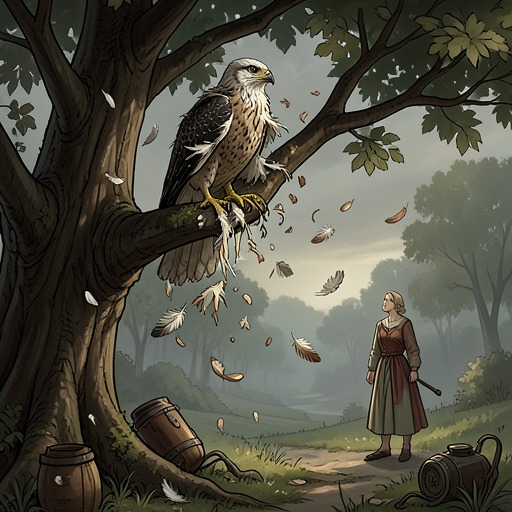
Then Macdonald remembers Mabel. She has heard stories of animals fleeing earthquakes and imagines that the hawk must be terrified. She races downstairs and turns on the light in Mabel’s room. Mabel wakes from sleep, lifts her head from her mantle feathers, and looks at Macdonald with clear eyes. Her yawn exposes a pink mouth and a black-tipped tongue. Cream-colored feathers fall over her feet, leaving one pale toe and one dark talon visible, while the other foot is drawn up against her chest.
Mabel has felt the tremors, but she has not panicked. She settles back to sleep as though the moving earth has brought no sense of wrongness. Macdonald watches her duck her head upside down, fluff her feathers, and close her eyes again. The sequence sharply contrasts the human response with the hawk’s: Macdonald is caught in fear that the world has come apart, while Mabel remains at home in it.
Consequence and Significance
Mabel’s composure does not undo the earthquake or explain it. It changes what the event means to Macdonald. In the aftermath of her terror, the hawk feels like a protecting spirit, a small household god; Macdonald had thought the world was ending, but Mabel’s presence helps the fear pass. The rescue is emotional rather than physical: the bird’s ordinary sleep gives Macdonald a living point of steadiness when reassurance in words has failed.
The episode also complicates the idea that Mabel is simply an object of human interpretation. Macdonald sees her through images of divinity and protection, yet the details that comfort her are concrete and bodily: the tucked foot, the feathers, the yawn, the return to sleep. Mabel does not respond to the earthquake for Macdonald’s sake; her indifference is precisely what makes it restorative. As the narrative moves from the shaking bed to the stillness of the hawk, the emotional movement is from disbelief and helplessness toward renewed trust in the world. The next day’s journey to Tony’s aviary remains ahead, but for this night Mabel’s calm allows Macdonald to feel that the world is still somewhere she can be.