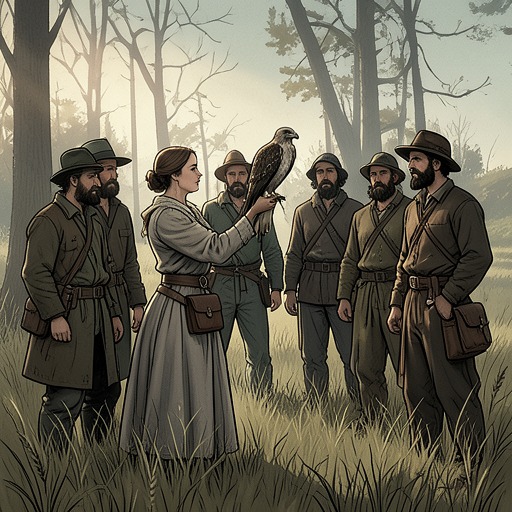
An Approved Treatise of Hawkes and Hawking
H is for HawkAn Approved Treatise of Hawkes and Hawking is a 1619 treatise on goshawks by Edmund Bert, Gentleman, whose influence in Helen Macdonald’s account reaches beyond falconry instruction. T. H. White cleaves to the rare book as he trains his hawk, and its older world of close attention and personal devotion helps frame his solitary vigil. For Macdonald, Bert’s writing also preserves a striking alternative to later accounts of the goshawk as innately difficult: a bird with needs and dispositions that the keeper must learn to understand.
Identity and subject
White has two modern falconry books to learn from, along with a description in the Encyclopaedia Britannica, but the text that holds his attention is this much older work. Published in 1619 and devoted to goshawks, it is rare enough that White does not yet own a copy. Macdonald allows that he may have read it at the Cambridge University Library, but does not establish that as fact; she also recalls having studied a copy there herself.
The treatise’s importance lies partly in the kind of falconry it represents. In Macdonald’s wider account, goshawks can hunt in relatively confined spaces, while flying falcons properly requires access to large expanses of land. Historical praise of falcons is therefore bound up with wealth and privilege, whereas the solitary austringer, who trains goshawks or sparrowhawks, has often been treated with contempt. Bert’s book draws Macdonald toward this older goshawk tradition rather than the prestige attached to falconry with aristocratic falcons.
Bert’s hawk and the keeper
Macdonald presents Bert as accomplished, cantankerous, and possessed of a bracing wit. He describes his hawks as well behaved and closely accustomed to him: they crane up to take marrow from his fingertips and travel with him. His account of taking a hawk into other people’s homes makes the intimacy comic as well as practical. He places the bird on a velvet stool in a dining room or parlour, then jokes that, if it fouls the room, he has promised to lick up the mess himself.
That boast makes the hawk’s presence in domestic space a measure of the keeper’s devotion, but Bert’s account also turns on familiarity rather than mere possession. Elsewhere in Macdonald’s discussion of early falconry writing, goshawks are described as wary and fearful, yet sociable and affectionate when treated kindly. Bert’s ideal is to provide for the hawk’s needs and become its friend and playfellow. Against later claims that such birds are simply sulky or aggravating, this tradition makes the keeper’s conduct part of the explanation for how a hawk behaves.
White’s reading and the vigil
The book haunts White as he trains his hawk. Macdonald describes his attachment to Bert as personal and imaginative: White wants to impress the falconer who lived three centuries earlier, and chooses to follow an old-fashioned approach rather than rely chiefly on modern instruction. The historical text consequently becomes more than a manual. It offers White a model for the solitary test he wants his own training to become.
White interprets the older method of keeping a hawk awake through continuous watching as a personal ordeal. The practice required a trainer to carry the bird and remain awake; Macdonald notes that an earlier falconer would have had friends or attendants available to take over, but White insists on undertaking the vigil alone. In six days he sleeps only six hours. Exhausted, he carries the frightened hawk on his fist through hours in the kitchen and lamplit barn, reciting Shakespeare, hymns, and other music to it. The episode shows how White’s reading transforms a practical method into a rite of endurance: he makes the training a test of himself as well as of the hawk.
Historical significance
Macdonald’s treatment of the treatise brings its historical distance into the present. Bert’s intimate, sometimes boastful account contrasts with later descriptions that cast goshawks as naturally vicious, difficult, or disagreeable. The contrast is not simply between old and new advice: it reveals competing ideas about whether a bird’s resistance belongs to its fixed character or may follow from rough handling and inadequate care.
The treatise also matters through its effect on Macdonald herself. As a student, she was drawn to Bert’s manner and to the relationship he describes, just as White had been. Read alongside later writing about goshawks, the book helps her question inherited judgements about the bird and the people who train it. Its lasting significance in the narrative is therefore twofold: it gives White a historical pattern for his vigil, and it supplies Macdonald with an alternative account of what considerate companionship between keeper and hawk might mean.