Cambridgeshire countryside
H is for HawkCambridgeshire countryside is the landscape where Helen Macdonald’s repeated walks and flights with Mabel turn a place she does not own into a deeply familiar home. Its fields, tracks, hedgerows, and wildlife shape their partnership: Macdonald learns to read the terrain through close attention, while Mabel establishes remembered hunting places of her own. The result is not an untouched pastoral idyll but a working countryside whose meaning depends on both ecological life and accumulated human and animal experience.
Terrain and Seasonal Life
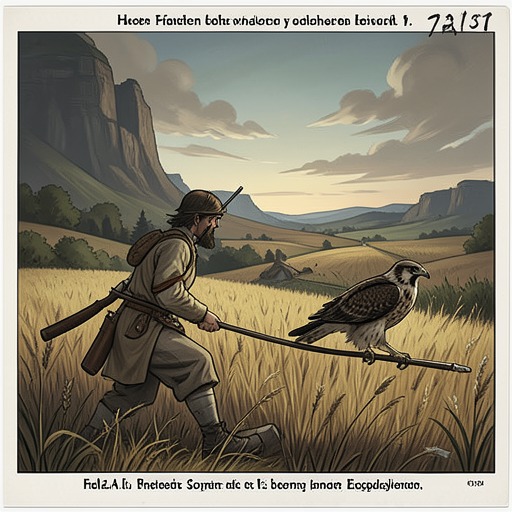
The hill’s paths move through fields and woodland edges whose details change with weather and season. In winter, gusts shake the hedgerows and blow leaves across the track; mud holds pheasant prints, and fieldfares feed among hawthorns before lifting away when approached. These conditions form the immediate setting for Mabel’s flights, not merely a backdrop to them. On one walk, she pursues a rabbit across the path, takes shelter on a narrow poplar branch, and then returns readily to Macdonald’s offered fist.
The wider landscape is a working patchwork. Macdonald’s account names a sheep field, a clover ley recently turned to earth, and a track bordered by mugwort, rubble, and soft ground where rabbits live. Higher up, the track narrows into grass among cow parsley, knapweed, and wild burdock; chalk lies beneath clay, and yellowhammers call from the hedges. These particulars make the hill legible through close familiarity: each stretch of ground has its own vegetation, animal signs, and routes of movement.
A Place Learned Through Attention
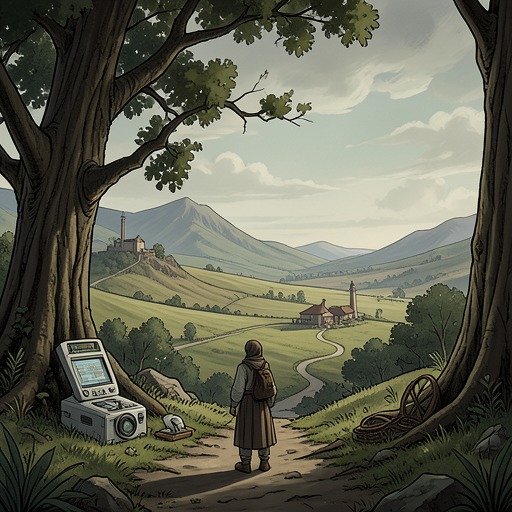
From the open-air fourth floor of a Cambridge car park, the fields appear as a distant band across the horizon. Macdonald describes an unsettling sense of being both in the city and on the hill, but the distance sharpens the difference between looking at a landscape and knowing it. The hill has become familiar through repeated visits: its hedgerows and tracks, the places where hares cross field boundaries, and the trees, warrens, and discarded machinery that mark particular routes.
Her knowledge includes the ways animals use the land. Larks sleep near the top of the hill and move to warmer eastern slopes on sunny mornings. After rain, rabbits from warrens beside ditches shift towards drier fields to graze. Sunlight on stubble, wind across a field, and the colour of the ground become clues to where animals may be. This is not ownership in a legal sense; Macdonald has permission to fly there. Instead, familiarity grows from walking the same ground and attending to its changing signs until its paths and inhabitants become part of her practical knowledge.
Mabel’s Map and the Shared Hunt
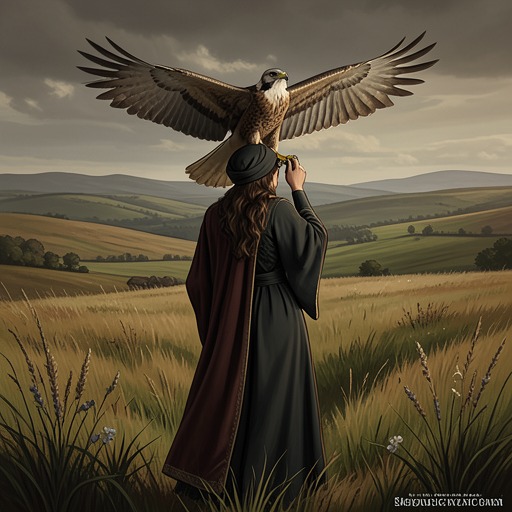
As Mabel is allowed increasing freedom to fly, she begins to revisit places where she previously found a rabbit or pheasant. Such detours are more than a routine imposed by the falconer: they show the hawk using remembered locations to guide her search. The places Macdonald recognizes as significant therefore acquire a second, partly independent map. Mabel’s learned routes overlap with the human landscape, but arise from her own hunting experience.
The account presents this overlap as a gradual making of place. Macdonald recalls the childhood waypoints that gave particular spots a lasting pull, even when later visits found them empty. She recognizes a comparable process in Mabel’s repeated checks of promising ground. The hill becomes a local patch for both of them, carrying memory and expectation as well as practical information about where prey may appear.
A pheasant hunt makes their interdependence especially clear. Mabel waits above a hedge after the bird disappears into brambles, while Macdonald searches below, trying to work out where it has gone and what the hawk is watching. Unable to see Mabel, she attempts to understand the scene from the bird’s position; her attention shifts between the hawk, the hidden pheasant, and her own place in the field. When the pheasant is flushed and Mabel launches towards it, the divided perspectives resolve into a shared physical encounter on the ground. The countryside here is not simply observed: its paths, cover, and distances organize the actions of all three participants.
Human Shaping and Ecological Contrast
The book distinguishes this lived, closely observed countryside from the simplified idea of an unchanging rural past. Macdonald describes the fields where she flies Mabel as organically farmed and rich in life, while contrasting them with chemically treated farmland elsewhere. In that other landscape, animals such as deer, foxes, and rabbits remain visible, yet many plants and insects are scarce; species once recorded there have disappeared over time. The contrast makes clear that similar-looking fields can sustain very different forms of life.
The hill’s significance thus rests on more than its scenery. Its wildlife is encountered through particular farming practices, remembered routes, and the repeated labor of observation. Macdonald’s familiarity does not erase the fact that she visits by permission, nor does her emotional attachment make the land hers alone. Mabel’s independent detours complicate any purely human claim to know or define the place. Together, their movements show how a countryside can become meaningful through attention while remaining a shared, changing habitat.