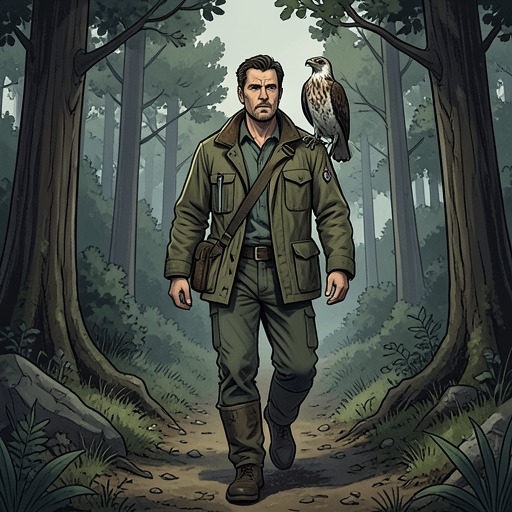
Colonel Cully
H is for HawkColonel Cully is the formidable goshawk at the centre of a nighttime initiation in T. H. White’s The Sword in the Stone. His encounter with the Wart makes courage inseparable from danger: the transformed boy is no longer plainly protected by the assumption that a human child in a story cannot die. For Helen Macdonald, the scene’s power lies in that uncertainty, and in the way Cully gives fictional form to parts of White’s troubled life.
Identity and Literary Context
Cully belongs to the castle’s trained hawks. The Wart, transformed by Merlyn into a merlin, is released into the castle mews and must undergo the customary ordeal for a new member of this group. He is ordered to stand beside Colonel Cully until the other hawks have rung their bells three times. The arrangement makes Cully both a fellow bird and an immediate threat: the initiate must endure his presence rather than simply learn about bravery at a safe distance.
Cully’s characterization also draws force from a long tradition of writing about goshawks as difficult, unruly birds. Macdonald traces a contrast between falcons, associated with aristocratic privilege and praised as noble, and the goshawk, often presented as a violent, temperamental outsider. Some falconry writers used that image to cast the goshawk as nearly impossible to understand or tame. Yet seventeenth-century accounts described goshawks as shy and responsive to harsh treatment, and presented considerate care as the basis for affection. Cully’s menace therefore reflects a literary stereotype, not a settled truth about the species.
The Ordeal in the Mews
As the test begins, Cully mutters and glowers. His speech runs together broken references to Shakespeare and Webster, while the bells mark the ordeal’s progress. After the first ring, he pleads for the test to stop. At the second, he moves towards the Wart. Macdonald emphasizes that his advance is driven by fear rather than triumph: Cully is terrified, yet feels compelled to attack. The scene gives the danger an unstable quality; the goshawk is not a confident villain but a frightened creature caught in an alarming role.
The Wart’s transformed body raises the stakes. Macdonald recalls being unable, as a child, to settle whether he remained safely human once he had become a bird. Human child-heroes might face peril and survive, but an animal could die; the book leaves that possibility open long enough to make the reading itself feel like an ordeal. At the scene’s climax, the Wart springs from the perch and pulls free of Cully’s grasp. His escape resolves the immediate danger without erasing the fear that made it consequential.
White’s History and Cully’s Significance
Macdonald connects Cully to White’s history of childhood abuse and to the shame White felt about his own violent fantasies involving boys. The connection does not make the fictional goshawk a simple portrait of White. Rather, the scene allows White to approach painful material through another self: Cully is a hawk, while the Wart is both a boy in danger and, in Macdonald’s reading, a figure through whom White’s own vulnerability returns. The character’s fear and capacity to harm coexist, giving the encounter a tragic tension that a straightforward monster would not carry.
Cully also concentrates the book’s recurring concern with ordeals and belonging. Macdonald later describes how school violence could make suffering a test of courage and entry into a group, and how White both endured such rituals and, at times, enforced them against younger boys. Against that history, the Wart’s confrontation with Cully is not merely a lesson imposed by a dangerous bird. It recalls a world in which fear is presented as a passage towards bravery, while exposing the cost and instability of that lesson. The Wart survives, but Cully’s scene remains charged with the question that held Macdonald’s childhood attention: whether becoming an animal has made the child vulnerable to death.