Falconry (Gilbert Blaine)
H is for HawkFalconry (Gilbert Blaine) matters in the book both as a practical authority on hawks and as a text through which social judgments about falconry become visible. Its account of a lost goshawk returning to a feral state gives T. H. White an image of escape that he connects to his own longing for freedom; elsewhere, its praise of aristocratic falconry and disparagement of goshawks reveal how class and gender shaped the language used to describe birds and their keepers.
The book and the hierarchy of falconry
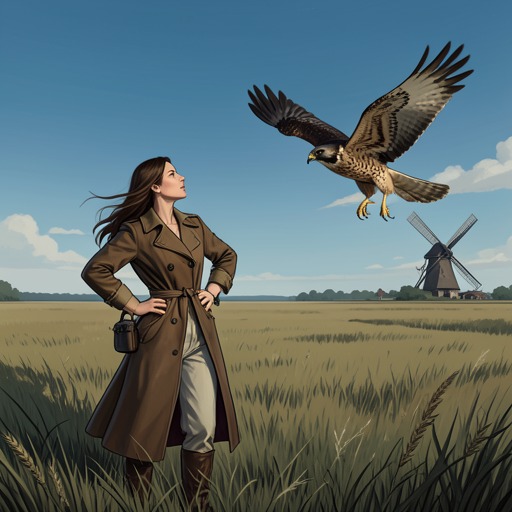
Helen Macdonald recalls that, as a young falconer, she preferred falcons and found goshawks unnerving. The distinction was not simply a matter of temperament or flying style. A goshawk can be flown in many places, hunting by a short dash from the fist at close range. Flying falcons properly requires extensive open land, such as grouse moors, partridge estates, and large farms—access more readily available to wealthy or well-connected people. Gilbert Blaine’s account of falconry makes this social division explicit: possession and use of the so-called noble falcons had been treated as an aristocratic privilege.
Macdonald places that prestige beside the longstanding contempt directed at austringers, the solitary falconers who train goshawks and sparrowhawks. Historical writers mocked the austringer as socially isolated and physically ungainly, while Blaine’s own descriptions cast the goshawk as a poor counterpart to the admired peregrine. The book’s vocabulary thus reflects more than a comparison between species: it registers a hierarchy in which the bird associated with aristocratic land and display is elevated, while the goshawk and its solitary trainer are demeaned. Macdonald’s early preference for falcons was formed within that inherited valuation, even as conversations with other falconers began to unsettle it.
White’s encounter with the lost hawk
The book enters T. H. White’s story at a moment of mounting fear. After resigning from Stowe School, White was troubled by the approach of war and by a conviction that modern civilization was unstable and doomed. His nightmares and his earlier writing repeatedly turned toward catastrophe and escape. In this state, he began reading a falconry book by Gilbert Blaine and encountered its report of a goshawk that had been lost while tame, then reverted within a week to a feral state and became a local legend.
That brief history becomes an epiphany for White. The idea of reversion to a feral state gathers force through its association with being ferocious and free. White identifies the hawk with parts of himself he had suppressed, including his sexuality and his desires for cruelty and mastery. He takes a cottage at five shillings a week and writes to Germany for a goshawk. He means to train the bird, to teach himself through the attempt, and to write a book about the ancient practice. In his imagined escape from contemporary danger, falconry promises a life in the countryside, sustained by pheasants caught by the hawk and set apart from both metropolitan sexual confusion and the conflicts of school life. Blaine’s anecdote is therefore not just an account of a bird’s survival; it supplies White with a powerful, if precarious, model for remaking his own life.
Difficulty, fear, and the language of temperament
Macdonald’s reflections on goshawk training also distinguish practical difficulty from the moral character commonly assigned to the bird. Goshawks are difficult to tame, or, in falconry terminology, to man. Their nervous systems allow them to respond rapidly to sights and sounds, which helps explain why they can be hard to reassure and why they may react before they appear to consider a stimulus. A seventeenth-century description by Richard Blome, discussed alongside Blaine’s book, emphasizes that rough handling can be remembered, whereas gentle treatment can make a goshawk tractable and attached to its keeper. The contrast directs attention to the falconer’s conduct as well as to the bird’s sensitivity.
A conversation in which a man assumes that Macdonald and her female hawk must naturally understand one another prompts her to test the published descriptions against one another. In Blaine’s book she finds the goshawk characterized as peculiarly sulky and as inclined to make herself disagreeable to her owner. Other falconry books use similar language, treating the bird’s resistance as an innate flaw. Macdonald contrasts this tradition with earlier writing by Simon Latham, which describes goshawks as shy and fearful but also sociable and affectionate when handled with kindness and consideration. Edmund Bert’s description of a keeper as his hawk’s friend and playfellow offers a different model: the bird’s difficult behavior may be a response to how it is treated, rather than proof that it is inexplicable or malicious.
Class and gender in the afterlife of the text
Macdonald’s reading makes the manual part of a longer history of human attitudes toward hawks. The descriptions that make goshawks seem unreasonable can excuse the falconer from examining his own role when a bird becomes nervous, resists handling, or flies away. Gendered language intensifies that effect: traits such as moodiness and flightiness are presented as defects of the female bird, while the falconers’ methods receive less scrutiny. The earlier writers Macdonald considers also use courtship and affection to describe relations with female hawks, but, in her reading, they acknowledge the birds as self-willed beings whose needs require attention.
A later contrast with hunting in Maine sharpens the class dimension. Macdonald describes access to hunting there as grounded in common law and associated with an egalitarian local tradition, unlike the exclusive estates and elite shooting grounds that structure much British hunting. That contrast helps explain why the practical requirements for flying falcons matter culturally: open land is not merely scenery but a condition of access. Across its use in White’s history and Macdonald’s reflections, Falconry (Gilbert Blaine) becomes a record of how ideas about wildness, temperament, and nobility are bound to the people who possess land, train birds, and claim authority to describe them.