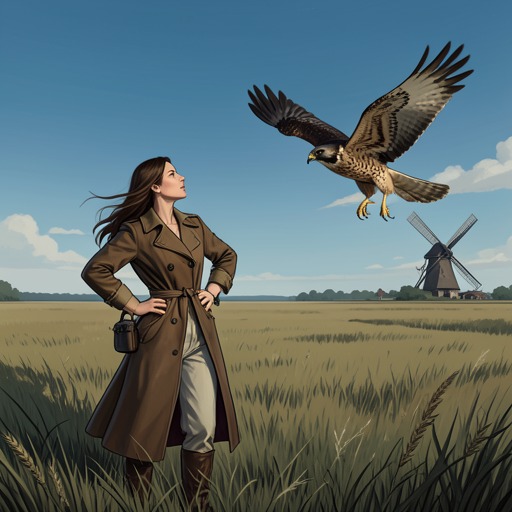
Falconry and the collapse of historical time
H is for HawkFalconry and the collapse of historical time describes how holding a trained hawk can make the distant past seem immediate: the bird in a modern falconer’s hand appears continuous with the birds held by people thousands of years ago. The sensation is intimate, but not innocent. It can invite a falconer to imagine shared experience across centuries while obscuring the profound differences between past and present, and the class histories that shape who has been able to practise falconry.
The hawk as a living link
Individual hawks die, but their species persist without the breeds or varieties created through domestication. The hawks flown today are, in this respect, unchanged from those of five thousand years ago. When a person takes one onto a fist, the physical act seems to bridge the interval: the falconer imagines someone in the distant past making the same gesture, and the historical bird can feel like the very one now being held.
The book compares this experience with handling small objects that have passed through unknown hands. Friends describe ancient pots bearing three-thousand-year-old fingerprints, antique keys, clay pipes, dancing shoes from the Second World War, Roman coins found in a field, and old bus tickets tucked into second-hand books. Turning such objects in the fingers can make an unknown person from long ago seem present, as if the years between holder and maker have briefly disappeared. The hawk produces a similar intimacy, but with an especially powerful impression of continuity: unlike an artifact, it is a living representative of a species that has not been remade by domestication.
The past imagined as inheritance
That apparent continuity has a risk. The person holding a hawk may forget how different the past was and assume that a long-dead falconer saw the world in much the same way. From there, imagined fellowship can become a claim about land and belonging: if ancestors like the falconer seem to have walked the same ground since time immemorial, their presence can be treated as a natural inheritance. The ancestors chosen for this identification are often lords, earls, and kings rather than ordinary people. Falconry’s historical aura can therefore turn a fleeting bodily resemblance into a flattering story about ancestry and entitlement.
The book makes that class history concrete through the unequal conditions required to fly different birds. A goshawk’s close-range dash from the fist permits hunting in many places. Flying falcons properly, by contrast, requires open ground such as grouse moors, partridge estates, and broad farmland—access that has often depended on wealth or social connections. Older falconry writing accordingly presents possession of the prestigious falcons as an aristocratic privilege. The sense of stepping into an ancient tradition is thus tied not only to the hawk’s biological continuity but also to histories of who could command land and participate in the sport.
Different birds, different social histories
The contrast between the aristocratic falconer and the solitary trainer of goshawks and sparrowhawks also shapes how the birds and their keepers are represented. Historical accounts disparage the solitary trainer as graceless and antisocial, and later writing casts the goshawk as difficult, unruly, and inferior to the peregrine. Such judgments do not simply describe different hunting styles; they give social hierarchy a language of character, making the bird associated with solitary practice seem disreputable beside the celebrated falcon.
The history of goshawk training also unsettles the idea that the past offers one stable tradition. Later falconers describe the female goshawk as sulky or contrary, and interpret her behaviour as an inherent defect. Seventeenth-century accounts instead describe goshawks as shy and fearful, responsive to rough treatment but capable of affection when handled with patience and kindness. One falconer presents himself as his hawk’s friend and playmate. These accounts do not erase the era’s gender assumptions, but they reveal a different model of the relationship: the bird’s behaviour depends partly on how the falconer treats her. Looking backward therefore does not yield a single, timeless truth about hawks; it exposes changing human descriptions and practices.
Local traditions and the limits of nostalgia
The book sets inherited aristocratic access against hunting in Maine, where common-law access to land is associated with a more egalitarian tradition. A wartime account contrasts this ideal with restrictions in fascist Italy and Germany, while acknowledging that Britain shared the exclusionary system being criticized. In Maine, hunting is also woven into ordinary community life: deer hunting touches many households, and venison is shared among friends and families. This contrast makes the social organization of hunting visible rather than allowing the romance of antiquity to stand alone.
Helen’s own relation to falconry’s historical glamour changes. As a child, its past seemed to promise secret magic and an identity beyond the ordinary. Later, while training Mabel, she rejects the idea that the hawk should make her feel special or like an heir to long-lost ancestors. She wants time to disappear, not to furnish a noble lineage. The distinction clarifies the concept’s double force: holding a hawk can make history intimate, but the intimacy need not become nostalgia or a claim to inherited status. It can instead suspend historical distance while leaving the differences, exclusions, and changing relationships of the past open to scrutiny.