Falconry as a balance between wild and tame
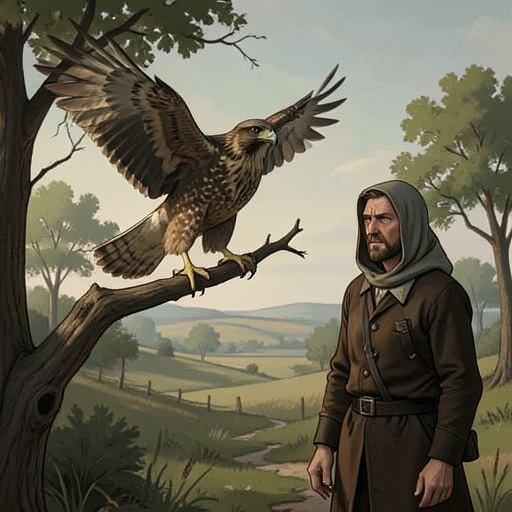
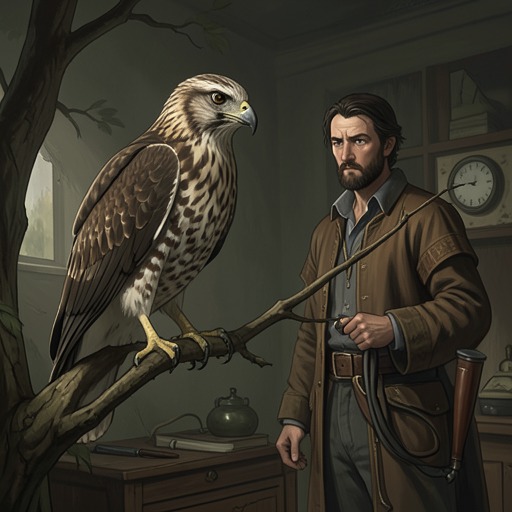
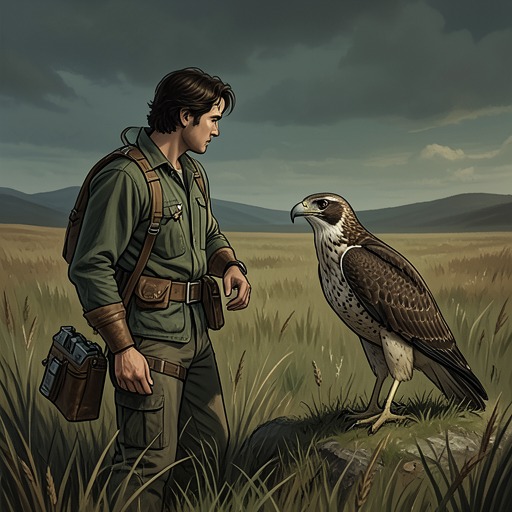
H is for HawkFalconry as a balance between wild and tame is the idea that working with a hawk requires both accommodation and restraint: a trained bird enters human routines, but does not become a human possession in the sense of being fully domesticated or understood. Helen Macdonald’s experience with Mabel tests that balance against grief, isolation, hunting, play, and the limits of human interpretation. Its eventual measure is not how closely Macdonald can imagine becoming a hawk, but whether she can share the world with one without mistaking her own meanings for the bird’s nature.
A relationship shaped by class and history
Falconry’s apparent balance is also shaped by who can practise it and where. Macdonald explains that falcons need wide, open ground for their characteristic hunting, making their proper use more accessible to wealthy or well-connected people with access to grouse moors, partridge estates, or extensive farmland. Historical writing described possession of the “noble” falcons as an aristocratic privilege. Goshawks, by contrast, could be flown in more varied places, but the solitary goshawk trainer, or austringer, was often disparaged. The distinction between supposedly noble falconry and supposedly rougher hawk-work therefore reflects social access as well as differences between birds.
Those judgments helped define which birds counted as admirable and which as difficult or disagreeable. Macdonald had absorbed this hierarchy: she loved falcons and regarded goshawks as unsettling, dangerous birds she did not want to fly. Later, reading older accounts of goshawk keeping, she encountered a different description. Some seventeenth-century writers called goshawks shy but sociable, responsive to kind treatment, and capable of companionship. This contrast does not make the hawk tame in a simple sense. Instead, it makes the falconer’s conduct part of the relationship: a bird’s response cannot be separated from the manner in which a person approaches and handles it.
Attention, training, and the limits of identification
The practical work of training begins with attention to the hawk’s reactions. Macdonald describes learning to read posture and feather position, first as broad signs of fear or ease and then as finer indications of mood. Watching closely allows a falconer to anticipate what the bird may do. But the heightened attentiveness also changes the observer. Macdonald describes grief and watchfulness as part of the process by which she felt herself turning into a hawk: her attention became so absorbed in the bird that she seemed to share its apprehensions and perceptions.
That imaginative movement has a double edge. It can make a trainer more responsive to an animal, yet it can also blur the boundary between observation and projection. Macdonald’s early sense of identification made the hawk’s world feel like a refuge from her own. Her later understanding is more limited and more respectful: close observation may disclose behaviour, but it does not make a hawk’s inner life identical to a human one. Falconry’s balance therefore depends not only on learning the bird’s cues but also on retaining awareness that the bird remains other.
Mabel’s agency in a shared life
Mabel’s responses repeatedly unsettle assumptions about what a goshawk can be. During an early visit from Christina, Macdonald removes the hawk’s hood while Christina reads nearby. Mabel watches the ordinary movement of a newspaper, later eats from Macdonald’s hand for the first time, and settles into a calmer state. The occasion is not the private, solemn encounter Macdonald had imagined. It takes place in a shared room, with another person and television present. The difference matters: the hawk’s progress occurs through her own responses to the actual environment, not according to the scene her trainer had hoped to arrange.
Play further complicates the familiar picture of the goshawk as merely severe or solitary. Mabel investigates and bites at a strip of paper, and Macdonald plays with her using a rolled magazine as a kind of telescope. Later, Macdonald makes toys from paper, tissue, and card. Mabel catches scrunched paper balls and tosses them back, then waits for another. Stuart doubts that goshawks play, but the repeated exchange is part of their life together. It is neither proof that Mabel is humanlike nor a mere instrument of training: her actions give the interaction its shape, while Macdonald responds and continues the game.
The balance becomes harder to sustain when the relationship is framed through inherited assumptions about sex and temperament. After a man suggests that Macdonald and her female hawk get on because both are female, she turns to falconry books and finds descriptions of goshawks as sulky, contrary, and difficult. She contrasts these accounts with earlier writers who stressed that rough treatment could provoke fear or resistance, while patience and considerate care could foster familiarity. The episode exposes how readily a bird’s behaviour can be explained through human stereotypes rather than through attention to the particular animal and the conduct of the person training it.
Wildness, grief, and the cost of imbalance
For a time, Macdonald’s bond with Mabel is bound up with bereavement and a retreat from ordinary human company. The hawk’s life includes hunting, while Macdonald experiences the acts required of the human falconer as emotionally difficult. She describes feeling detached from the human community and uncertain about her place in the scene. In this period, wildness does not function as an uncomplicated cure. Macdonald recognizes that other falconers may balance solitary time outdoors with family, work, and domestic life; she feels that she has only the wildness and none of those counterweights.
The distinction makes Leopold’s account of falconry as a balance inside the falconer as well as in the hawk newly significant. As Macdonald’s life begins to open again—she reconnects with friends, makes plans, and looks for a house—she notices that the distance between her world and Mabel’s is increasing. She does not take this as a failure of affection. Instead, it corrects the assumption that loving the hawk means that their worlds must coincide.
A hunt in a Maine backyard gives that correction a different setting. Scott’s red-tailed hawk pursues a squirrel among suburban trees, with houses, a fence, and familiar signs of domestic life close by. Macdonald sees fierce wildness unfolding not in a remote landscape but within an ordinary community. The encounter unsettles the idea that the wild must be somewhere beyond home. It also suggests that human and wild lives can occupy the same place without becoming the same thing.
Separation without estrangement
Macdonald’s final reflection on Mabel clarifies the ethical force of the balance. Looking again at T. H. White’s list of human and historical figures associated with Gos, she resolves not to turn Mabel into a symbol, a historical character, or a villain. A hawk can carry meanings that people give it, but those meanings do not exhaust the living animal. Macdonald’s insistence on this distinction marks a change from imagining that she could inhabit the hawk’s world to recognizing a life that belongs to the bird in its own right.
Their shared life consequently becomes one of separation as well as companionship. Macdonald acknowledges that she once brought the hawk into her world and then imagined that she had entered Mabel’s. She now understands the relationship as two lives lived together without collapsing their difference. The scars on her hands recall the practical risks and work of keeping a hawk; other, less visible changes, she associates with what the relationship helped mend. Falconry’s balance is thus neither mastery nor a fantasy of complete identification. It is an ongoing practice of attention, care, and limits: the human and the hawk remain distinct, and that distinction is part of what makes their companionship meaningful.