Falconry as same-sex intimacy and queer kinship
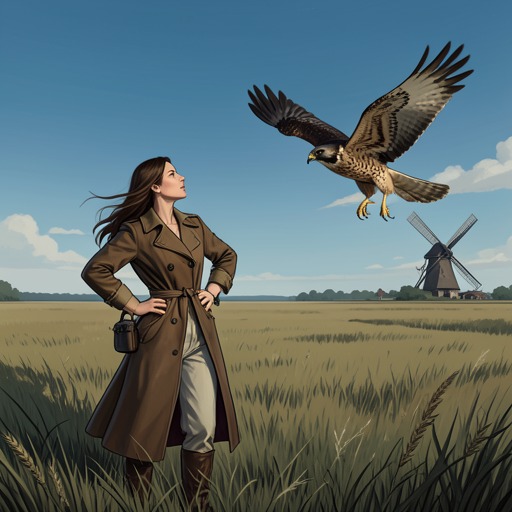
H is for HawkFalconry as same-sex intimacy and queer kinship describes the way T. H. White’s bond with Gos and his encounters with other falconers offer a language for attachment that conventional social life leaves difficult to express. The book links this intimacy to fellowship across generations, while also setting it against the class privilege and gendered assumptions that have shaped how falconers and goshawks are judged.
Gos and the forms of attachment
T. H. White’s attachment to Gos grows, in part, from the hawk’s reputation as an outsider among falconers. Gilbert Blaine’s dislike of goshawks, which White encountered in a letter, reflects the alienation their supposed suspiciousness produced in many practitioners. White later explained his own attraction through an enduring affection for those regarded as unteachable, untouchable, or inferior. Gos’s difference from the ideal of the civilised English heart made him a figure through whom White could explore a range of identities: benevolent parent, innocent child, kindly teacher, and patient pupil.
The bond also unsettles a firm boundary between human and bird without erasing their difference. White imagined himself as a mother nourishing a child and described the two minds as linked. The book presents this image as part of a search for kinship: falconry lets White experience an attachment that is intimate and transformative, but not reducible to an ordinary human relationship. Gos is not simply a symbol for White’s feelings; the hawk’s distinctness is precisely what makes the connection meaningful.
Private writing and queer longing
White’s notebooks, written in green ink, preserve material too revealing for his published book. Their candid, private reflections show an aspect of his relationship with Gos that the finished narrative does not fully disclose. Read alongside them, the book can be understood as a work of suppressed homosexual desire redirected toward a yearning for kinship and recognition. This is an interpretation of the emotional structure of White’s writing, not evidence of a sexual relationship between a man and a hawk.
The longing extends beyond Gos. Falconry offered White a way to imagine that other men shared an attachment he had experienced as unusual and difficult to explain. Gilbert Blaine’s account of a deep-rooted inclination toward hawks similarly treats the true falconer as someone born with that affinity, rather than made into one. In this framing, a love of hawks becomes a basis for fellowship: a shared disposition can connect men before they have found the words to describe what they have in common.
Fellowship across men and generations
The falconry circle White encountered included men such as Jack Mavrogordato and Ronald Stevens, whom the book identifies as gay. Falconers were also described as a close-knit, almost monastic fellowship, a small and persistent group whose attachment to hawks was not readily understood by outsiders. White recalled that, after keeping hawks alone, meeting another mature falconer and seeing his birds brought an immediate sense of recognition. Conversation seemed to need no completion; the shared experience supplied what ordinary explanation might not.
That fellowship reaches backward as well as sideways. Looking at a photograph of an Assyrian falconer carved three thousand years earlier, White imagined joining hands across the centuries with a predecessor. The image makes falconry a form of historical kinship: individual people and hawks die, but the practice and its birds persist. A falconer handling a hawk can therefore feel connected to earlier practitioners through an activity that has survived changes in civilisation. The imagined lineage gives White’s present-day sense of belonging a long past in which men like him have existed.
Class, gender, and the outsider hawk
The fellowship is not separate from social hierarchy. Falcons were celebrated as noble partly because flying them properly required open country—grouse moors, partridge estates, or extensive farmland—that wealth and social connections made easier to access. Goshawks, whose hunting style could be practised over a wider range of places, were associated with the solitary austringer instead. Medieval writing mocked such trainers, while later falconry books disparaged the goshawk as difficult, disagreeable, or inferior to the Peregrine falcon. The contrast reveals how status attached not only to birds but also to the people who could afford the landscape and leisure associated with flying them.
Gendered judgments reinforced the pattern. When a man suggested that Helen Macdonald and Mabel must get along because both were female, Helen rejected the implication that shared sex explained the relationship. Reading falconry books afterward, she found generations of male writers describing female goshawks as moody or unreasonable, as though the birds’ behaviour were a defect rather than a response to how they were treated. Earlier accounts offered a different model: Simon Latham described goshawks as both wary and sociable, and Edmund Bert stressed kindness, consideration, and friendship between keeper and bird. These accounts made room for a self-willed animal whose trust depended on the falconer’s conduct.
That contrast sharpens the meaning of queer kinship in the book. Connection does not depend on sameness: White and Gos belong to different species, just as the hawk cannot be reduced to the human stories told about her. Falconry’s most sustaining relationships arise instead from attention to difference and from a willingness to seek companionship beyond conventional categories. For White, the hawk and the fellowship around hawks make that possibility tangible; for Macdonald, earlier accounts of mutual care also challenge the inherited stereotypes that obscure it.