Falconry’s low-profile principle
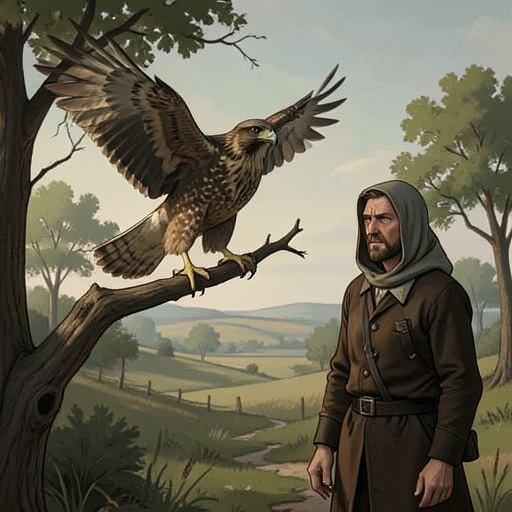
H is for HawkFalconry’s low-profile principle is Helen’s name for the quiet, deliberate withdrawal required when a newly caught hawk is too frightened to eat in a human’s presence. The trainer does not overcome that fear by force: stillness and attention to food make a first exchange possible, and repeated observation allows the human to become present again. The principle is both a practical method of training and a description of the intense, sometimes unsettling attentiveness through which Helen learns to read Mabel.
The Principle and Its Method
A fresh hawk on the glove may be tense and defensive, with food beneath its feet but its attention fixed on the person holding it. For Helen, the first task is to make the food, rather than the trainer, the focus of the encounter. Hawks are not social animals in the manner of dogs or horses, she observes, and coercion or punishment does not establish the relationship she seeks. Food offered as positive reinforcement is the beginning of a process that may eventually make the hawk and falconer hunting partners.
The distance between fear and food is not crossed by patience alone. The trainer must become unobtrusive: empty the mind, stay still, and avoid making the human presence the event the hawk has to respond to. A slight adjustment of the gloved fist can alter the balance of the food; from the edge of her vision, Helen sees the hawk look down. The aim is to let food occupy the hawk’s attention while the trainer recedes from it. If the bird begins eating, the trainer can slowly become more present. Even without moving, a change in the person’s mental state may be noticed by the hawk, so returning to ordinary presence takes time.
Training as Mutual Adjustment
The principle belongs to a wider practice of reading and responding rather than imposing a human schedule on the bird. During the first days, Helen watches Mabel’s posture and feathers to judge when to move, approach, retreat, or remain still. Feathers held close to the body indicate fear; looser feathers indicate ease. Sustained attention lets Helen notice finer changes in expression and infer states such as contentment or sleepiness. The trainer’s task is therefore not simply to wait quietly but to learn what the hawk’s changing signals require.
Mabel’s first eating from Helen’s hand does not occur in the carefully controlled solitude Helen had imagined. Christina visits with coffee and newspapers. Helen asks her to ignore the hawk and continue reading while Mabel is unhooded. At first the bird watches the unfamiliar activity; later, after a sudden bate, Helen recognizes that the movement came from frustration rather than fear. Mabel then eats, and her relaxed behavior afterward signals contentment. The episode shows why the principle depends on interpretation, not a fixed formula: the trainer must distinguish one response from another and revise an assumption when the hawk’s behavior contradicts it. Mabel becomes comfortable enough to sit bareheaded, though she is not yet ready to be picked up without bating.
The same attention eventually makes room for play as well as feeding and hunting. Mabel turns her head upside down to inspect a paper ball and repeatedly engages with it; Helen also plays with her using homemade toys. These encounters challenge the idea that a goshawk is defined only by difficulty or by its usefulness as a hunting bird. They do not erase the hawk’s independence. Instead, they show a relationship developing through attention to what Mabel herself chooses to investigate and do.
Watching, Invisibility, and the Self
For Helen, becoming unobtrusive is also a familiar human habit. As a child, she would hide beneath a rhododendron bush on a hill behind her house and watch the world below. The concealed position offered safety and the particular calm of seeing without being seen. She recognizes that this way of attending—watching rather than acting, making herself disappear—can carry into relationships and other parts of life, where it does not necessarily serve her well. In the first days with a new hawk, however, the ability to withdraw attention from oneself becomes useful.
The practice can deepen into a temporary identification with the animal. Helen describes grief, close watching, and a diminished sense of her ordinary self as parts of her change; careful attention to Mabel’s cues begins to feel like sensing what the hawk feels and noticing what she notices. The low-profile principle thus has a double edge. It helps the trainer avoid overwhelming the hawk, but it also asks the human to loosen the boundary of self in order to anticipate another creature’s actions. That attentiveness can support cooperation without making the hawk an extension of the trainer.
Historical and Social Context
The principle contrasts with traditions that treated the goshawk as an intractable bird and explained its behavior through fixed character judgments. Helen finds older falconry writing that describes goshawks as shy but sociable, wary of harsh treatment, and capable of affection toward a considerate keeper. This account places responsibility on the trainer’s conduct as well as on the bird’s temperament. The low-profile method gives that idea practical form: fear is not evidence that the hawk must be subdued; it is a condition the human must learn to approach differently.
The history of falconry also carries distinctions of access and status. Flying falcons properly required extensive open land, such as grouse moors and large estates, and falconry writing associated possession of the prized falcons with aristocratic privilege. Goshawks could be flown in more varied settings, while the solitary austringer was often disparaged in contrast to the more privileged falconer. Helen’s account of hunting in Maine describes a different social setting, where common-law access to hunt is presented as an egalitarian tradition. These contexts do not define the low-profile principle, but they underline that relations with birds take place within human arrangements of land, class, and accepted practice as well as in the immediate encounter between glove, food, and hawk.
From Attention to Partnership
The method’s intended outcome is not simply a bird that tolerates handling. It opens the possibility of a working partnership, one built by learning the hawk’s responses and making human actions legible without forcing compliance. Later, when Mabel pursues a pheasant and waits for Helen to flush it, Helen must work out the hawk’s position while searching through the hedge herself. Her awareness shifts between the human below and the hawk above; the scene makes concrete the shared attention that training has cultivated. The eventual hunt is not the first step in taming, but an outcome made possible by the earlier work of observing, waiting, and responding.
Falconry’s low-profile principle therefore joins a specific training practice to a broader claim about attention: progress depends on the trainer’s capacity to notice the hawk without mistaking human expectations for the bird’s experience. Its discipline is not disappearance for its own sake. The trainer withdraws so that the hawk can attend to food, then returns gradually, with a better understanding of the creature whose trust the work seeks.