Falconry's militarization and nationalist symbolism
H is for HawkFalconry's militarization and nationalist symbolism names the process by which hawks become more than hunting birds: they are made to signify military force, national continuity, social rank, and political authority. In Helen Macdonald’s account, the image of the raptor as a natural war machine joins medieval romance to modern aviation, while T. H. White’s experience with Gos turns that public symbolism into a private struggle with authoritarian violence. The Berlin exhibition of 1937 offers its most concrete political expression, but the book also questions the human stories imposed on birds, whose behavior and relationships exceed their use as emblems.
Raptors, Aircraft, and National Identity
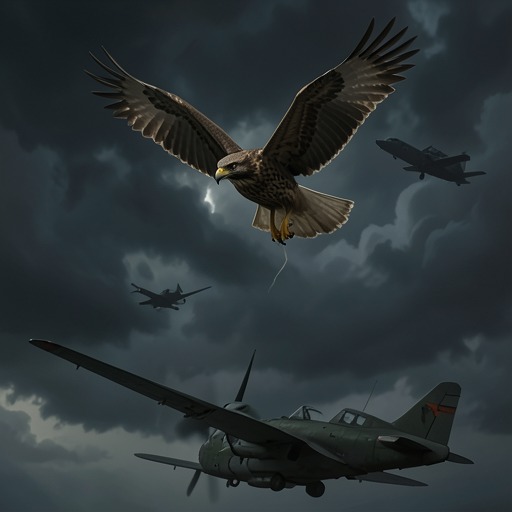
Since the beginnings of military aviation, birds of prey had been compared to warplanes: both fly, pursue, and kill, and both could be presented as embodiments of aerodynamic power. Military propagandists used the resemblance to make air warfare seem part of the natural order. The comparison did not simply describe aircraft or birds; it lent the technology and violence of war an aura of inherited natural legitimacy.
The 1944 film A Canterbury Tale compresses that cultural argument into a visual transition. Its opening sequence shows a knight releasing a falcon above the downs on a journey to Canterbury. A cut transforms the bird’s silhouette into a diving Spitfire; the knight’s face then reappears beneath a modern airman’s helmet. The unchanged face binds medieval falconry to contemporary military service, presenting both as expressions of an essential Britishness carried through time. Romantic images of the past thus become a language for modern national defence.
Macdonald places this image beside her father’s habit of watching aircraft and her own attention to birds. Their objects of attention were different, but she comes to see them as historically entangled: the same cultural imagination made raptors and aircraft signs of flight, vision, and predatory mastery. Her father’s childhood visits to airfields, where he waited with a Box Brownie camera, notebook, and pencil, give this connection a personal history without reducing it to a simple equivalence. Looking upward can be inherited as a way of seeing, even when the watcher chooses birds rather than planes.
White, Gos, and the War Within
The military imagery also illuminates White’s relationship with Gos. White’s childhood nightmares featured aircraft that approached through a haze and found him even when he sought shelter. Macdonald connects those fears with his upbringing under violent authority and with the approach of war in Europe. White later explained that he had learned to fly because he feared aircraft; Macdonald suggests that taking on the airman’s perspective may have been an attempt to master a fear of persecution as well as a fear of falling.
Gos becomes part of that effort, but not a simple instrument of White’s control. White cast the hawk as a violent, foreign force and associated its imagined laws with those of Hitler and Mussolini. In Macdonald’s reading, the hawk carried the glamour and menace of dictatorship, allowing the training narrative in The Goshawk to be read as a war fought in domestic and rural spaces. White’s conflict with Gos therefore stages a larger question: whether the violence he fears belongs only to an external enemy, or also to himself.
The political allegory turns inward when White recognizes himself in the figure of the dictator. He chooses to shoot rabbits rather than people and, through Gos, to fight the dictator within himself. He valued the hawk’s inability to dissemble as a corrective to less visible forms of human savagery. The hawk could consequently serve both as an image of threatening power and as a means of confronting the human capacity for violence. This double role complicates any reading of falconry as straightforward celebration of dominance: the bird can represent the force a person fears, but also expose the violence that person would prefer not to recognize.
Berlin: Falconry as State Display
The 1937 International Hunting Exhibition in Berlin made the connection between falconry and state power unusually visible. Gilbert Blaine and Jack Mavrogordato travelled there with a British display of stuffed falcons, equipment, photographs, books, and paintings. Lord Halifax, Britain’s pro-appeasement Foreign Secretary, was also present for secret talks with Hitler. Macdonald suspects that the falconers’ last-minute participation may have provided diplomatic cover, though she presents this as a possibility rather than an established explanation.
Falconry had few practitioners in Germany, yet its political symbolism was prominent. The exhibition catalogue showed a stylized, naked superman holding a golden hawk, and the Deutscher Falkenorden enjoyed state patronage. The Reichsfalkenhof, a large half-timbered State Falconry Centre, had recently been built in the forest at Riddagshausen. Inside the exhibition halls, hawks, falcons, and eagles appeared among thousands of antlers and red banners bearing swastikas. The arrangement made falconry part of a wider spectacle of authority, hunting, and national power.
The demonstrations did little to conceal the difference between the prestige of the display and the conditions of actual hunting. Blaine and Mavrogordato saw a saker falcon catch a tethered pigeon and an eagle released toward a rabbit that remained tame near the demonstration. Such scenes sit uneasily beside the ideal of the falcon as an image of unforced, natural power. The exhibition’s presentation depended on arranging animals and symbols for a political audience, even as the birds’ lives and behavior could not be exhausted by that staging.
Only Germany and Britain had falconry exhibits. Germany received first prize, while the British Falconers’ Club came second. The bronze falcon later found among Gordon’s possessions was that British award, sent to the club by Hermann Göring. Göring, Hitler’s deputy and commander-in-chief of the Luftwaffe, valued falconry as a romantic sport associated with ancient Teutonic kings. In his political imagination, hawks offered a natural elite: powerful predators whose success could be made to appear an endorsement of hierarchy. The award therefore connected British falconry, however indirectly, to a Nazi spectacle that used the bird to lend natural authority to political inequality.
Class, Gender, and the Limits of the Emblem
The politics of falconry were not confined to nationalist spectacle. The privilege attached to different kinds of hunting shaped which birds were admired and who could fly them. A goshawk could hunt after a short dash from the fist at close range, whereas flying falcons properly required extensive open country, such as grouse moors, partridge estates, or large farmland holdings. Access to those landscapes was difficult without wealth or powerful connections. Gilbert Blaine described possession of the noble falcons as an aristocratic privilege, and the contrast helped elevate the falcon while diminishing both the solitary austringer and the goshawk.
Macdonald’s account of older falconry writing further shows how descriptions of the birds carried human prejudices. Later writers repeatedly cast goshawks as sulky, difficult, and irrational, often treating female birds through gendered stereotypes. By contrast, seventeenth-century falconers described them as shy but sociable and familiar, capable of affection when treated with patience and consideration. That difference matters to the political image of the hawk: the supposedly natural character used to justify mastery was also produced by the attitudes and treatment of human handlers. When Mabel plays with paper and responds to interaction, her behavior unsettles the fixed portrait of the goshawk as merely violent or unmanageable.
The contrast with Maine offers another perspective on hunting and social access. Macdonald describes a local tradition in which land could be hunted under common law, and where hunting was not obviously divided by the same inherited class barriers she associates with Britain’s elite shoots and grouse moors. A 1942 Outdoor Life article invoked that distinction in wartime, contrasting American access with hunting restricted to estate owners and their guests in fascist Italy and Germany, while acknowledging that Britain shared the exclusionary system. The comparison makes clear that nationalist stories about hunting could also be arguments about who had a right to land and leisure.
Across these episodes, the hawk remains both a powerful political image and an animal whose actions exceed the image. White’s symbolic struggle with Gos, the carefully staged birds in Berlin, the class distinctions surrounding falconry, and Mabel’s playful behavior do not resolve into one stable meaning. Instead, they show how readily people enlist raptors to make violence, hierarchy, or national identity seem natural—and how attentive observation can reveal the limits of that appropriation.