From observer to participant
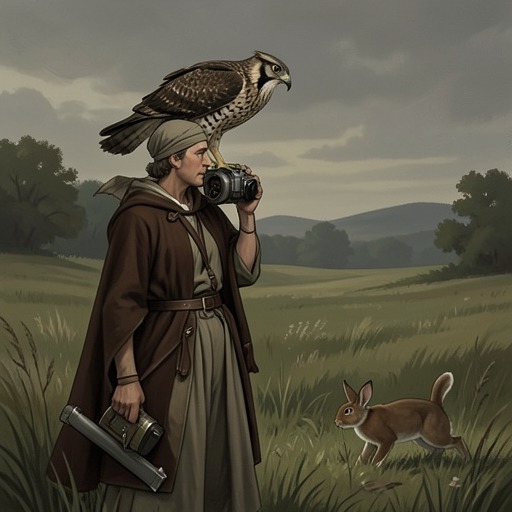
H is for HawkFrom observer to participant names a decisive change in Helen Macdonald’s relation to the living world: watching remains a form of attention, but it can no longer stand in for action when an animal’s fate depends on her. Her father’s wartime plane-spotting and her own attention to birds prepare her to see; hunting with Mabel makes her answerable for what she sees.
An Inherited Practice of Watching
Helen Macdonald traces her disposition as a watcher to Helen’s father, whose childhood unfolded under wartime aircraft. During his first four years, bombers passed overhead in formations, their presence making aircraft part of the conditions of ordinary life. He learned to identify them by details such as engine position, tail shape, sound, and fuselage. Model aircraft and the magazine Aeroplane Spotter gave that attention objects to study and classify.
As he grew older, Helen’s father cycled to airfields including Farnborough, Northolt, and Blackbushe. He carried a bottle of Tizer, a Box Brownie camera, a notebook, and a pencil, then waited by the perimeter fence to watch. The scene gives the inherited habit a precise form: patient looking, close identification, and a record of what passed overhead. Helen Macdonald later recognizes a family resemblance in her own childhood attention to flying things, though her subject was birds rather than aircraft.
The distinction between those subjects becomes less secure when she considers how military culture had linked predatory birds with warplanes. Both could be presented as creatures or machines made for speed, flight, and attack. In the film A Canterbury Tale, a falcon’s flight is joined by a cut to a diving Spitfire, connecting medieval falconry with modern air war. This broader history complicates the apparently private inheritance of watching: looking upward had been shaped by cultural ideas about power and defence as well as by family practice.
When Watching Is No Longer Enough
With Mabel, observation moves into a more demanding relationship. The hawk’s capture of prey repeatedly interrupts any comfortable position outside the event. Macdonald had defended eating hawk-caught food by contrasting it with meat from animals raised in crowded conditions. She had also argued that hunting left animals either caught or escaped and that what was caught would be eaten rather than wasted. Those principles could describe the practice, but they could not contain the experience of being present when an individual rabbit was caught and might continue to suffer.
The change is not a rejection of the hawk’s success. Macdonald can be glad that Mabel has hunted effectively and grieve for the rabbit at the same time. What matters is that the rabbit is no longer an example in an argument about food, hunting, or nature. It is an individual animal whose death is occurring in front of her. The encounter makes mortality immediate, including her own, and turns attention into a demand for a response.
Responsibility and the Act of Intervention
Macdonald’s intervention carries a moral burden precisely because it does not make her indifferent. She describes learning to set part of herself aside long enough to act, while insisting that this hardening of the heart is not the same as ceasing to care. The rabbit remains important; its life is not treated lightly. Responsibility here is neither control over the entire hunt nor an escape from its consequences. It is the obligation to respond when Mabel’s capture leaves an animal in distress.
That obligation also marks a limit to the transformation. Macdonald says she became accountable to herself, the world, and its living beings when she killed, but does not present herself as permanently released from the role of watcher. The days remain dark. Her new participation is therefore not a clean passage from detachment to mastery; it is a difficult capacity to act within a situation she cannot make morally simple.
The Rabbit at the Roadside
A later encounter extends this change beyond the hunt. Driving home, Macdonald sees walkers gathered near a sick rabbit at the roadside. They recognize that the animal needs help but do not know what to do, and none approaches it. Their concern does not become action. After they leave, Macdonald gets out of the car and intervenes, ending the rabbit’s suffering.
The episode echoes the earlier lessons of hunting while changing their setting. The rabbit is not prey caught by Mabel, and the immediate occasion is not the management of a hunt. Still, the same question returns: what does attention require when suffering is visible? The walkers’ hesitation makes the difference between witnessing and participation especially clear. Macdonald’s response does not undo the animal’s illness; it makes her responsible for what can still be done.
Significance of the Shift
The concept gathers together several kinds of looking: a child’s learned attention to aircraft, a naturalist’s observation of birds, and the close attention required by falconry. It also distinguishes observation from a claim to safety. The wish to remain detached and protected cannot survive unchanged once Macdonald is involved in the consequences of a hawk’s hunt. Her participation is not simply a deeper form of looking; it includes action, grief, and accountability.
The movement is deliberately unresolved. Macdonald does not conclude that hunting is ethically uncomplicated, nor that feeling sorrow makes intervention unnecessary. Instead, the episodes hold together Mabel’s success, the rabbit’s individual loss, and the human responsibility that follows. Moving from observer to participant means accepting that attention may bring obligations—and that meeting them does not remove the grief attached to what has happened.