Germany
H is for HawkGermany occupies two sharply contrasting but connected places in the book: it is the destination of wartime bombing flights, and the setting for a 1937 exhibition that made falconry part of Nazi political display. The contrast lets the narrative examine how flight can signify power and danger, and how an old hunting practice can be recruited to express modern political ideals.
Germany in the wartime sky
The book recalls American airmen stationed in Britain who flew aircraft to and from Germany. Their commanding view from above did not make the sky safe: the crews endured cold cockpits, unreliable heated suits, and oxygen hoses that could ice over at altitude. They flew for hours through skies filled with exploding shells to drop bombs over Germany. One in four did not complete a tour of duty. In this account, Germany is not a distant abstraction beneath an airman’s gaze but the destination of a mission whose costs reach the crews in the aircraft as well as people on the ground. The narrative refuses to make aerial warfare seem clean or detached simply because it is conducted from above.
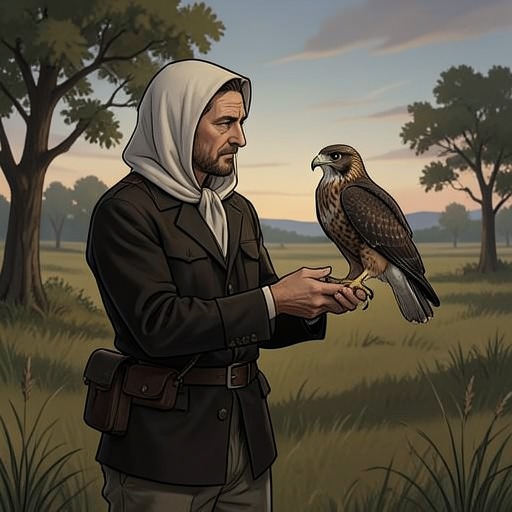
The airman’s elevated perspective also becomes a point of comparison with the hawk. A hawk’s view, like an airman’s, can suggest height, command, and distance from ordinary human life; yet the wartime flights show that height offers no real safety and that a view from above is inseparable from what descends below. After a bomber passes overhead, the hawk on the narrator’s fist finishes eating rabbit and looks toward the empty sky. The juxtaposition draws the German wartime landscape into the immediate scene of falconry: the bird’s capacity to kill and the bomber’s destructive purpose occupy radically different scales, but neither can be considered apart from the lives affected by predation.
Fear, flight, and T. H. White
Germany also enters through T. H. White’s remembered nightmares of aircraft. In his notebook, planes approach through a blue haze; he tries to hide underwater or in cellars, but they find him. The account places these childhood fears amid the violent authority of his father, schoolmasters, and prefects, and the wider threat of dictators drawing the world toward war. White later explained that he learned to fly because he was afraid of aeroplanes. The book considers whether flying may have offered a way to take possession of the perspective that had frightened him: instead of being pursued from the sky, he could assume the airman’s eye.
That interpretation is connected to White’s struggle with Gos, the goshawk he trained. White cast the bird as a murderer and associated its violence with the dictatorships of Hitler and Mussolini. The book reads this conflict as something like a war in miniature, while making clear that the political analogy belongs to White’s way of understanding the hawk. White’s own politics were uncertain and contradictory: he feared the loss of individuality under revolution, disliked nationalism, and did not believe people were equal. His writings imagined war as destruction that might nevertheless be followed by wisdom. Against this background, the hawk became a means of confronting violence without turning it into a straightforward endorsement of violence against people: White chose to hunt rabbits rather than people, and the book presents his contest with Gos as a way of wrestling with the violence he recognized in himself.
The 1937 exhibition in Berlin
In 1937, Gilbert Blaine and Jack Mavrogordato travelled to Berlin for the International Hunting Exhibition, carrying a British display of stuffed falcons, equipment, photographs, books, and paintings. The book suggests, without presenting it as certain, that their last-minute participation may also have served as diplomatic cover: Britain’s pro-appeasement Foreign Secretary, Lord Halifax, was travelling to the exhibition for secret talks with Hitler. The sporting gathering thus took place alongside high-level political negotiation.
Falconry had few practitioners in Germany—the book gives their number as no more than fifty—but enjoyed considerable symbolic prominence in the Reich. The exhibition catalogue showed a stylised, naked Übermensch holding a golden hawk. The Deutscher Falkenorden had state patronage, and the Reichsfalkenhof, a large half-timbered State Falconry Centre, had recently been built in the forest at Riddagshausen. In Berlin, Blaine and Mavrogordato walked through halls crowded with antlers and red banners bearing swastikas. They admired the hawks, falcons, and eagles displayed on perches, though the open-air demonstrations impressed them less: one featured a saker falcon catching a tethered pigeon; in another, an eagle was released at a rabbit that remained tame as the bird approached.
Only Germany and Britain had falconry displays at the exhibition. Germany received first prize; the British Falconers’ Club came second. The bronze falcon later found among Gordon’s possessions was that British award, sent to the club by Hermann Göring. Its journey links an object of British sporting recognition to a German exhibition shaped by Nazi patronage. The book explains the attraction of falconry for Göring not only as a romantic image of ancient Teutonic kings, but as a vision of nature ordered by power: a hawk could be presented as an elite predator whose violence appeared natural and guiltless. The exhibition’s imagery therefore did more than celebrate a sport; it aligned the authority of the state with an idealized natural hierarchy.
Hawks, class, and political meaning
The German exhibition sits within the book’s broader account of who could hunt and fly particular birds. Peregrine falconry required open ground such as grouse moors and large estates, resources more readily available to the wealthy and well connected. Older falconry writing described possession of noble falcons as an aristocratic privilege. Goshawks, by contrast, could be flown in more varied places, but their trainers—the solitary austringers—were often disparaged, along with the birds they handled. These histories make the Berlin display’s celebration of falconry socially resonant: its imagery of natural elites echoed a sport already shaped by unequal access to land and status.
The book also sets this exclusivity against hunting in Maine, where common law allowed people to hunt over the land and locals valued that access as an egalitarian tradition. A wartime American account contrasted this system with hunting in fascist Italy and Germany, where hunting was described as restricted to estate owners, their guests, and the powerful; it acknowledged that Britain shared similar restrictions. This comparison does not make the exhibition and hunting access identical issues. Rather, it shows how control of land and the language of privilege could connect sporting customs to political order. Germany’s place in the narrative is consequently more than geographic: through wartime air missions, White’s fear of aircraft, and the Berlin exhibition, it becomes a setting where flight, hunting, violence, and social hierarchy acquire competing meanings.