Gos's escape and disappearance
H is for HawkGos’s escape and disappearance is the turning point in T. H. White’s attempt to train the goshawk: an improvised tether meant to grant Gos greater freedom instead fails, and White’s efforts to recover him expose the cost of a relationship organized around control. The bird is lost, White is left with remorse and uncertainty about Gos’s fate, and the episode becomes the basis for his belated resolve to treat a hawk as a partner rather than a subordinate.
Background and the failed tether
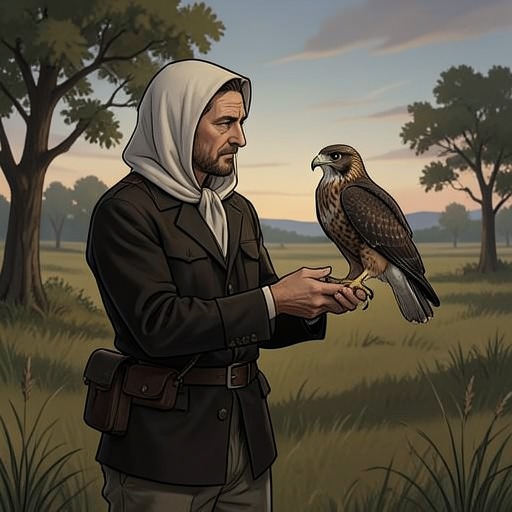
White has been troubled by Gos’s confinement and by the fact that the hawk can only sit where he is placed. During heavy rain and strong wind, he tries to offer him a way to move between the barn and the outside. He sets a bowperch just beyond the barn door and connects it to Gos’s swivel with six yards of tarred twine. The line is weak, frayed, and already snapped twice, but White believes that this arrangement will let Gos fly out and return to the barn when he chooses. The attempted kindness is therefore built on a dangerous makeshift restraint: it offers the appearance of freedom without making the tether reliable.
White leaves the barn and goes back to the house. He intends to make the day more comfortable for Gos by walking with him, offering food, and playing music, but the wireless has stopped working. After cycling to borrow a telephone and arrange for a new battery, he returns to small tasks, including repainting the passageway and planning to paint the kitchen door. The ordinary work delays his return to the barn. When he finally goes to fetch paint, Gos flies up into the rafters and out through the open door. White finds the perch empty and the end of the twine snapped on the ground. The escape is not the result of a deliberate release; it follows directly from a tether that had already proved unreliable.
Search and failed recovery
White searches in the rain, putting pieces of rabbit at places where Gos has been. He has run out of rabbit and has no lure, only liver. He recalls advice from Gilbert Blaine’s writing that crows or rooks mobbing a bird may indicate that a lost hawk is nearby. After hearing a crow, White finds Gos on the top branch of a tree a couple of hundred yards away. The bird is exposed to the gale, and White’s frequent stroking has removed the natural oil that protects his feathers from water. White stands beneath the tree and tries to draw him down with food and a handkerchief. Gos begins to descend, but the wind catches him; without the skill to manage such conditions, he is carried away downwind and disappears again.
The search continues in another attempt to bring Gos within reach. White uses a pigeon he had bought to trap hawks in the wood, throwing it into the air to draw Gos closer. Each time the hawk stoops, he comes nearer to White’s waiting hands. But the pigeon is tame and familiar to him, and White cannot make himself use it once more, knowing that the exhausted bird can barely fly and that Gos may catch it. He stops rather than carry through with the plan. Remembering a method for capturing hawks while they sleep, White returns with a ladder, rope, torch, and the salmon rod he had previously used to reach Gos in a tree. Before the attempt can succeed, Graham Wheeler arrives; Gos is startled and slips from the tree into darkness.
Disappearance and its consequences
For days, White walks the Ridings and sometimes sees Gos soaring above the trees in widening circles. Those sightings suggest that the hawk is alive and able to fly, but they do not resolve whether he can survive. White believes Gos deserves his freedom and wishes him well in the wild. At the same time, he fears that the jesses and swivel left on the bird may snag on a branch, leaving him unable to escape or find food. The episode consequently remains suspended between release and danger: White can see Gos at a distance, but cannot protect him or know what ultimately becomes of him.
The loss also changes how White understands his own part in their relationship. He recognizes that, despite his claims to the contrary, he has become a persecutor to a hawk he had identified with himself. His guilt is sharpened by the contrast between the freedom he wants Gos to have and the restraints he has imposed. White imagines that if Gos were ever returned to him, he would treat him differently—as a partner rather than a subordinate. That resolve does not undo the escape or establish Gos’s final fate; it records the change in White’s understanding that the disappearance forces upon him.
Narrative and historical significance
The event also sits against the book’s account of falconry as a practice shaped by access and status. Flying falcons properly requires large open spaces, which historically made them the preserve of wealthy or well-connected people; goshawks, whose hunting begins at close range, can be flown in more varied settings. Yet goshawk trainers were often disparaged, and goshawks themselves described as difficult and disagreeable. White’s failed arrangement makes the practical stakes of training visible: the hawk’s freedom depends not only on the trainer’s intentions but on the equipment, weather, and learned ability that the situation demands.
The narration gives the disappearance a larger consequence without resolving it into a clean rescue or a confirmed death. White sees Gos alive after the first break, loses him again to the gale, and later watches him at a distance, still carrying the equipment of his former captivity. The uncertain ending preserves the difference between wanting an animal to be free and being able to ensure that it will be safe. For White, that unresolved separation makes the promised partnership a recognition of what he failed to provide, rather than a relationship he gets the chance to put into practice.