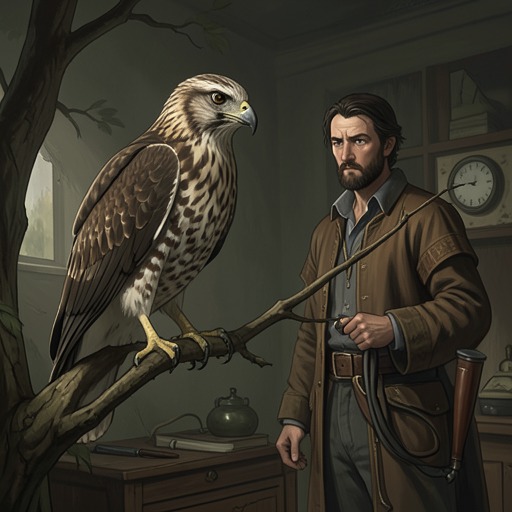
Gradual environmental acclimation through carrying the hawk
H is for HawkGradual environmental acclimation through carrying the hawk is a falconry training principle in which a hawk is carried through changing surroundings so it can become familiar with them. In Helen Macdonald’s account, carriage is not a test of endurance or a matter of accumulating miles: its value depends on noticing the bird’s responses and letting new experiences become tolerable over time. The practice thus connects a practical training method to a broader question of how people should approach an animal whose reactions they must learn to read.
What carriage means
Falconers call walking with a hawk to tame it carriage. Earlier falconry books present carrying as essential to managing a goshawk. Gilbert Blaine describes repeated carrying as the key to management; other writers call it a central secret of discipline. A seventeenth-century explanation emphasizes that a hawk walking outdoors continually sees changing objects. Kept indoors, it would not become accustomed to the unfamiliar things it would later encounter.
The principle concerns exposure to a changing world, not simply exercise. A hawk must meet movement, noise, people, and other unfamiliar features of its environment if it is to learn that they are not necessarily threats. Macdonald’s account makes the trainer’s attention part of that process: the handler must observe the bird’s state and adjust to its responses rather than assume that repeated exposure alone will do the work.
Macdonald’s gradual method
After advisers encourage Macdonald to take Mabel outside, she recognizes that carriage is the next stage of training, but going out also means confronting her own reluctance to meet people. She first takes Mabel into the walled garden of her college house. The shifting clouds, breeze, leaves, sunlight, and passing aircraft present a world of movement; Mabel watches them without the alarm Macdonald anticipates. The outing makes visible a difference between the human trainer’s overwhelmed attention and the hawk’s capacity to select and follow details in her surroundings.
Macdonald’s approach is deliberately incremental. In the aftermath of her father’s death, she believes that Mabel must move from dark rooms into daylight and from enclosed spaces into the open air gradually. She describes the process as advancing by days, short distances, and individual mouthfuls of food. The point is to let the hawk encounter an unfamiliar world at a pace that allows her to settle, rather than treating distress as proof that she must simply endure more.
When Mabel is taken into the city, the contrast between the method and its purpose becomes especially clear. At first she is apprehensive; after a period she begins eating while traffic passes. Macdonald, who has spent so much time with the hawk, finds herself looking at ordinary city activity as if through Mabel’s attention. Traffic and bicycles lose their familiar human meanings, while a wood pigeon becomes immediately significant. The outing is therefore not just a test of whether Mabel can tolerate the city: it reveals how the hawk’s attention organizes the scene, and how close observation can change the trainer’s own perception.
T. H. White’s contrasting practice
Macdonald sets her patient method against T. H. White’s training of Gos. White’s account makes walking itself seem the essential instruction, and he took Gos outside from the day the hawk arrived. Within days, Gos was exposed to a farmhouse gathering, barking dogs, roads, vehicles, cyclists, and other busy settings. White’s diary records repeated distressed reactions on these outings. He continued taking Gos into varied surroundings, including a pub, a fishing trip, and a journey to Banbury by car, on the grounds that the hawk had to learn to bear bustle.
For Macdonald, this history shows the difference between carrying a hawk and attending to one while carrying it. Exposure can make a bird encounter the world, but it does not by itself demonstrate that the bird feels safe. She compares White’s approach with an education in which there is no escape from repeated difficulty; her own method instead treats accommodation as gradual and responsive. The contrast is sharpened by the fact that White’s method followed what his books prescribed, while Macdonald emphasizes the need to interpret the hawk’s experience rather than follow a routine mechanically.
History, access, and the meaning of the method
The practice also sits within a social history of falconry. Macdonald notes that falcons require extensive open land to be flown properly, making their use more accessible to people with wealth or connections. Goshawks, by contrast, can hunt after a short flight from the fist and can be flown in a wider range of places. Carrying a goshawk through everyday surroundings is therefore associated with a different setting and tradition from the aristocratic landscapes linked to falconry with falcons.
Historical writing about goshawks also shapes how the method is understood. Some later falconers describe them as difficult, sulky, or unpleasant, while seventeenth-century writers such as Simon Latham present them as shy but sociable and responsive to kind treatment. Macdonald’s observations of Mabel—including her calm attention to new things and her playful engagement with paper—complicate the inherited stereotype. Her account suggests that what a trainer calls a bird’s temperament may depend partly on the treatment and circumstances the bird encounters.
Carriage consequently serves as both training and a discipline of attention. To carry a hawk well is to introduce it to change while watching for signs of its response, rather than treating the trainer’s intention as a substitute for the bird’s experience. In Macdonald’s account, the rule’s significance lies in that distinction: the surroundings matter, but so does the pace at which the hawk meets them and the quality of attention accompanying each encounter.