Hawks and mourning
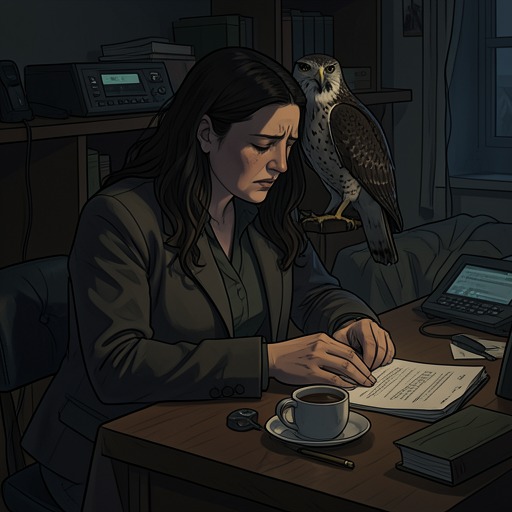
H is for HawkHawks and mourning describes the entanglement of grief with the training and flight of Mabel. For Helen, the hawk’s return initially seems to answer bereavement with a reliable bond: Mabel flies back, and Helen experiences that return as a form of reassurance. But falconry does not provide an escape from death. It leads Helen toward hunting, where the hawk’s independent action makes her both participant in and witness to killing. The relationship thus becomes a way to approach grief and a way to avoid it, with the danger that its intensity can turn into dependence.
Falconry, class, and the meaning of the goshawk
Helen’s changing relation to goshawks is set against a history in which falconry carried social distinctions. She had long preferred falcons, admiring their speed and flight, while regarding goshawks as difficult and unsettling. The difference was not simply a matter of temperament or hunting style. Goshawks could hunt in a wider range of places, whereas flying falcons properly required extensive open land, such as grouse moors and large estates. Access to that land favored wealthy or well-connected falconers. Gilbert Blaine described possession of falcons as an aristocratic privilege, while historical accounts cast the solitary trainer of goshawks and sparrowhawks as an ungainly, antisocial outsider. The prestige attached to the falcon therefore reflected who could fly it as well as the bird’s qualities.
The disparagement of the goshawk also took gendered form. Falconry books described female goshawks as sulky, contrary, and difficult, often treating their behavior as an inherent defect rather than asking how a falconer’s actions might affect them. When a man suggested that Helen and Mabel naturally got along because both were female, Helen rejected the idea that a bond of sisterhood could explain the behavior of two different species. Yet his comment prompted her to compare the books’ stereotypes with earlier writing. Simon Latham described goshawks as shy and fearful, but also sociable and familiar; he connected their reactions to harsh handling and their affection to kindness. Edmund Bert presented the keeper as a friend and playfellow responsible for the hawk’s needs. These accounts offered Helen a different model: not a bird whose supposedly irrational moods must be endured, but a self-willed animal whose treatment mattered.
Return as consolation
During Mabel’s training, the call from the fist becomes charged with more than the practical purpose of recall. Helen whistles for the hawk to come, and, while Mabel is still on the creance, fears that she may falter, veer away, or be frightened off. When she flies back and lands on the glove, Helen experiences the return as a repeated reassurance. She understands it as Mabel choosing to come back, and finds that nothing else offers the same relief to her grieving heart.
That confidence also unsettles the boundary between the trainer’s feelings and the hawk’s actions. When Mabel sits twenty yards away, Helen feels as though part of herself has moved with her. She compares their felt connection to the relationship between a person and their animal daemon in Philip Pullman’s His Dark Materials, where separation brings pain. The analogy expresses the intensity of Helen’s attachment, not proof that Mabel shares her interpretation. Helen feels incomplete when the hawk is not on her hand and comes to trust her return as if it were part of the world’s ordinary order. In that state, a failed approach does not feel like a minor training setback: Mabel once takes food from Helen’s fist and continues flying away, and Helen’s expectation of reunion gives way to alarm. The creance brings the flight to an end; Mabel returns to the fist, but the incident exposes how much emotional certainty Helen has placed in her coming back.
Hunting brings death back into view
The consolation of training does not remove the question of what the hawk is being trained to do. Helen had hunted before without thinking of herself as a killer. The language of falconry helped preserve that distance: hawks caught quarry or game, terms that could make death seem like a technical feature of sport. She had understood herself chiefly as a spectator of the hawk’s flight, and took pleasure in the bird’s success without dwelling on the death it involved.
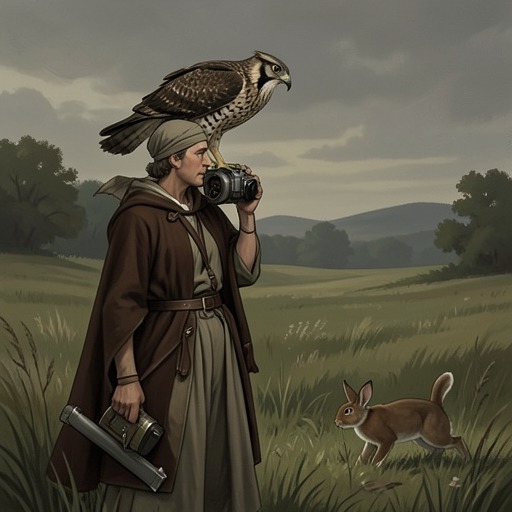
After her father’s death, that separation becomes harder to sustain. Helen recognizes that she will hunt with Mabel, because a goshawk trained but never allowed to hunt would be denied a central part of its activity. Yet the hawk also represents a refuge from mourning. She sees Mabel as wholly present, absorbed in the immediate world rather than burdened by past or future, and imagines that following the hawk’s life might carry her away from death. The contradiction is central: the hawk seems to offer escape from grief, but hunting binds the relationship to the very fact of death that Helen is trying not to face.
Risk, dependence, and loss of control
A later hunt changes Helen’s understanding of falconry. She rejects the description of it as intense birdwatching: what matters is not simply watching a bird, but preparing for a moment when control is relinquished. Training requires the falconer to invest skill and care, then allow the hawk to leave the fist and act beyond the falconer’s command. The outcome remains uncertain, and that uncertainty is part of the attraction. The investment creates hope of success without guaranteeing it.
Helen identifies this exposed interval as a kind of addictive lure. When a person is hurt by grief, the temporary surrender to chance can feel like relief: the world, rather than the self, determines what happens next. Her outing with Mabel makes this pattern legible to her. She recognizes that she has become attached not only to the hawk but to the intense uncertainty of the hunt, and fears that the attraction may be ruinous. The insight does not cancel the connection or resolve her bereavement. Instead, it shows how an activity that began as a means of living alongside loss can also draw her toward repeated, uncontrolled encounters with danger and death.
Social context and the limits of consolation
The association between hunting and privilege remains part of the concept’s wider frame. In Maine, Helen encounters a hunting culture she understands as less restricted by inherited class distinctions than British falconry. Common-law access to land supports an egalitarian ideal, and hunting is embedded in local life: even households that do not hunt may know people who do, while venison is shared among friends and families. This contrast helps clarify that hunting’s social meaning depends partly on who has access to land and participation, not only on the act itself.
Across these contexts, the hawk cannot be reduced to an instrument of consolation. Mabel has her own flight and behavior, and her return is never entirely under Helen’s control. That independence gives the relationship its force: the connection can be experienced as reciprocal, but it cannot be made into certainty. Hawks and mourning therefore holds together two consequences of falconry. It makes an intense bond possible at a time of bereavement, while obliging the falconer to confront the animal’s difference, the uncertainty of its actions, and the deaths involved in the hunt.