Helen Macdonald acquires and chooses Mabel
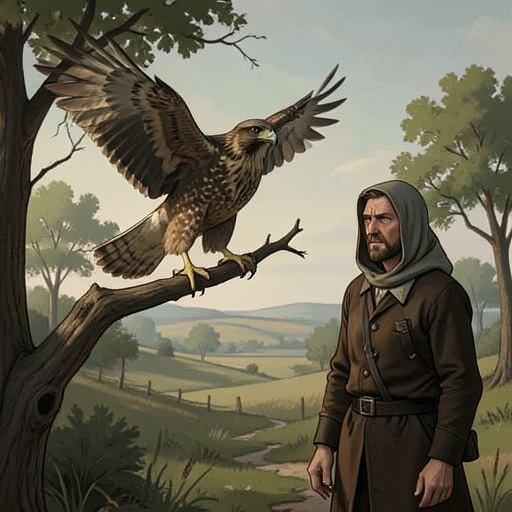
H is for HawkHelen Macdonald acquires and chooses Mabel during a journey to Scotland in the aftermath of her father’s death. The acquisition turns on a reversal: Helen arrives expecting one bird, but asks to take another, smaller goshawk instead. The exchange brings a new animal into her life while also unsettling her assumptions about goshawks, about choice, and about what it means to hold on to another living creature.
Background and decision
By late July, Helen believed she was nearly back to normal, even as her familiar surroundings had begun to feel strange and distant. In that state she contacted friends and found a breeder in Northern Ireland who had one young goshawk left from that year’s brood. The bird was ten weeks old, small for her kind, and had a mixed Czech, Finnish, and German ancestry. Helen arranged to drive to Scotland to collect her. She thought she wanted a small goshawk; beyond that, she believed the particular bird was not really a matter of choice. In her later account, the hawk had caught her, rather than the other way around.
That decision also reversed a longstanding preference. As a falconer, Helen had loved falcons for their flight and had regarded goshawks as unnerving birds associated with difficulty and death. The histories and manuals she had read reinforced the contrast: falcons were treated as noble birds, while goshawks and their solitary trainers were described in disparaging terms. Helen later connected this hierarchy to access and class. Hunting falcons properly required extensive open land, often available only to the wealthy or well connected; goshawks could hunt at close range in a much wider range of places. The language of falconry had turned practical differences into judgments about which birds, and which falconers, deserved admiration.
The journey and handover
In early August, Helen was about four hundred miles from home, waiting on a Scottish quay with Christina, who had accompanied her. Helen carried £800 in cash. The car was her father’s, and its boot still held his belongings, including film canisters, a partly completed crossword, aspirin, and winter gloves. Their previous day had been spent driving; the journey and an uncomfortable hotel stay had left them tired. These details made the purchase more than a routine collection: Helen was traveling in the car and among the possessions of the person whose death had altered her life.
The breeder arrived carrying two large cardboard boxes. He explained that another falconer was to receive the younger bird and that Helen’s was meant to be the older, larger one. He checked the birds’ ring numbers against their Article 10 documents, the official forms accompanying captive-bred rare birds. When the first box was opened, the bird inside had lost her hood. The breeder handled her carefully, and Helen helped put the hood back on before they checked the paperwork. The numbers showed that this was not the bird assigned to Helen: it was the younger, smaller goshawk.
The second bird, the one listed for Helen, was substantially larger and behaved differently. She made a loud call, and Helen, while hooding her and checking the paperwork, felt that this was not her bird. The transaction had proceeded: the second bird had been returned to her box, the form folded, and the money exchanged. Yet Helen could not accept the match simply because the documents and payment identified it as hers. She asked, hesitantly and at length, whether she could take the first bird instead. The request broke the expected arrangement and put the breeder in the position of deciding whether to allow a last-minute change.
The choice and its consequences
The breeder agreed. His response allowed Helen to take the younger, smaller bird, the one she had first encountered, rather than the older and larger goshawk originally assigned to her. The scene makes the acquisition an act of selection rather than mere purchase. Helen had thought that the hawk herself was settled in advance; at the quay, she discovered that her attachment to a particular bird could override the plan, the paperwork, and the exchange already made. The evidence does not present the choice as a calculated assessment of temperament. It presents it as an urgent recognition that she could not leave with the other bird.
The handover also brought the bird’s earlier life into view. She had been bred in captivity, and the breeder had cared for her from hatching, feeding her as a chick. His practiced handling and concern for her welfare made the exchange a relationship among more than buyer and animal: the breeder’s care had helped form the bird Helen was taking home. After the choice, Helen’s preparations acquired new meaning. She made leather jesses, the cords that would connect hawk and handler, and understood them as ties running in both directions. The work brought back a vivid memory of her father, who had used deliberately imprecise names for falconry equipment. Helen now understood this not as teasing but as a compliment grounded in his own professional habits as a photojournalist.
When Helen first held the hawk at home, the end of the drive and the beginning of their life together came together in a single practical gesture: the bird stepped onto her fist. Helen recalled the moment through an image from The Sword in the Stone, where taking a goshawk onto the fist is likened to putting on a familiar wooden leg. The comparison conveys how strange and, at the same time, immediately fitting the contact felt to her. She had brought the hawk into her house, but the relationship still had to be made through patient work.
A relationship in the making
The early training required Helen to attend closely to the bird’s posture, feathers, and small changes of expression in order to judge whether she was afraid, settled, or ready for what came next. This watchfulness became more than a technique: Helen describes it as part of her grief and of a period when she felt less securely herself. The acquisition thus began a relationship that changed the observer as well as the animal. Helen learned to anticipate the hawk’s responses by watching her, while recognizing the risk of losing too much of her own sense of self in that act of attention.
The bird’s first experiences at home complicated the received picture of the goshawk as merely difficult or sulky. During an early feeding, she ate from Helen’s hand while Christina was present and the television played. Later she played with small objects, including a crumpled paper ball, and responded to Helen’s attempts to engage her. Helen had not expected goshawks to play; the books she had relied on had not prepared her for it. Such moments did not erase the bird’s wildness or make the relationship effortless. They showed instead that a living goshawk exceeded the fixed character assigned to her by falconry writing.
The choice at the quay therefore opened onto the book’s larger inquiry into how humans classify and relate to wild animals. Helen’s earlier picture of the goshawk had been shaped by inherited judgments and by accounts that made female hawks seem unreasonable or troublesome. Her experience with Mabel gave those judgments a counterweight: the hawk displayed her own responses, and Helen’s understanding had to change accordingly. The acquisition began not with mastery but with an encounter that Helen could not fully explain, followed by the sustained attention required to live and work with the bird.