Helen Macdonald and Mabel
H is for HawkHelen and Mabel’s relationship is the central practical and emotional partnership of Helen Macdonald’s work with a goshawk: it begins in mutual fear, advances through patient food-based training, and becomes a form of collaboration that alters how Helen understands herself and the bird. Mabel is not simply a symbol or a tame possession. Her choices, moods, play, and hunting behavior continually set the terms to which Helen must respond.
An unlikely partnership
Before choosing a goshawk, Helen had preferred falcons and regarded goshawks as unnerving, difficult birds associated with woodland and death. She admired falcons’ speed and ease in open air, but later recognized that their prestige also reflected who could afford the land and space needed to fly them properly. Falconry with goshawks could be practiced in more varied settings, while falconry with falcons depended on access to extensive open country. Historical writing reinforced that social distinction: falcons were praised as noble and aristocratic, while the solitary goshawk trainer, or austringer, was mocked, and goshawks themselves were described as coarse, unruly, and inferior.
That inherited ranking shaped Helen’s expectations before Mabel arrived. The goshawk’s reputation seemed to confirm Helen’s reluctance to train one. Her relationship with Mabel therefore begins against two forms of distance: Helen’s own fear of the bird and a cultural tradition that had already assigned goshawks a negative character. Learning to train Mabel means learning to question both.
Trust built through training
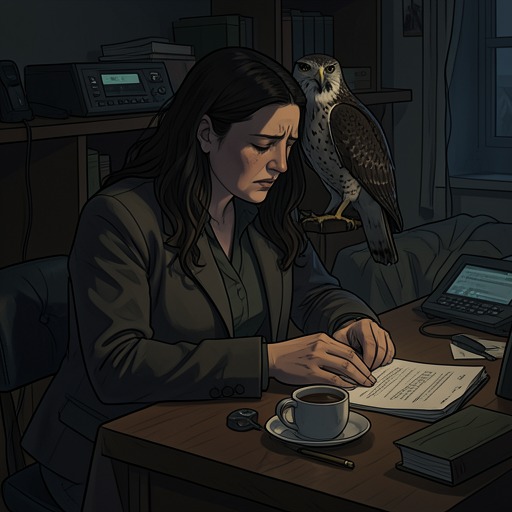
In the dim room where Mabel first sits hooded, Helen takes her onto a falconry glove and removes the leash from the perch. The bird reacts to the unfamiliar movement by trying to escape. Helen returns her to the glove gently, then weighs her and checks her condition, aware that a hawk’s flying weight affects its willingness and capacity to fly. When Helen removes the hood, Mabel again attempts to get away. The encounter makes clear that the early stages of training do not begin with trust: Helen is frightening a bird whose fear she must acknowledge rather than punish.
Helen’s method relies on food rather than force. With meat beneath Mabel’s feet, she tries to make herself unobtrusive enough for the hawk to attend to the food instead of the person holding it. The aim is not merely to secure obedience. Eating is the first step across what Helen understands as a wide gulf between terror and the possibility of becoming hunting partners. Stillness and patience are active parts of the training: Helen watches for the smallest shift in Mabel’s attention and avoids treating a frightened response as defiance.
That attention becomes reciprocal in practice. Helen learns to read Mabel’s posture and feathers, from tight feathers that indicate fear to looser ones that accompany ease. With time, minute changes in the bird’s face and expression help Helen anticipate her state. The close watching that makes training possible also changes Helen’s own habits of perception. Rather than observing Mabel from a comfortable distance, Helen tries to notice what the hawk notices and to anticipate what she may do next. The relationship depends on this imaginative effort, but it also exposes a risk: Helen can become so absorbed in the hawk’s perspective that her own sense of self recedes.
Naming, play, and changing assumptions
Mabel’s first meal from Helen’s glove comes in an ordinary room, with Christina present and a television on. After a period of calm, Mabel suddenly moves and then eats. The setting frustrates Helen’s expectation that this milestone would emerge from solitary, meditative quiet. Instead, Mabel’s first feeding takes place amid company and television comedy. Her response is not an abstract sign of progress but a particular event, achieved under conditions Helen had not planned.
As Helen feeds her small pieces of meat, the name Mabel comes to mind. It suggests affection rather than menace, a marked contrast with the imposing names T. H. White gave Gos. Helen had once found that list faintly ridiculous; now it seems too close to death for the hawk she is trying to know. Naming Mabel also leads Helen to register her own name anew. The paired names mark a relation in which the bird is not anonymous quarry or a generic instance of a supposedly bad-tempered species, and the human trainer is not wholly lost inside the act of watching.
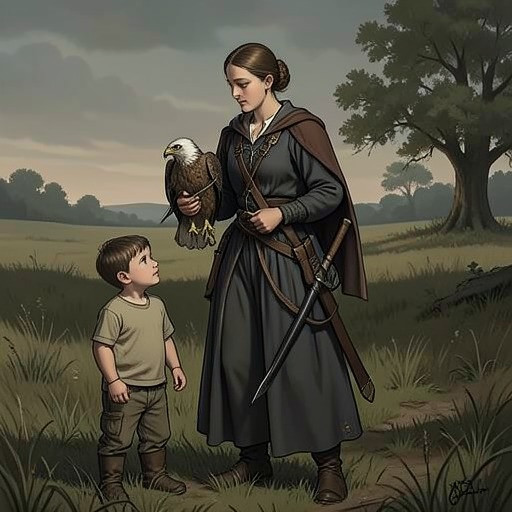
Play further unsettles the conventional picture of the goshawk. Mabel turns her head upside down, investigates a paper ball, and repeatedly engages with it. Later, she examines a paper tube as Helen looks through it, then responds to Helen’s voice and play with the object. These exchanges make visible a form of behavior Helen had not expected and had not found described in her falconry books. They also change the balance of the relationship: Helen does not only direct a training exercise but responds to Mabel’s curiosity and amusement. The bird’s play supplies evidence of an individual disposition that inherited descriptions had left out.
A falconer’s remark that Helen and Mabel must naturally get along because both are female provokes anger and then research. Helen finds later falconry accounts that characterize female goshawks as sulky, contrary, or difficult, and recognizes how readily those judgments turn a bird’s responses into defects. By contrast, seventeenth-century writers describe goshawks as shy and fearful but also sociable and familiar, and connect their behavior to whether their keepers treat them harshly or kindly. Those accounts do not erase the difference between human and hawk; they give the bird a more complex character and make the keeper’s conduct part of the explanation. Mabel’s play gives Helen a present-tense reason to doubt the old stereotype: perhaps the behavior absent from the books had simply not been invited or noticed.
From close observation to shared action
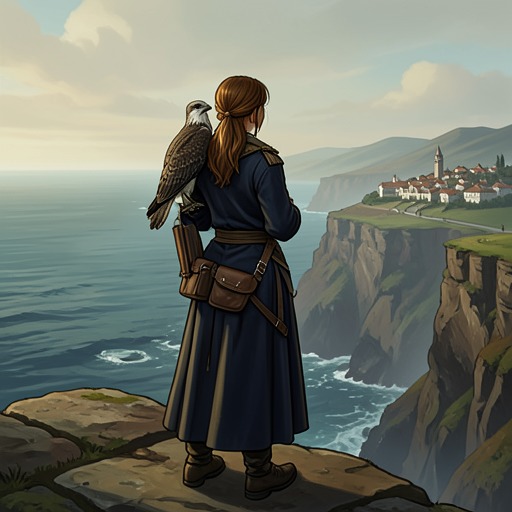
The relationship does not remain confined to the darkened room. During a pheasant hunt after her father’s death, Mabel waits above a hedge while Helen searches below for the bird. Helen loses sight of the hawk and tries to work out her position by imaginatively taking up Mabel’s perspective. For a time, she experiences herself as divided between the human searching in the brambles and the hawk watching from above. When the pheasant is flushed and Mabel pursues it, the scattered positions and possibilities resolve into a shared event on the ground. The scene makes their cooperation concrete: Helen’s task is to locate and flush the quarry, while Mabel acts from her own position and capacity.
Yet the partnership does not make Mabel an extension of Helen. Training requires Helen to attend to a bird whose responses are not under complete human control. Mabel may hesitate, move away, or respond in ways Helen did not anticipate; each action requires a fresh adjustment. Their connection is therefore made through a line of attention and practical work, not through sameness. Helen’s imaginative identification with the hawk enables her to cooperate with Mabel, but the bird’s independent behavior keeps that identification from becoming a simple claim that they are alike.
Wildness and the limits of the bond
In a later period of despair, Helen plays catch with Mabel using scrunched paper. Mabel catches the balls, tosses them back, and waits for another throw. Stuart doubts that goshawks play in this way, reflecting how far the activity falls outside familiar expectations of hawk training. Helen has made room for it because she is trying to leaven the chill of her circumstances. At the same time, she recognizes a painful imbalance: other falconers return from hunting to domestic lives and relationships, whereas she feels she has only wildness. The companionship with Mabel is real, but it cannot supply every form of human closeness Helen lacks.
This limit sharpens the significance of the relationship. Mabel’s hunting and play are not reducible to remedies for Helen’s grief; the bird continues to act as a goshawk, with appetites and responses that belong to her. Nor does the bond domesticate her. The hawk has been brought into a human home and trained, yet goshawks remain undomesticated animals, carrying the cultural force of wildness precisely because closeness to people has not made them fully manageable. Helen’s partnership with Mabel holds together care and difference, attachment and independence. Its development is measured not by the disappearance of Mabel’s wildness but by Helen’s growing ability to meet the bird on terms that leave that wildness present.