Helen Macdonald and T. H. White
H is for HawkHelen Macdonald and T. H. White are joined by The Goshawk (book), which moves through Macdonald’s life from childhood fascination to adult resistance and, finally, to a difficult recognition of shared motives. White is not simply an influence she accepts or rejects: his book’s account of hawk training becomes a point of argument, a source of unease, and a way for Macdonald to approach her own reasons for training a hawk after her father’s death.
A book that returns
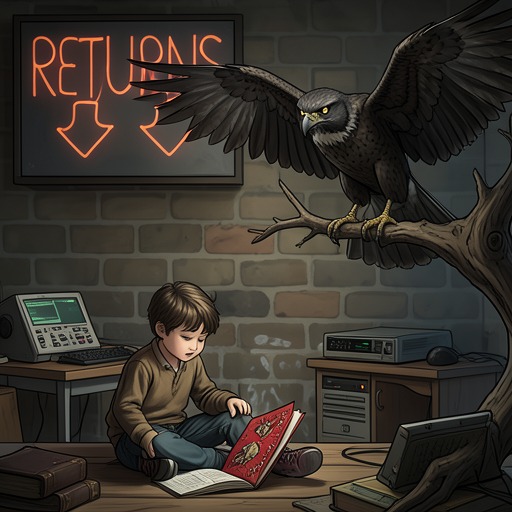
For Macdonald, the connection begins before she can fully understand it. As a child, she read The Goshawk (book), and years later the volume remained on the second shelf by her desk: a red cloth cover, a spine marked in silver letters, its surface stained and worn. When she began training a goshawk, her attention repeatedly avoided the book. The avoidance grew into an inability to work at her desk without being conscious of it, although she could not initially explain why. Eventually she took the book down and opened it. Its first chapter carried her back to herself at eight years old, making the encounter with White also an encounter with a former version of Macdonald.
That return gives the book a double presence. It is a physical object in the room and a record of an earlier self, one whose childhood response to White’s writing had not disappeared. Macdonald’s adult reading therefore does not replace the child’s reading with a detached verdict. It brings the child’s feelings forward, allowing old admiration, anger, and apprehension to coexist. The book’s persistence becomes a formal sign of the relationship: White’s words have remained available to be reread, but their meaning changes with Macdonald’s experience.
Admiration and disagreement
Macdonald describes The Goshawk (book) as an early work by a young man, written before White became famous. White presented its subject as the effort of a solitary, imperfect thinker to train a bird rather than a human being. On rereading it, Macdonald came to see more than failed or inadequate falconry. She understood how White had made hawk training into a metaphysical contest, giving the encounter between human and animal the gravity of a spiritual struggle. This reading helps explain the book’s literary power without requiring her to approve of its account of the bird.
Her disagreement is specific and consequential. Macdonald is angry that White’s hawk suffered during his attempts to train it, and that his portrayal of falconry as a pitched battle between man and bird helped shape later ideas about goshawks and the practice itself. She rejects the image of hawks as monsters and refuses to treat falconry as warfare. Yet she also recognizes that White’s admissions of ignorance, which she once regarded as foolish, can be understood as brave. The change is not a simple conversion: greater understanding of the book’s achievement sharpens rather than dissolves her objections to its treatment of the hawk.
A conversation across time
White becomes a presence in Macdonald’s own training, even though the relationship is entirely literary and retrospective. The account of Sylvia Townsend Warner visiting White’s house on Alderney supplies an image of his absence made tangible through possessions, among them an unfinished hawk hood in a sewing basket. Macdonald connects this sense of a life persisting through its objects to her own experience: while training her hawk, she felt White was there, not as a literal apparition but as an influence that accompanied her work and dreams. Reading his book had made her wonder what kind of man could bind himself to a hawk he seemed to hate; handling a hawk herself opened a way to see more clearly both the man and the bird in his story.
The comparison is intimate but not identifying. Macdonald recognizes in White a wish to withdraw from human society and an attraction to the wild, while also seeing the danger in that attraction: it can strip away human tenderness and leave a person in a severe solitude. White’s life unsettles her, but his writing also records delight in the independent lives of other creatures and surprise at the world. His response to ordinary natural events—including the birth of a foal—shows the capacity for wonder that Macdonald values in him. Her account thus holds together the unhappy, troubling figure and the attentive observer of nature rather than reducing him to either.
The personal stake
Four months after her father died, Macdonald understood why she had resisted looking at the book. Part of her anger, she realized, came from sensing that her desire to train a hawk was not entirely her own; some part of it belonged to her father. This recognition makes White’s book more than an argument about falconry. It becomes a mirror that exposes a motive Macdonald had not yet fully acknowledged, while her resistance to White’s influence reflects her concern about what inherited or borrowed meanings might do to her own practice.
Macdonald explicitly distinguishes her story from a biography of White, while insisting that he belongs in it because his work was present during her training. Their connection is therefore an ongoing, asymmetrical dialogue: a long-dead writer cannot answer her, but his book gives her a language and an opposing account against which to test her experience. The relation ends not in reconciliation or repudiation, but in a more complicated recognition. Macdonald can condemn the suffering and combative ideas associated with White’s falconry, acknowledge the book’s literary force, and value his wonder at nature—all while discovering that her own wish to train a hawk carries a personal inheritance of its own.